-
Manacor’s Sant Jaume wine and tapas festival
The 2017 edition of this Sant Jaume wine and tapas festival takes place on Saturday, July 22nd.
“Brussels sprout wine, anyone?” Memories of my childhood flashed through my mind when we heard that Manacor was hosting a wine and tapas festival … featuring home-made wines. My dad used to make his own wine, from almost anything he could find on a market fruit and veg stall. His demijohns of murky liquid would sit fermenting in our family home’s warm airing cupboard and, on more than one occasion, the liquid erupted from its glass container all over mum’s freshly laundered linen. Thankfully, I was too young to drink the stuff.
Nothing but the grape
But the home-made wine we tried last weekend was rather good, and made from grapes (what else, here on Mallorca?); not a drop of parsnip or rhubarb wine was to be tasted. The first-ever Wine Festival & Tapas Night took place in Plaza Rector Rubí, between the town’s imposing church and the highly recommended El Palau café, and was part of the town’s annual Sant Jaume festivities.
![IMG_4286[1]](https://eatdrinksleepmallorca.com/wp-content/uploads/2016/07/img_42861.jpg?w=700)
For a ticket costing 5 euros, members of the public could choose two of the excellent tapas on offer for the occasion at El Palau and taste as much wine as they liked, without further charge. The hobby winemakers were stationed at 11 tables in the square outside the café, bottles at the ready. We were pleasantly surprised not just at the quality of the wines, but also the attention and detail that had gone into bottling and labelling wines that are not produced for commercial gain. These bottles of wine would not have looked out of place on the shelves of a wine store or supermarket. Some of the winemakers had come from as far as Alcúdia and Binissalem.
![IMG_4291[1]](https://eatdrinksleepmallorca.com/wp-content/uploads/2016/07/img_42911.jpg?w=700)
Tasty tapas
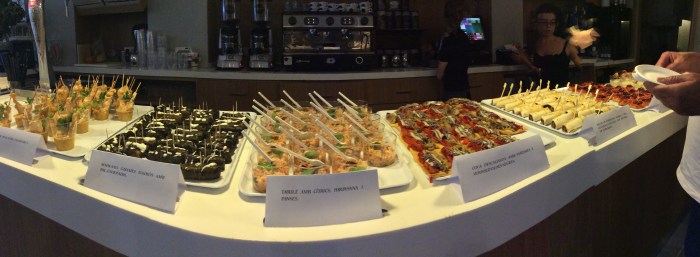
A delicious array of tapas for the event at El Palau Cafe
El Palau café (Manacor’s best, in our opinion) prepared trays of nine varieties of tapas, which were displayed on the counter so that we could make our choice. It was difficult to choose only two and, because they were so tasty, we went back and paid to have some more.
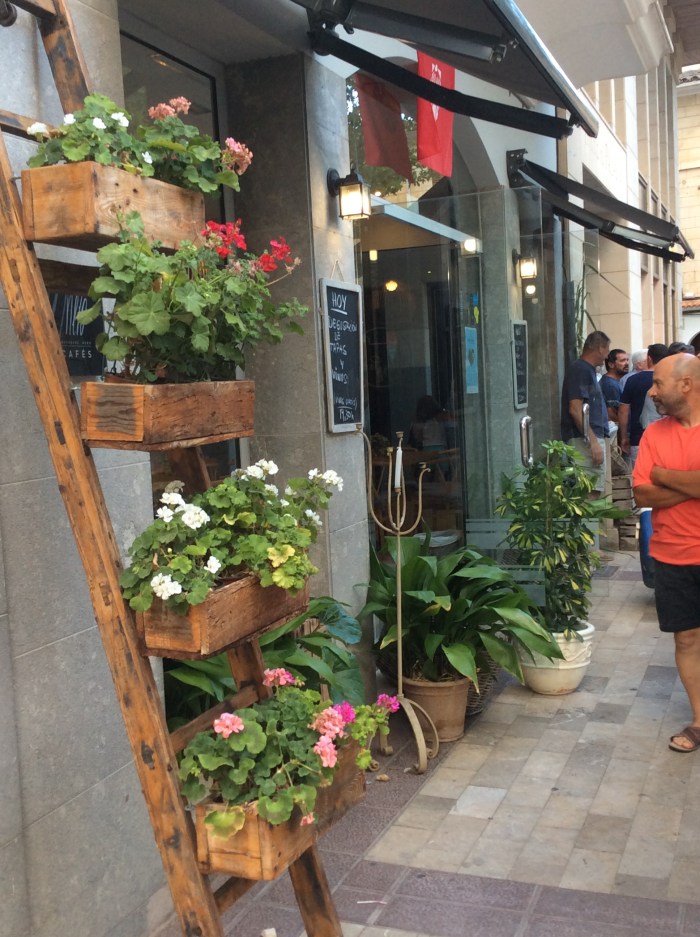
The exterior of El Palau
We thought this inaugural Mostra de Vins Casolans (home-made wine show) was a great success – and are already looking forward to next year’s Sant Jaume festivities in Manacor. I may just invite my Dad over to Mallorca to come too …
Jan Edwards©2016
-
Peccata Minuta: summer gourmet tapas at Mallorca’s Golf de Son Vida
Mallorca’s latest Peccata Minuta gourmet tapas route had all the ingredients of a perfect summer’s evening: delicious food from six top chefs (two from Michelin-starred restaurants), two cocktail connoisseurs, champagne, and a glorious setting.
The fun began when we were ‘limousined’ from the car park area to the Golf de Son Vida clubhouse … on a golf buggy. At the 19th hole, the organizers Chefs(in) checked us in (this event had required advance purchase of tickets), and gave us our ‘passports’ – a booklet of tear-out tickets to exchange for the various dishes and drinks.
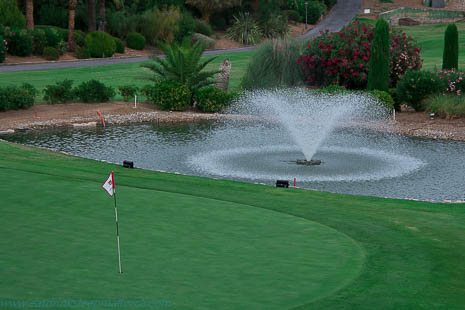
Golf de Son Vida
The eating and drinking began on the huge terrace of the clubhouse, where we gazed out over the golf course and backdrop of the Son Vida hills, dotted with luxurious mansions. As we rarely visit golf courses, the sight of green (rather than brown) grass in the heat of July was quite a novelty …
We started in fine style: a cocktail created by Rafa Martín, owner of the cosmopolitan Palma cocktail bar BrassClub.
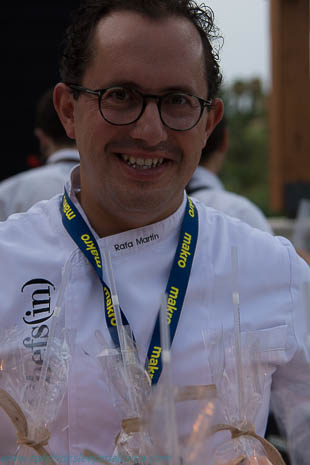
Rafa Martín
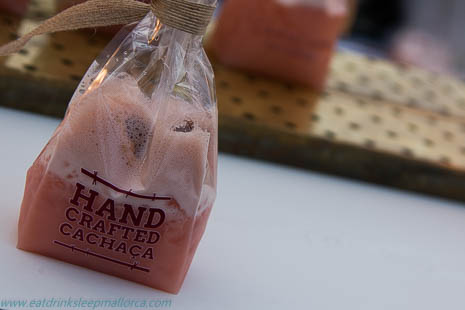
Rafa’s delicious concoction contained strawberries, coconut, lime, and the Brazilian distillation Capucana Cachaça.
Two of the chefs were stationed on the terrace, serving starter-style dishes. First, Juan Portillo of Blau Portopetro Hotel:
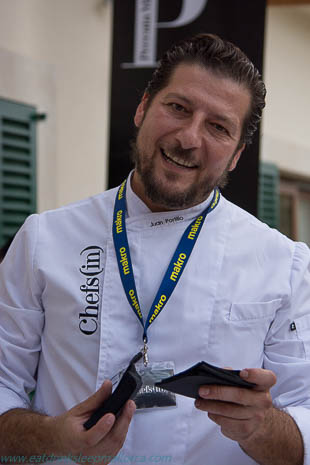
Juan Portillo
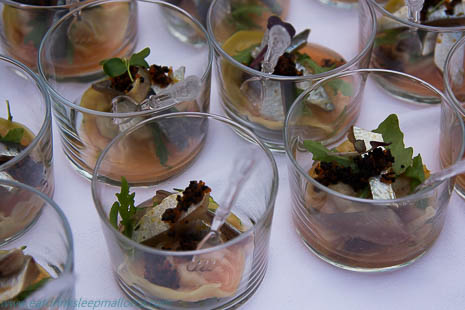
Juan’s cold ravioli of trampó (a refreshing Mallorcan salad of chopped tomato, peppers, and onions) with ‘ramallet’ tomato-water and marinated sardine.
At the other end of the terrace, we found the team from the renowned Manacor restaurant Can March.
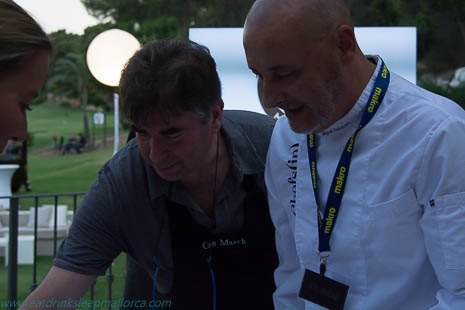
Brothers Tolo (left) and Miquel Gelabert from Can March.
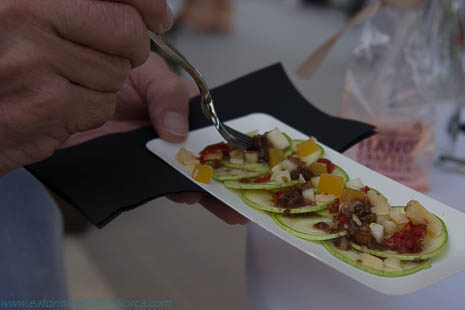
Can March’s carpaccio of courgette with apple, cheese, dried tomato and dried fruits, with DO-designated olive oil from Mallorca; full of flavour – and healthy!
We moved downstairs to the greens, where the other chefs had set up their stalls near the attractive fountain. It was time for a visit to the Vinamica stall, where we handed over two tickets for a couple of flutes of Aubry Brut Rosé. We then visited each food stall for a portion of the dishes prepared by the respective chefs.
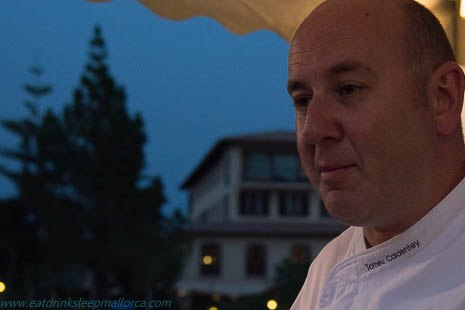
Tomeu Caldentey owns the Michelin-starred Bou in Sa Coma. A must-visit for an amazing dining experience.
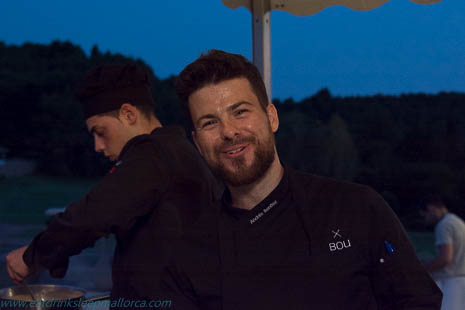
Andrés Benítez from Bou
Tomeu, Andrés and the Bou team produced the Tomeu Caldentey classic dish Cannelloni 2001. I’ve eaten it a few times and always marvel at the depth of flavour in the dish. Highly recommended.
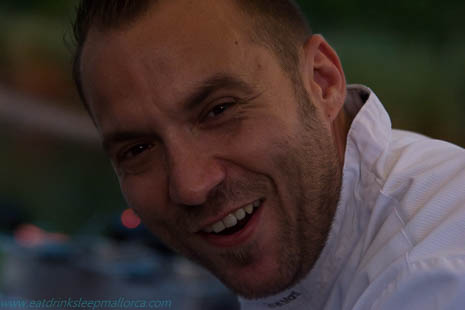
Tomeu Martí from Arume in Palma
Tomeu produced a tender beef cheeks and foie Malaysian curry – rather different to (but every bit as tasty as) the cuisine on offer at his Palma restaurant Arume. Rafa Sánchez of Es Fum offered a fish dish:
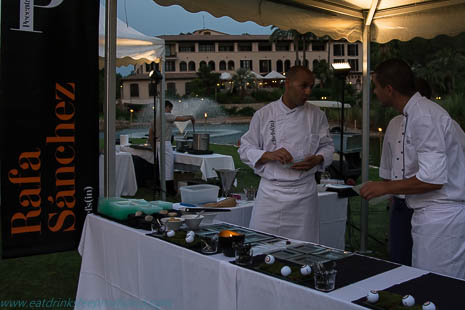
Rafa, left, is from Michelin-starred Es Fum at St Regis Mardavall Mallorca Resort
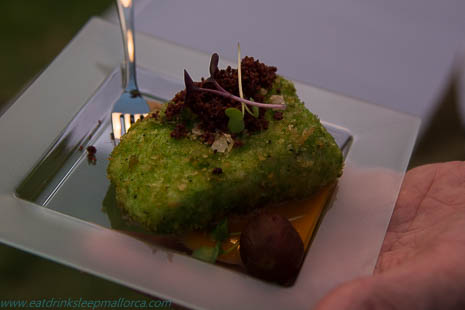
Rafa’s black halibut, tamarillo cream, and pecan nut, with beetroot dust
Silvia Anglada from Es Tast de na Silvia had come over from Menorca to produce the dessert: a warm coca bamba with ice cream made from the Menorcan liqueur ratafia, based on green walnuts and aromatics. She also brought two artisan cheeses from Mahón.
Another cocktail beckoned: a refreshing blend of gin, citrus textures, mint, and ginger, created by Joan Canals.
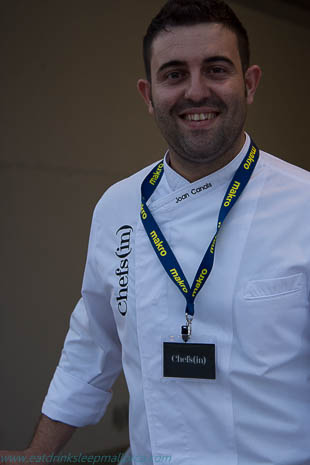
Cocktail maker Joan Canals from Ulisses in Ciutadella, Menorca
The Marabans coffee and tea ‘truck’ is often seen at street food festivals on Mallorca and made an appearance on the course to dispense its popular Marabans Frozen Coffee. I always drink my coffee black and wouldn’t have tried this wonderful concoction ordinarily. It proved to be a revelation and could be the start of a small addiction …
We’ve been to several of these Peccata Minuta events and they are well worth attending if you are on Mallorca (or Menorca) while one is taking place. Check out the Chefs(in) website to keep up to date with these and other events they organize.
Text & images ©Jan Edwards 2016
Arume, Blau Portopetro Hotel, Brassclub, Can March, Cannelloni 2000, chef Miquel Gelabert, cocktails, Es Fum, Es Tast de na Silva, gastronomy Mallorca, Golf de Son Vida, gourmet tapas route Palma, Joan Canals, Juan Portillo, Mahon cheeses, Manacor, Marabans teas and coffees, Peccata Minuta, Rafa Martin, Rafa Sanchez, Restaurant Bou in Sa Coma, Silvia Anglada, St Regis Mardavall Mallorca Resort, tapas, Tolo Gelabert, Tomeu Caldentey, Tomeu Martí, Ulisses in Ciutadella -
Nice ice, baby: Palma’s best ice-cream places
Back in my days of presenting a programme on BBC local radio, I made a one-night-only appearance in pantomime at the Oxford Playhouse. Dressed in a voluminous fairy-queen-mother-type gown, I had to sing (oh, the poor audience) ‘I scream for ice cream’. The words haunted my dreams for a week or two beforehand, as I set about learning my lines. “Never again will I have to sing that song,” I declared with relief after my brief panto debut.
![IMG_1937[1]](https://eatdrinksleepmallorca.com/wp-content/uploads/2015/09/img_19371.jpg?w=300)
This week, however, I could scream for ice cream. The mercury is rising and what better than an ice cream to provide some relief? If you’re visiting Palma (you surely are, because everyone else seems to be), you’ll find ice cream on sale in plenty of places (look for the queues outside). But for something special – artisan ice cream – these are my favourite purveyors:
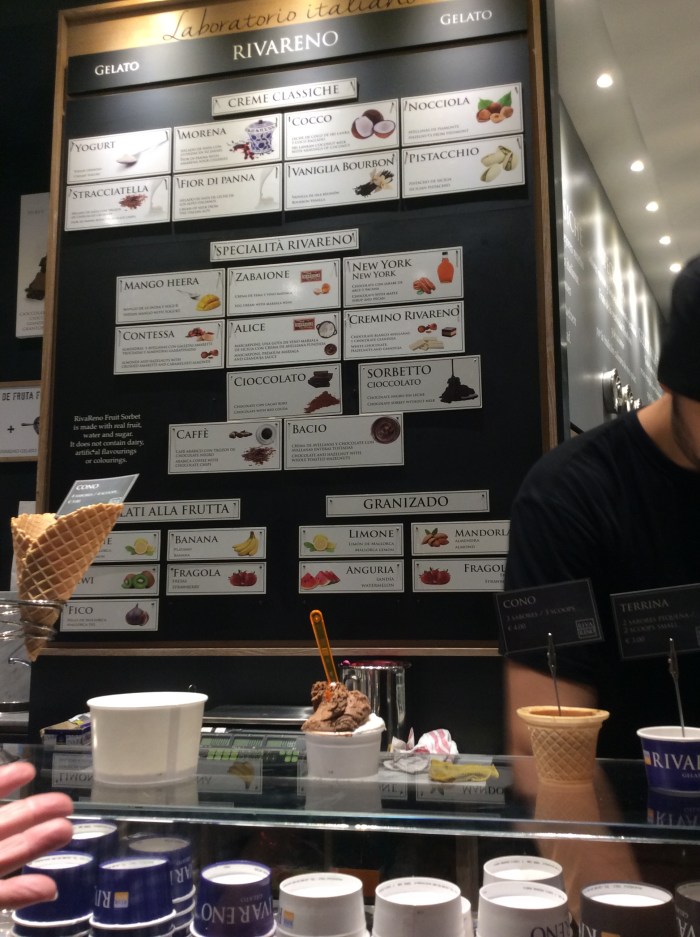
A choice of fabulous flavours.
RivaReno Gelato
RivaReno Gelato is an Italian ice cream place in the La Lonja district, located near the waterfront and opposite the handsome sandstone building known as Sa Llotja. The ice cream is made fresh daily on the premises (in the adjoining laboratory – open to view) and if you’re really naughty, you can have it drizzled with melted chocolate from a special tap. If you don’t want the sunshine to melt your ice cream, perch on one of the stools and eat it on the premises – handy if you decide to indulge in a second round. As if!
Can Miquel Gelateria
Can Miquel Gelateria is a Mallorcan company that’s been satisfying the ice cream demands of the good folks of Palma for more than 30 years, using a traditional base recipe passed down over the years. Their ice cream parlour used to be located in Jaime III but is now tucked away in more contemporary (and larger) premises a few steps away from the original location. On one visit I counted 15 different varieties of chocolate ice cream. It’s very popular among local yummy mummies taking their children for a treat.
Bo Bom Gelato – This Italian-owned business has now relocated to England
This place, owned by an Italian family, opened only in March this year but already has a lot of fans – of whom I am one. Luca Narbona is passionate about his country’s gelato and learnt the artisan craft of making it from one of Italy’s gelato maestros. Find the ‘laboratory’ (where the magic happens) and shop in Palma’s Costa de la Pols (just off the Rambla). You can also find their gelato on sale in Santa Catalina’s indoor market. As well as gelato in cones or paper cups, you can buy in larger quantities to take home. Do check out the gelato patisserie as well. Hard to believe those gorgeous cakes are made from gelato!
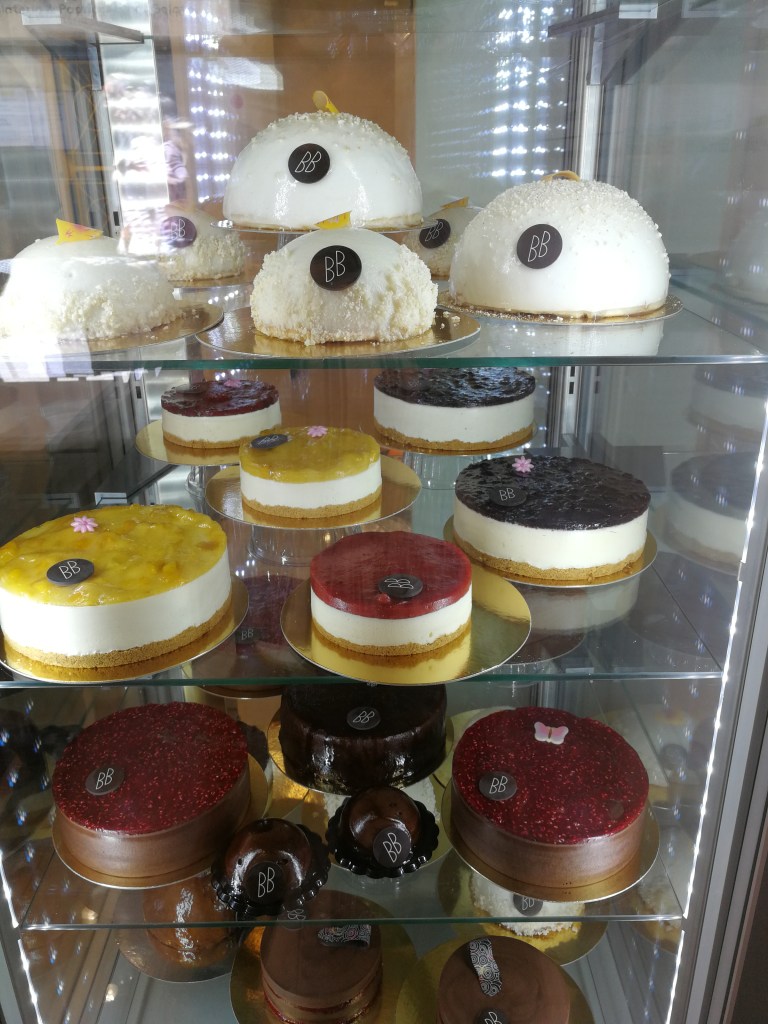
Temptations galore in this cabinet full of gelato patisserie at Bo Bom
Ice Wave
I haven’t yet tried the ice cream at Ice Wave in C/ Sindicat (one of the busy shopping streets of central Palma), but a couple of people have told me it’s good. It’s certainly different: your ice cream is made right in front of you, to order, on a frozen pan – thus keeping the optimum freshness of the fruit and other ingredients. The concept apparently comes from Thailand and one of this business’s founders brought the idea to Spain after spending time over there. Whenever I’ve walked past there’s always been a queue and I’ve always been in a hurry. Another time maybe.
It’s 30 degrees (and rising) in the shade on the terrace at home. If we were in Palma right now we’d probably be thinking about having an artisan ice cream …
Text & images ©Jan Edwards 2016 Updated June 2018 to add Bo Bom.
-
Review: Mallorca vegan/veggie restaurant: Bellaverde, Puerto Pollensa
Yesterday saw the start of Vegan Week in Mallorca and some interesting things are happening in this period (June 27th to July 1st, 2016). Not connected to this in any way is the fact that I am preparing my first vegan lunch for friends this week …
A green oasis in a popular Mallorcan resort
On Sunday we were in Puerto Pollensa for a walk and decided to have lunch at Restaurante Bellaverde, a welcoming place offering vegetarian and vegan cuisine in this north Mallorcan resort. Having read that its owner Svenja Gallé – an instructor at the Vegan Gastronomy Culinary Academy – is hosting a vegan wine tasting and food pairing event (June 30th from 20h-23h at the restaurant) as part of this Vegan Week in Mallorca’s programme of activities, it seemed a good opportunity to share a bit more information about her restaurant.
Come into the garden …
Restaurante Bellaverde is just a few steps away from the seafront but, once you’re through the gates into the tranquil garden, you feel a world away from a popular family resort. Svenja uses a variety of spices and herbs, and cooking techniques to create her delicious (and generously portioned) vegetarian and vegan cuisine, based on organic vegetables.
The setting is relaxing, and on alternate Sunday lunchtimes live handpan music from Jordi Cantos and Sergio Huerta enhances the ambience. We weren’t familiar with this music and it felt like a great discovery, so we bought two CDs of their sounds.
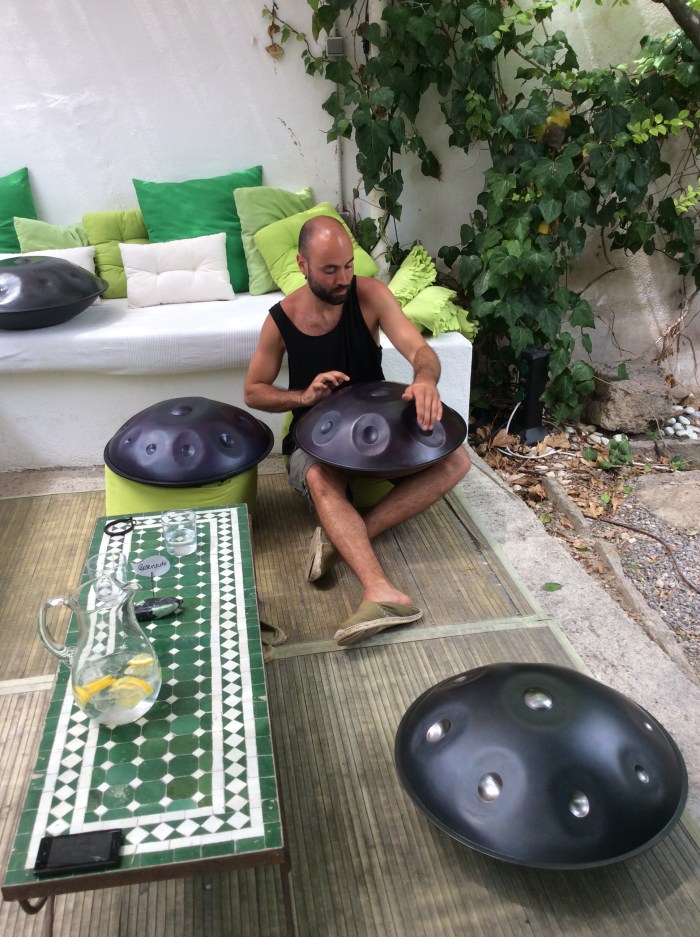
Live – relaxing – music on alternate Sunday lunchtimes
There are lovely shaded areas of the garden where you can sit and relax over a drink or coffee, as well as the tables and chairs for eating. At the heart of the garden is an enormous spreading fig tree, providing shade and the delicate scent of fig leaves. You can also eat indoors in the attractive dining room.
![IMG_4013[1]](https://eatdrinksleepmallorca.com/wp-content/uploads/2016/06/img_40131.jpg?w=700)
![IMG_4020[1]](https://eatdrinksleepmallorca.com/wp-content/uploads/2016/06/img_40201.jpg?w=700)
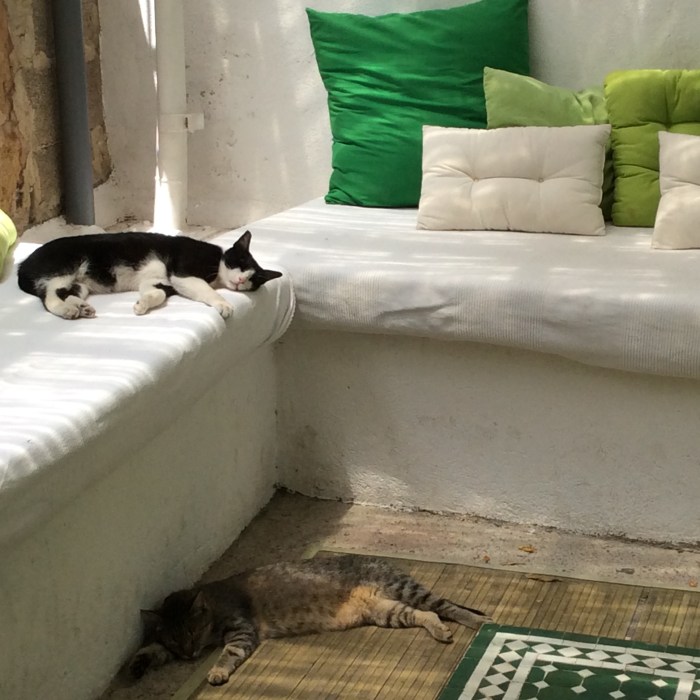
Chilled-out cats in one corner!
Food and drink
We each had a salad and dessert, with a half-litre jug of home-made lemonade (deliciously refreshing on a hot day).
![IMG_4016[1]](https://eatdrinksleepmallorca.com/wp-content/uploads/2016/06/img_40161.jpg?w=700)
A delicious almond dressing was drizzled over this salad with caramelized goat’s cheese
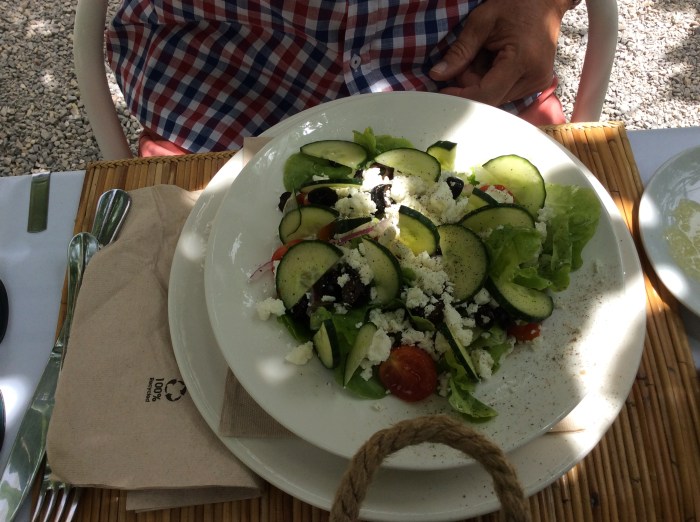
Greek salad
As well as lunch, Bellaverde offers breakfast (it adjoins the Bellaverde Hostal) and dinner; at night the menu includes a few additional main course dishes. We still haven’t been for dinner (it’s about an hour’s drive home for us in season), but we intend to before the summer is out.
Text & images ©Jan Edwards 2016
-
Al fresco lunch at Café Miró in Deià
Our foodie friends recently paid their annual visit to us and, as last year, we enjoyed a week of eating out and sharing some of our favourite restaurants with them. The highlight of the week was undoubtedly lunch at Café Miró, one of the restaurants at the Belmond La Residencia in Deià. It was our friends’ first visit to this iconic 5-star hotel and they loved everything about it (except having to leave the place later that afternoon).
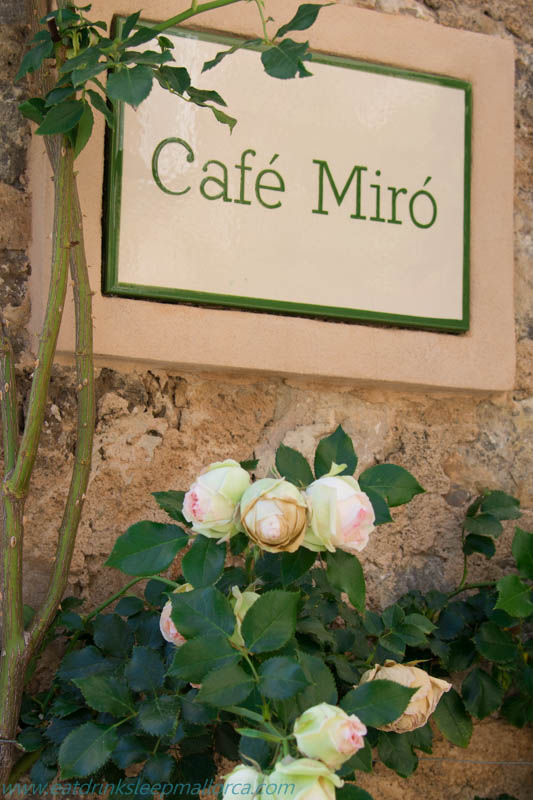
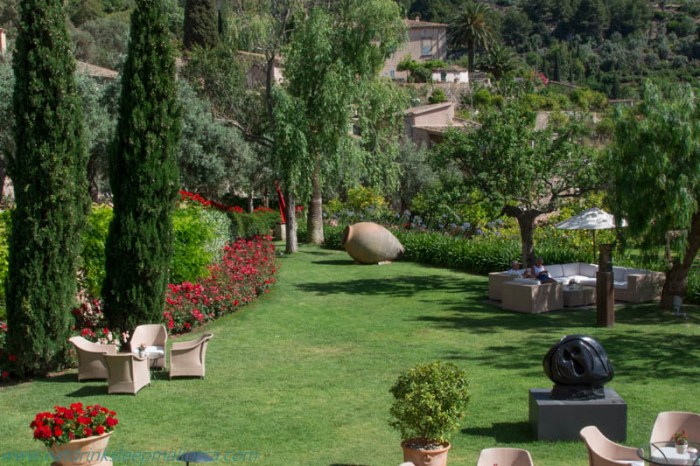
La Residencia sculpture garden
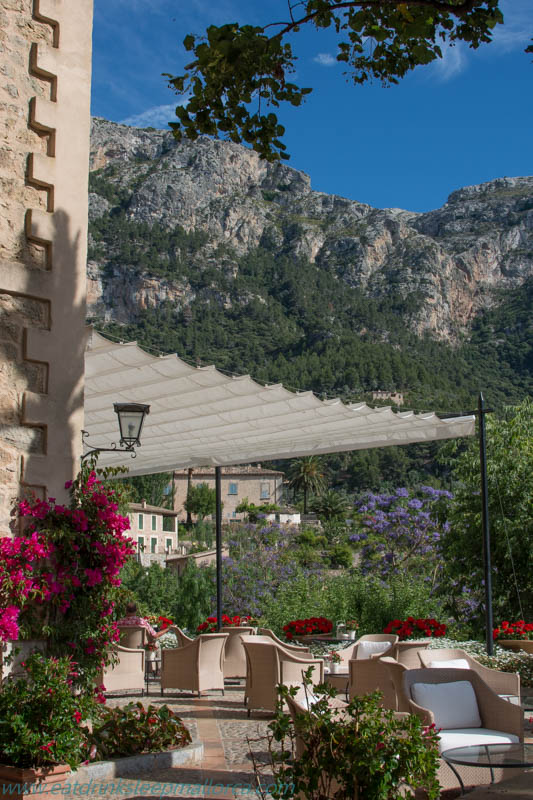
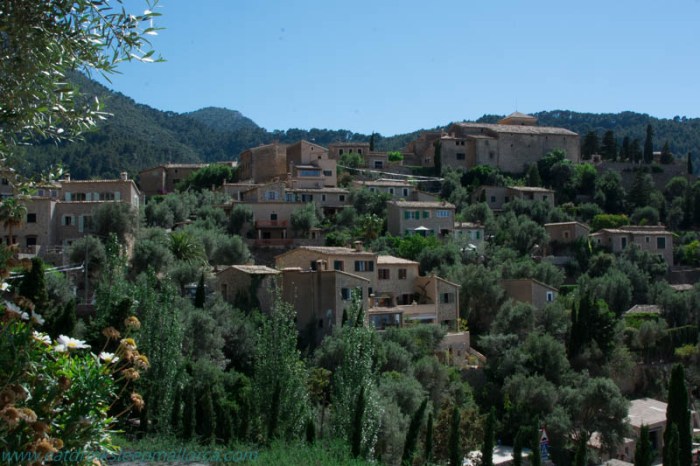
Deià village views
Café Miró’s menu is sectioned into hors d’oeuvres and salads, pasta and rice dishes, tapas, seafood and meats, vegetables and salads (to accompany), and desserts.
Our Café Miró lunch …
Having first checked the latter section and decided that space should definitely be saved for one of the tempting-sounding sweet dishes, the four of us shared a salad of warm goat’s cheese with Mallorcan rosemary-flower honey, and dried fruits (18 euros), to start lunch. It was delicious and a good recommendation for anyone who likes goat’s cheese.
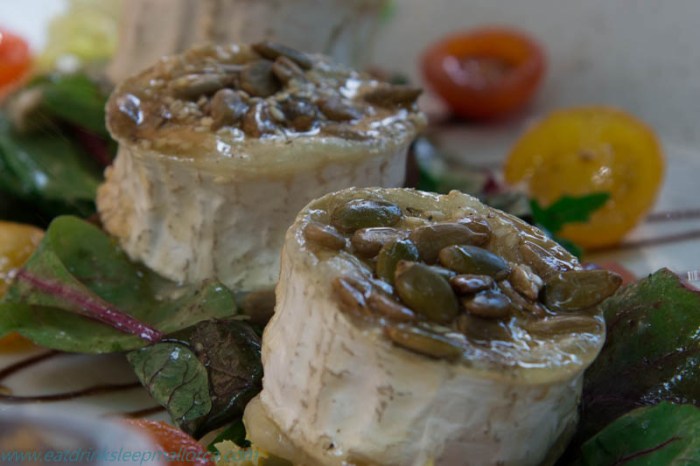
Warm goat’s cheese salad
Our two friends chose the main course of sea bass medallion with fennel salad and La Residencia olive oil (28 euros); The Boss had a grilled sirloin steak with celery puree and seasonal vegetables (29 euros), and I chose grilled Sóller prawns (34 euros). If you’re a seafood fan and come to Mallorca, these delicious prawns are a must-try.
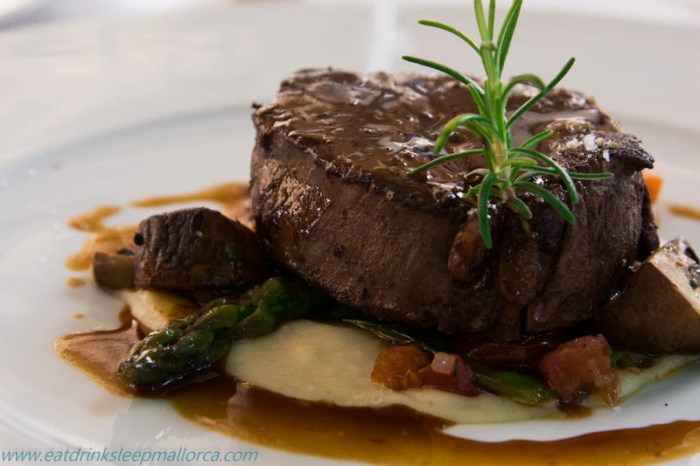
The Boss’s steak – declared succulent and perfectly cooked to his request
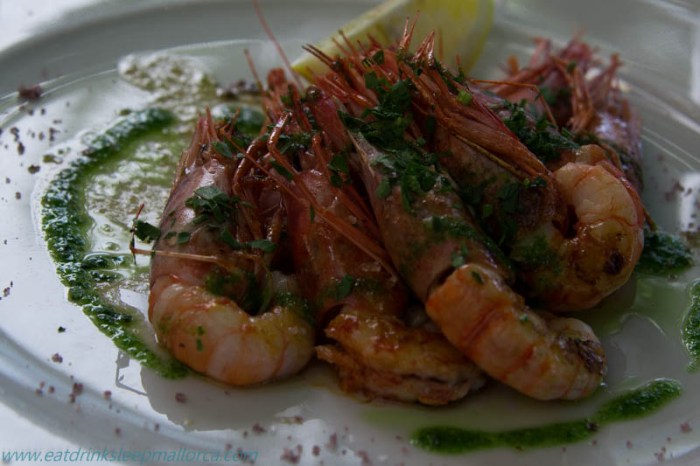
Famous Sóller prawns
After a short pause – during which we relaxed and enjoyed the surrounding views of mountains and the village – we had dessert and coffees. To drink, we had a glass of cava to start, a bottle of Muscat from Miquel Oliver (which has just opened their new contemporary winery just outside Petra), and a complimentary digestif of the hotel’s own moreish (and unusual) limoncello.
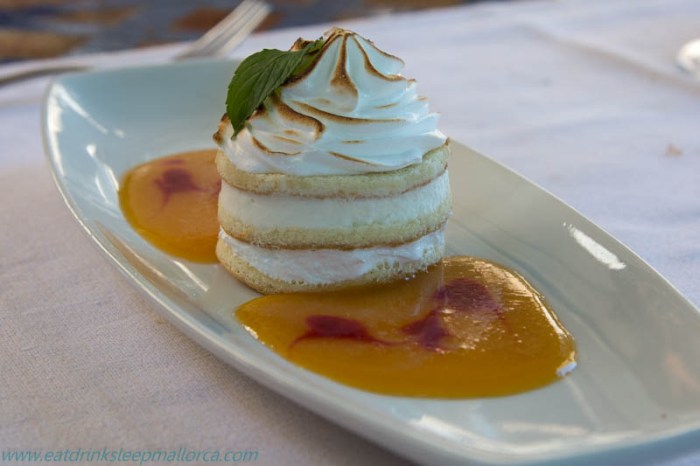
Meringue pastry with apricot sauce
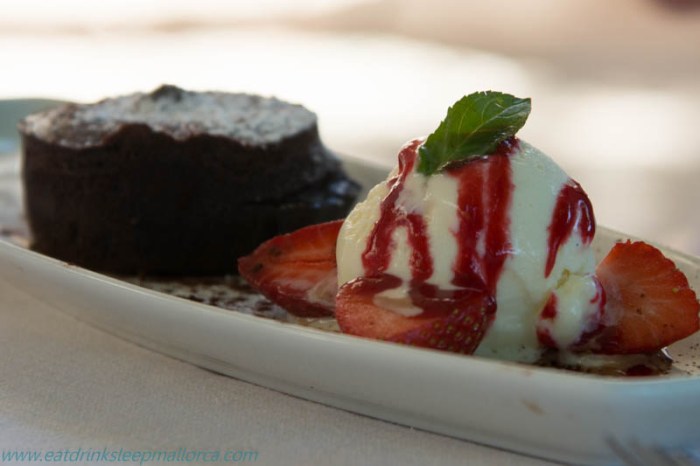
Chocolate fondant with ice cream
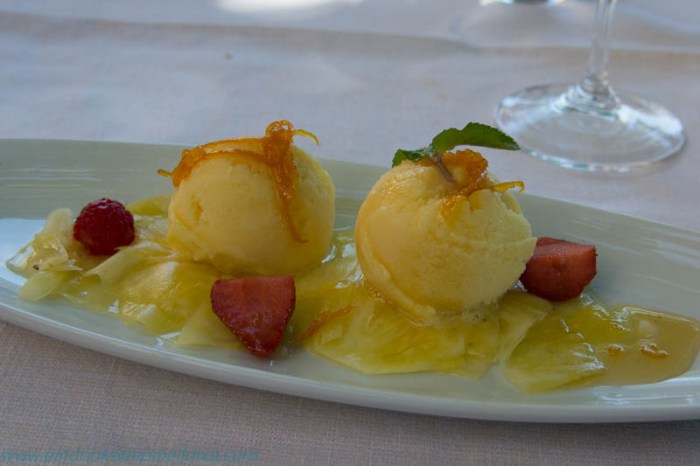
Pineapple carpaccio with passion fruit sorbet – for me, the perfect summer lunch dessert
It was a superb lunch (from a kitchen headed by executive chef Guillermo Méndez), with warm unstuffy service (led by restaurant manager Onofre), in a fabulous setting. At one point our friends declared it was like being in a dream or on a romantic film set.
Belmond La Residencia is a luxurious hotel and the food and beverage prices reflect that. But, if your budget stretches to it, lunch at this renowned hotel perched above the picturesque village of Deià is likely to become one of your lasting memories of summer. It will certainly be for us and our friends …
Jan Edwards© 2016
-
Where chef/restaurateur Marc Fosh eats out on Mallorca
Marc Fosh is a chef I admire greatly, so I was pleased to have the opportunity to write about him for the Spring edition of Insiders Abroad magazine; the article is republished below.
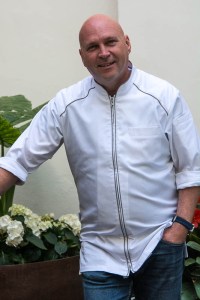
Marc Fosh on the terrace of his restaurant in Palma, Mallorca
Londoner Marc Fosh has achieved something no other British chef in Spain has done – gaining Michelin-star recognition for his cuisine in, not just one, but two restaurants.
This affable softly spoken chef’s extraordinary culinary career began modestly, in the early ‘80s, when he was a self-confessed “working-class kid”. He admits he was drawn to working in a kitchen by the camaraderie of being part of a team, rather than a great passion for food. The latter would soon come.
London’s The Greenhouse and The Chelsea Room (Carlton Tower Hotel) are on his CV, but he moved around to keep learning from different people. Working with Brian Turner, for instance, taught him the importance of coming out of the kitchen to talk to diners.
In the early ‘90s, Marc moved to San Sebastian, to immerse himself in Spain’s gastronomic revolution. There he worked alongside a developing young Spanish chef called Martín Berasategui … now one of the country’s culinary giants.
Island-bound
Next stop was Mallorca, as executive chef in the fine-dining restaurant of a British-owned country house hotel. His unique take on Mediterranean cuisine – based on fresh, high-quality ingredients, and a modern touch – won many fans and, in 2002, the restaurant was first awarded a Michelin star (which it retained while Marc still worked there).
In 2009 he left the star behind to open Simply Fosh, his own restaurant, within the Hotel Convent de la Missió in central Palma. Gone were the foams and fancy flourishes: “In the beginning, a star wasn’t the goal. It was about good food, with everything else stripped back,” he says.
The restaurant soon became a hotspot for local and visiting gourmets, also garnering enthusiastic reviews from food critics visiting Mallorca. The Wall Street Journal, Financial Times, and Condé Nast Traveller have all praised the restaurant and Marc’s cuisine. International recognition led to him becoming a brand ambassador for Braun, and being invited as guest chef to create first- and business-class inflight menus for Lufthansa. His consultancy work has taken him as far as Russia and China, and he was one of 400 of the world’s best chefs featured in the first edition of the compendium Where Chefs Eat (Phaidon).
Several young chefs who have worked in Marc’s kitchens over the years now have their own restaurants on Mallorca. Joan Marc, Andreu Genestra (Michelin-starred), and Adrian Quetglas are all establishments here owned and run by his former protégés: “It makes me feel proud to see these great chefs having their own success,” he says.
Simply Fosh evolved in an organic way and eventually ticked all the boxes for the Michelin inspectors, who awarded one star for 2015 and again for 2016. Last year Marc’s wife Iris joined him at work, as director of service and customer relations.
Re-branding
Marc’s Simply Fosh restaurant in Palma has been re-branded as Marc Fosh and his name will be the cornerstone of future projects. “I’ve been thinking about this for a couple of years, because ‘simply’ doesn’t really apply anymore,” he says. The hotel in which the restaurant is located has also invested in improvements and expansion with a view to attaining a 5-star rating. “So it’s a good time to re-brand and push forward.”
The restaurant is a Palma lunch hotspot and will continue to offer an innovative but affordable set menu. Dinner will be a more refined gastronomic experience, fitting of a starred restaurant. At night there’s a new culinary concept of three tasting menus, ranging from five to seven courses (one of the latter is vegetarian and has been “phenomenally successful”). The menus are based on fresh seasonal produce, and a wine pairing option is available.
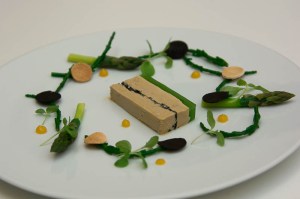
Foie gras terrine with green asparagus, samphire and fresh truffle
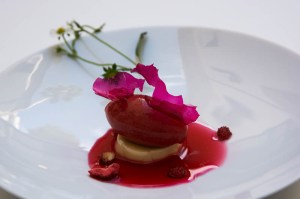
Orange-blossom cream, wild strawberries, toasted strawberry sorbet, with chilled hibiscus and strawberry-leaf infusion
The 5-course menu includes some of Marc’s classic repertoire dishes, such as preserved lemon cream, sweet dukkah, cherry rosewater sorbet, and ras al hanout caramel. Browse the dishes on the 7-course menu degustación and you’ll spot rosehip, samphire, hibiscus, summer savory, burdock, liquorice, black garlic, and aloe vera.
Marc has always looked for interesting ingredients for his cuisine and is often inspired by some of the herbs and spices found in health food stores that are not traditionally used in restaurant kitchens: “It takes you on a little journey,” he says, adding that his passion for highlighting certain ingredients “defines my cuisine.”
I ask Marc if he thinks he could have achieved similar success had he remained in the UK. “Yes, I do. I believe in my ability. Living in the Mediterranean for such a long time it’s bound to have refined my style, but I can see that my food would fit there.”
Thankfully he reveals no plans to leave Mallorca. “We’re lucky we have pretty good produce around us,” he says. Of the challenges of running a restaurant here, the biggest is probably staffing. “We’re in an itinerant trade, in many ways, so building good teams has been fundamental for me.” Marc Fosh’s carefully chosen team has the honour of working for, and learning from, the chef who is still the only Brit in Spain creating Michelin-starred cuisine.
-o-
Jan Edwards©2016
-
A visit to Mallorca’s Son Campaner winery
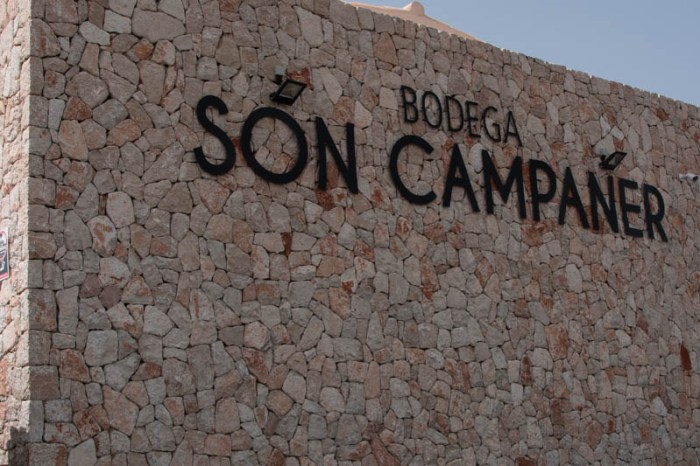
Mallorca’s wines – particularly the reds – are often a little hefty in their alcohol content. Delicious they may be, but there are times when a lighter wine is called for, such as the hotter months of summer, for lunchtime drinking, or when you’re trying to negotiate your way around a yacht out at sea. Some friends who own a yacht-charter business were looking for lighter wines to offer with lunch to their clients, and invited us to join them on a visit to the winery Son Campaner, near Sencelles. The bodega produces wines in the category Vi de la terra Mallorca and has become known for their lighter wines.
A German-owned and run Mallorcan bodega
The land surrounding the modern stone-built bodega has been used to grow vines for some time, although the property’s previous owner didn’t make wine himself and used to sell the grapes. When the current German owner bought the property in 2009, it had been his dream to have his own vineyard. It took until 2014 for him to obtain planning permission to build the superb recently opened winery that sits amid the five hectares of vines today and, in the meantime, Son Campaner wines were made in an industrial unit in Binissalem.
In April 2011, owner Ralf Hämmerling appointed Stefan Winterling and Eva Gómez to run the winery. Oenologist Stefan is from a German wine-making family and worked for well-known companies in Germany and California before coming to Mallorca, where’s he worked as a vintner since 2008. He told us he loves making wine and that became obvious the more he talked about his work.
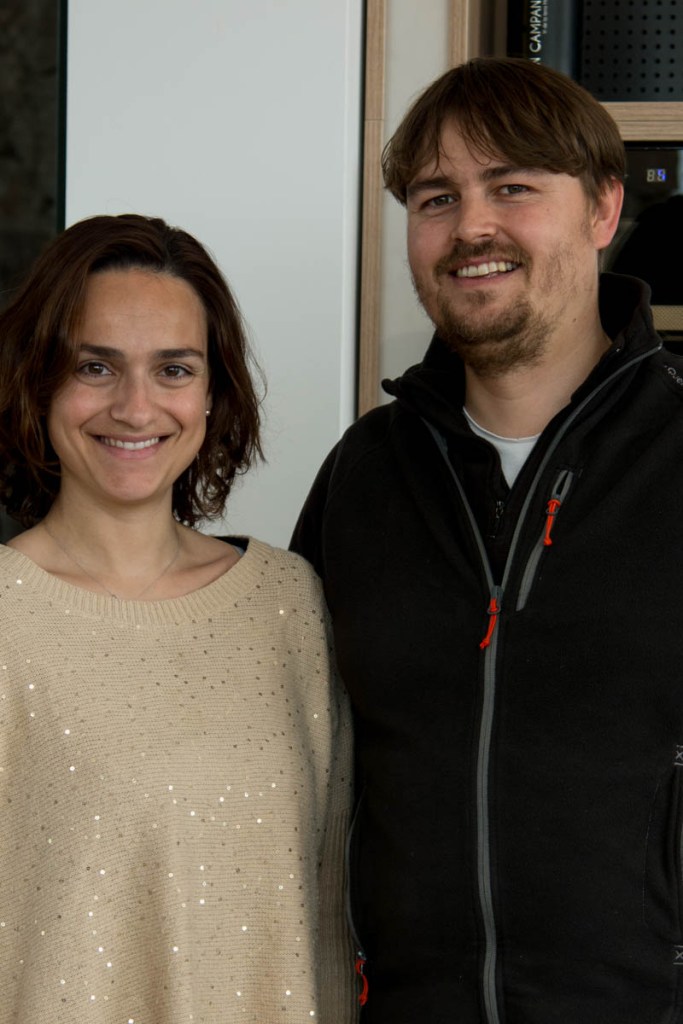
Eva and Stefan
A tour and tastings
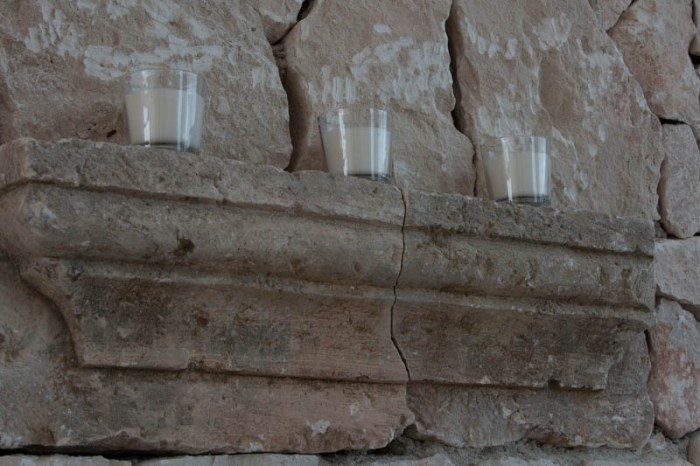
Interior detail in tasting room.
Stefan showed us around the winery, which has a light-filled and contemporary-style room for tastings and events. We sat at a table here, tasting the wines and enjoying views over the vineyards outside. It has been Stefan’s mission to make wines with a lighter alcohol content, and he’s now happy with the whites he’s producing. “The idea is to make subtle, easy-drinking wines that are elegant and more feminine,” he tells us. “To do this we harvest early, which is good for the acidity of the grapes and means the sugar content isn’t so high.”
Whites and a rosé
The three lighter wines (two white, one a pale rosé) are: Pálido (11.5% vol) – which had sold out; Blanc de Blancs (12% vol), and Blanc de Negres (11.5% vol). The latter is a pale rosé made by pressing the grapes with their skins still intact and then processing them as for a white wine; grapes used for this are Syrah, Cabernet Sauvignon, and native variety Manto Negro. Typically, the Mallorcan rosé wines (known as rosados here) that we usually have in our rack at home are anything from 13% to 14.5% vol. Having tasted and liked the wine, we bought a case for those occasions when we want something lighter.

The Blanc de Negre we bought. And a bowl of Mallorcan Quely biscuits (made in Inca) – the essential ingredient of wine tasting events.
Red wines from Son Campaner
Stefan is still working to reduce the alcohol content of the red (tinto) wines. There are two coupages: Terra Rossa and Athos (named after the owner’s German tyre company – but, thankfully, with not a hint of rubber in its taste!). The third red is the single variety Merlot, which happens to be the owner’s favourite grape. “It’s an easy grape to work with, and is popular,” says Stefan. “Red wines should always be served chilled here in the summer,” Stefan reminds us, as he pours wine into our glasses.
Son Campaner wines are sold through three wholesalers on Mallorca and at the bodega itself. Visits to the winery are by appointment only, by phoning +34 618 596 233.
Where to eat in Sencelles
If you’re looking for lunch or dinner near to the bodega, I’d suggest the Sencelles village restaurant Sa Cuina de n’Aina, which has been serving customers since 1995. It’s an appealingly decorated family restaurant and offers Mallorcan and Mediterranean cuisine, with a side order of friendly service. We’d called here without a reservation once before, on a Sunday lunchtime, and found the place completely full.
During the week, they offer a lunch menu of three courses and one drink for 18 euros.
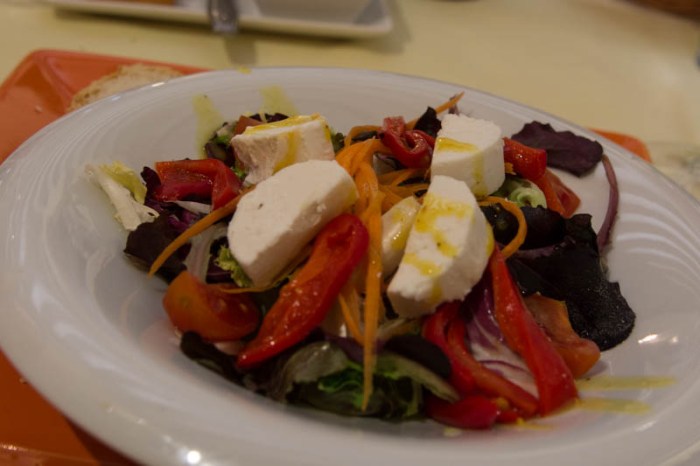
My goat’s cheese salad starter.
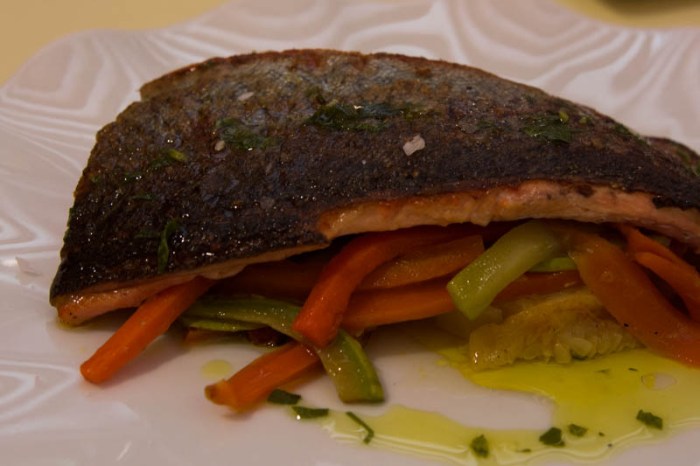
Perfectly cooked fillet of trout with vegetables.
We came here after our visit to Son Campaner and had a very good lunch. Bonus feature for warmer months is the rear garden. Oh, and we managed to park in the street right outside the restaurant entrance.
Jan Edwards©2016
-
Palma hotel review: Hotel Born – a traditional place to stay

The peaceful courtyard of Hotel Born in Palma.
Despite having suggested Palma’s Hotel Born a few years ago to a friend, as a reasonably priced place to stay in Palma, we’d never spent a night there. Fortunately, said friend really liked it. The hotel has been on the must-try list for some time, along with plenty of other hotels on Mallorca I’d like to write about here.
A place to stay when attending Peccata Minuta
The recent Peccata Minuta event in Palma proved the perfect opportunity to put Hotel Born to the test. The tapas event didn’t start until 9pm and there would be wine. Which meant there should be no drinking for whichever one of us was going to drive. Although there’s a reliable, reasonably priced railway service linking Palma with our nearest town, the last train from the capital leaves at 10.15pm. So much for late nights out in Spain!
It made sense to find somewhere to lay our heads for the night so that we could enjoy the whole Peccata Minuta experience. If you missed it yourself, the organisers Chefs(in) made the following video of the event (in which we make a fleeting appearance). Eagle-eyed watchers of The Night Manager on BBC TV may recognise Palau March, the venue, as the exterior of the Istanbul hotel seen in episode four.
Anyway, we booked ourselves a room at Hotel Born for a little over 120 euros for the night, including tax and breakfast. A good price for a stay in the centre of Palma.
Tradition and history
Hotel Born is ideal for those who want a more traditional place to stay in Palma; it’s conveniently located for anyone wanting to be right in the heart of the Mallorcan capital’s shopping centre. It’s a few steps away from the Paseo del Borne and the colonnaded shopping street, Jaime III, but has only a narrow – mainly motor-traffic-free – lane outside its front doors.
The hotel was originally built in the 16th century as a palace for the Marquis of Ferrandell. It still has features such as the large wrought-iron gates and patio, or courtyard, that are typical of the traditional Mallorcan noble properties that can be seen in Palma’s old town.

Part of Hotel Born’s spacious tiled foyer.
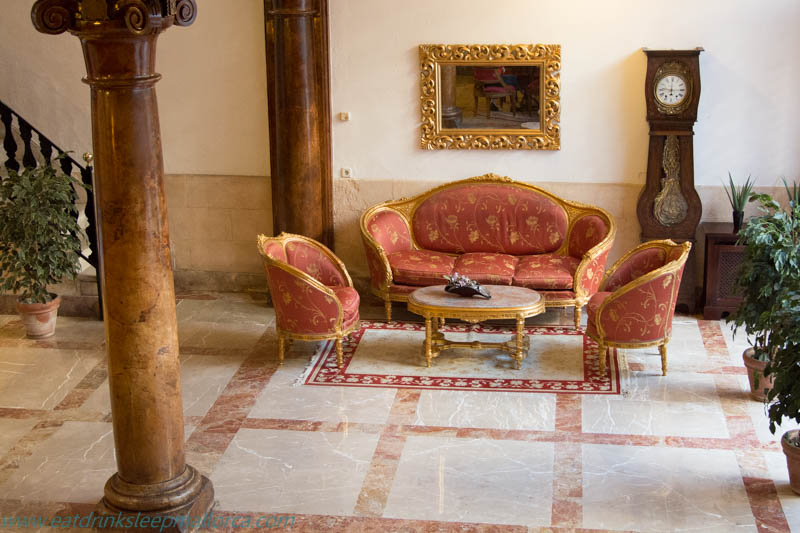
Another area of the foyer of Hotel Born.
The family-owned Hotel Born was completed renovated in 1993, prior to which it had been a hostel. As we were checking out and paying the bill, the receptionist told us that it had originally had 90 simply furnished bedrooms, with one bathroom to every 10 bedrooms. Today it has 30 much more spacious rooms, thankfully all with en suite bathroom.
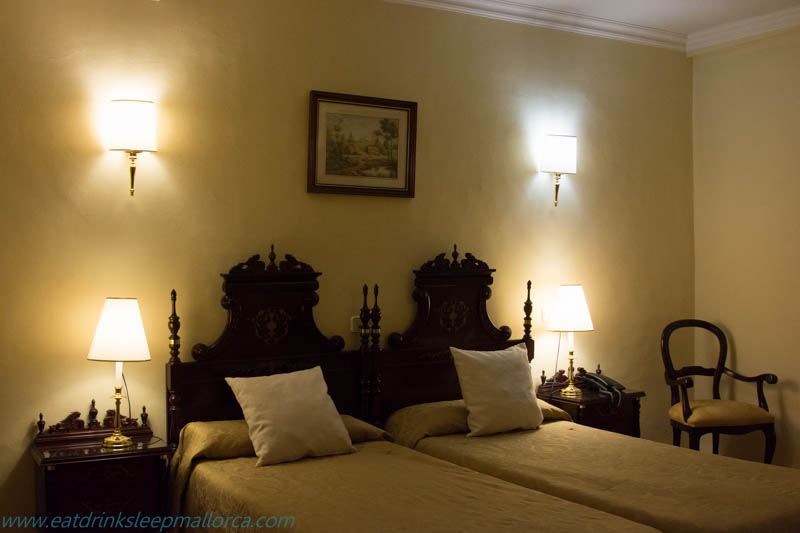
Our room
The style is traditional Mallorcan, with antique-style furnishings. Our room (303) was spotlessly clean, comfortable and neat and, although the bathroom was a bit small and old-fashioned in style, it too was clean and perfectly adequate. The room and bathroom were both comfortably warm (there’s also air conditioning for the summer months). Our room overlooked the courtyard and was very quiet. I’d recommend asking for an inner-facing room if you book to stay here. The free high-speed Wi-Fi worked very well in our room.
The hotel does not have a lift (elevator), so ask for a room on a lower floor if a lot of stairs are a problem. Neither does it have a restaurant, but Palma is full of great places to eat (several in the same little lane as the hotel). If you’d rather eat in, sushi from the nearby Japonice restaurant can be delivered to your room.
The morning after the night before
The breakfast buffet offers a decent enough choice (including Mallorcan offerings) and our coffee was made to order. Supplies at the buffet were regularly replenished. In warmer weather you can enjoy breakfast at a table in the courtyard but, in winter, this isn’t an option. My only tiny gripe was that, even at the end of February, the breakfast room is too small for the number of guests. When we arrived for our breakfast, the room was full and another person was already waiting for a table. Shortly after we were seated (at a table for four), we were joined by a German couple. I always enjoy meeting new people but am not at my most sociable over breakfast!
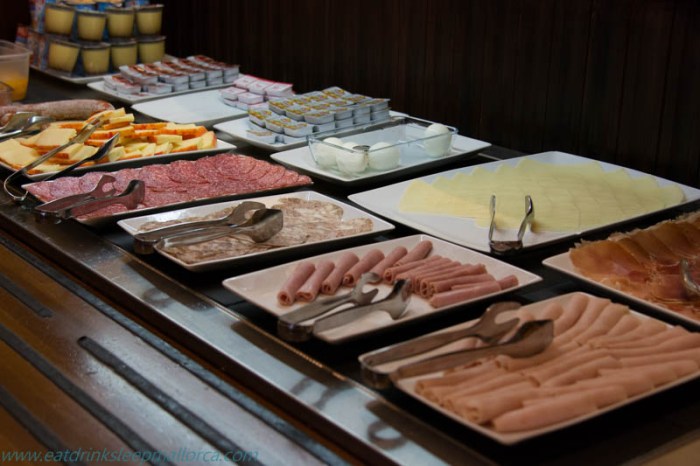
Part of the breakfast buffet
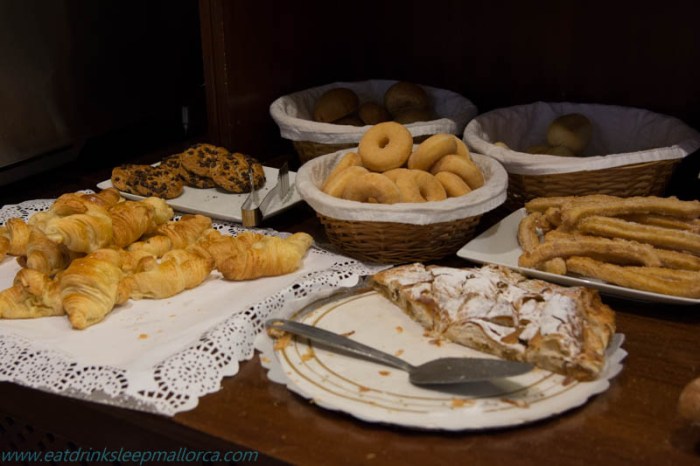
When we were checking out, the receptionist told us that quite a few people from the north of Mallorca stay here after a day’s shopping or a night on the town. Hotel Born is certainly a great affordable option if you want to be in the centre of Palma, and don’t mind sacrificing the fluffy robes, slippers, minibars with designer crisps and chocolates, and other little extras provided in more expensive hotels.
A bonus: we were pleased to be given a small discount because we paid our hotel bill in cash, rather than by card.
©Jan Edwards 2016
-
Mallorca is one of the star locations of ‘The Night Manager’
The current BBC mini-series ‘The Night Manager’ – based on the book by John le Carré – is revealing a side of Mallorca that’s different to the Spanish island’s more usual portrayal in the British tabloid press.
The scenes of Mallorca in the second episode must have been a revelation to those whose perception of the island has been coloured by images of ‘over-refreshed’ and possibly over-sexed holidaymakers, seen in some newspaper reports and voyeuristic reality TV programmes.
Actor Hugh Laurie – who plays Richard Roper – must have seen a great deal of Mallorca during his stay. Not only was he travelling around the various island locations, he also stayed at the 5-star Castillo Hotel Son Vida for the duration of the shooting. Located on the Son Vida hill, a short drive from the heart of Palma, the elevated position of this historical hotel (a renovated 13th-century castle) would have given Hugh panoramic views of Palma and the Bay of Palma. Lucky Hugh.
Puerto Pollensa
‘The Night Manager’ features the spectacular British-owned 17th-century La Fortaleza estate at Puerto Pollensa – playing the island home of bad-boy arms dealer Roper. The fortress was originally built to defend the peninsula on which it sits. The estate covers 232 acres, and has more than 15,000 sq ft of terraces and nearly 12,000 sq ft of gardens.
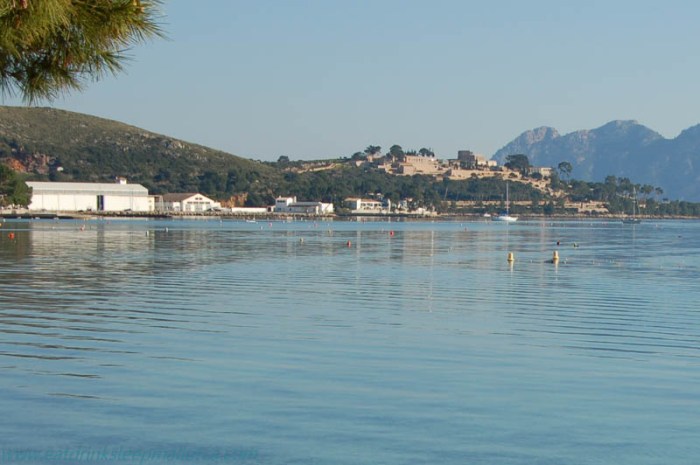
La Fortaleza in the distance from Puerto Pollensa’s Pine Walk.
Argentinian artist Roberto Raumagé bought the property in 1919 and renovated the ruined buildings. The estate was sold by his family to a British owner in the late ’80s. Another British buyer became the owner of La Fortaleza in 2011, for a sum reported to be between 30 and 35 million euros. The estate had originally been put on the market by the real estate agent for 100 million euros.
Cala Deià
The not-easily-reached waterfront restaurant Ca’s Patro March in Cala Deià was the location for the fake attempted kidnap of young Master Roper. Both places are breathtakingly beautiful and I know I’m not the only writer whose blog has come up in searches for ‘Mallorca locations + The Night Manager’!
Sa Drassana
In the fourth episode, when Angela had a meeting in a restaurant in Madrid, the location was the Palma restaurant Sa Drassana. It’s located in the area known as La Lonja, in a square packed with bars and eateries (and close to the President’s office).
Palau March
In the 4th episode, Roper et al checked into a hotel in Istanbul. The exterior of the hotel – seen briefly as the party arrived – was actually the beautiful Palau March in the centre of Palma (close to the Cathedral). It’s a museum – with some notable sculptures – and the home of the March Foundation. Interestingly, Palau March’s courtyard was the location of the last Peccata Minuta tapas event on February 29th.
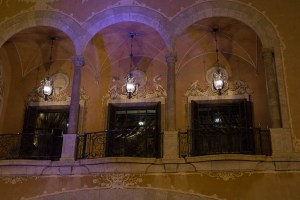
Mallorca not Monaco
Staying at La Fortaleza isn’t possible for we ordinary mortals, but one of the third episode’s Mallorca locations does open its doors to guests. Playing the role of a hotel restaurant in Monaco, the 5-star Hospes Maricel hotel is a beautiful coastal property which I first visited in 2008, after I was commissioned to write an article about it for a glossy interiors and design magazine.
The hotel was used again in the fourth episode screened on March 13th – the one where Jonathan and Jed have a passionate quickie up against a hotel bedroom wall, while Jed’s boyfriend Richard Roper is sitting at night by the pool having a meeting.
The hotel is part of the Hospes group, and located in the area of Cas Català, just southwest of Mallorca’s capital Palma. Barcelona-based company ADD+Arquitectura Xavier Claramunt was responsible for this luxurious property’s interior design and the renovation of a late-1940s-built hotel, with stately 16th-and-17th-century influences.
The place is gorgeous: ultra-chic, light, spacious, airy, and luxurious, with a long sea-facing terrace. Unfortunately we’ve not yet stayed there, although I had a memorable dinner on the restaurant’s terrace a few years ago.
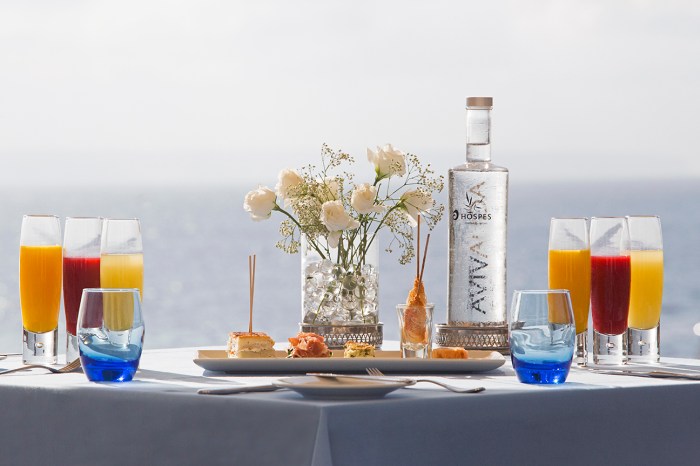
The world’s best breakfast. Photo is the property of Hospes Maricel.
World’s best breakfast
Hospes Maricel is probably best known for its award-winning breakfast – named ‘The best breakfast in the world’ by gastronomy critics at the second Madrid Fusion summit. This three-hour gastronomic adventure in the hotel’s Maricel Restaurant offers an innovative and seemingly endless tasting menu of seasonal dishes, and costs 48€ a head. I’d love to tell you all about it but I’ve yet to try the world’s best breakfast. Had I known that Hugh Laurie was visiting, I’d have been there by now.
UPDATE: In August 2017, this special breakfast will be relaunched. Having tried it in advance, I can recommend it.
You don’t have to stay overnight to breakfast here, but you do need to reserve your place a day in advance (up to 3pm). Even if your name is Richard Roper . . .
Jan Edwards©2016
‘The Night Manager’, 5-star hotels Mallorca, Bay of Palma, BBC TV mini-series, Ca’s Patro March, Cala Deia, Cas Catala, Castillo Hotel Son Vida, Hospes Maricel, Hugh Laurie, John Le Carre, La Fortaleza, Mallorca hotels with panoramic views, Palau March, Palma, Puerto Pollensa, Sa Drassana restaurant, Son Vida, World’s best breakfast -
Presentation of Mallorcan olive oils from the 2015-2016 harvest
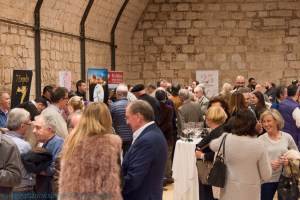
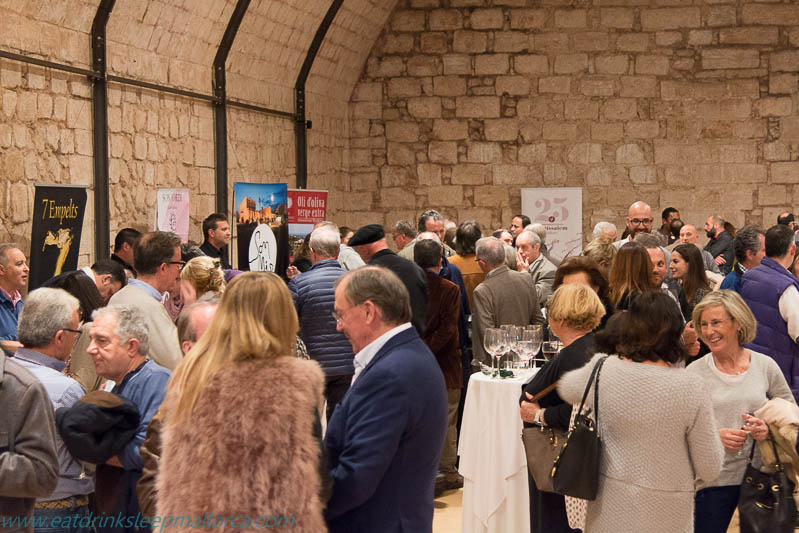
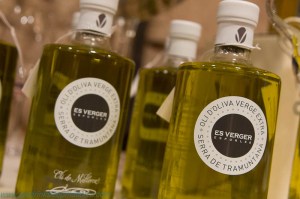
Presentation of the latest olive oils from Mallorca at the Aljub, Es Baluard.
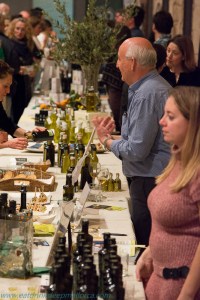
Mallorca offers a huge choice of delicious olive oils from different producers – 23 of which attended a presentation last night of oils produced from the latest harvest. The event took place in the Aljub at Es Baluard Museum of Modern and Contemporary Art in Palma. The Aljub was once an underground water storage facility but is now an attractive and spacious venue for events – and proved ideal for this one, which attracted a lot of visitors (including some well-known chefs on the island).
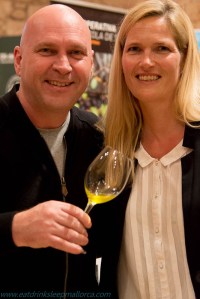
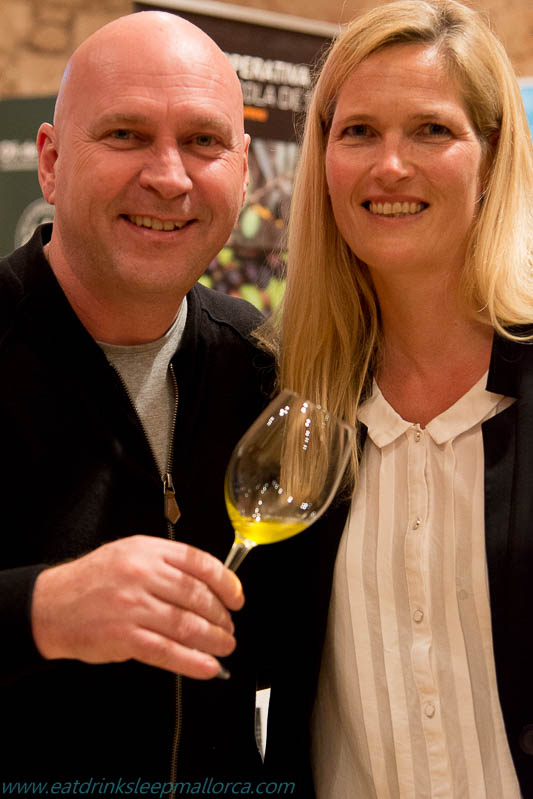
Chef/patron Marc Fosh of Michelin-starred Marc Fosh in Palma, with Iris – his restaurant manager and wife.
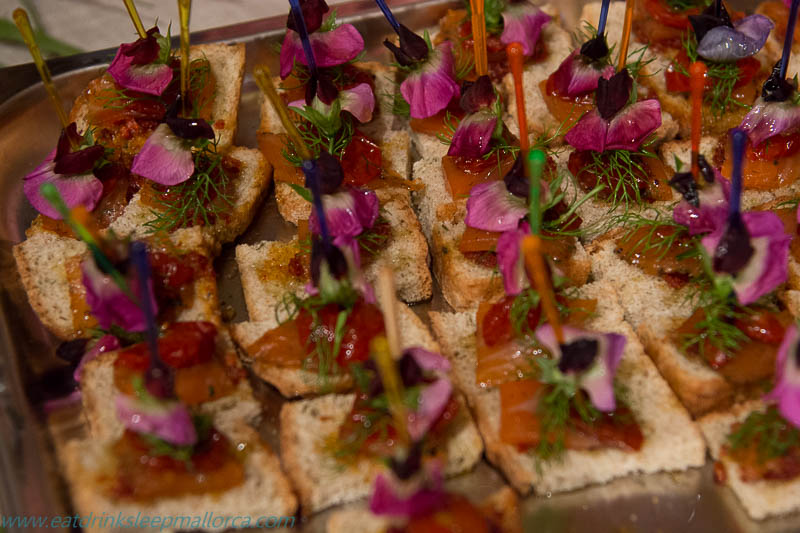
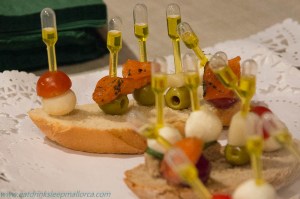
Tables were set up around the walls of the space and each producer set out their wares for visitors to see and try. We were able to taste the oils – and an item of food made from olive oil, which each producer had provided. The tasty morsels ranged from simple bread and oil (and salt, of course) to silky chocolates and desserts. Wine and soft drinks were available for visitors – although, as I was driving, I opted for water (which was also probably better for a spot of serious olive oil tasting).
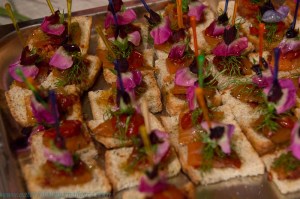
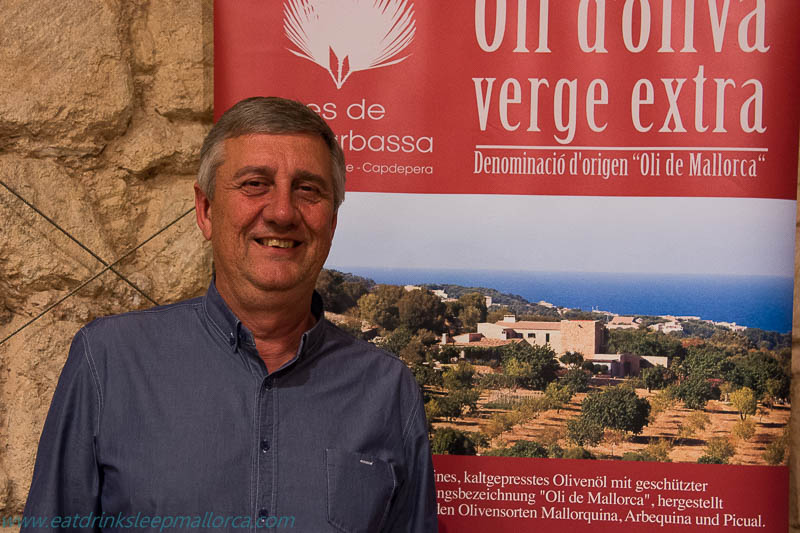
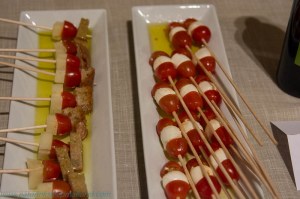
The most colourful culinary creations were those above, from Cases de Son Barbassa in Capdepera,
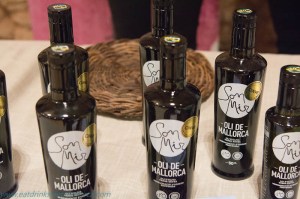
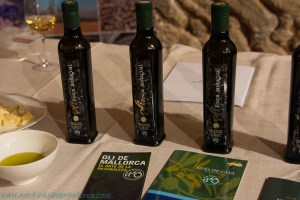
All the featured oils were designated (DO) Oli de Mallorca – a mark of quality introduced on Mallorca in 2002. I didn’t taste them all, but enough passed my lips for me to make kissing The Boss on my return home a slippery encounter!

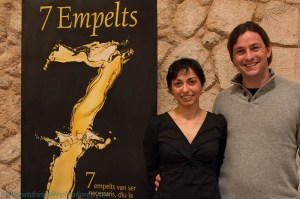
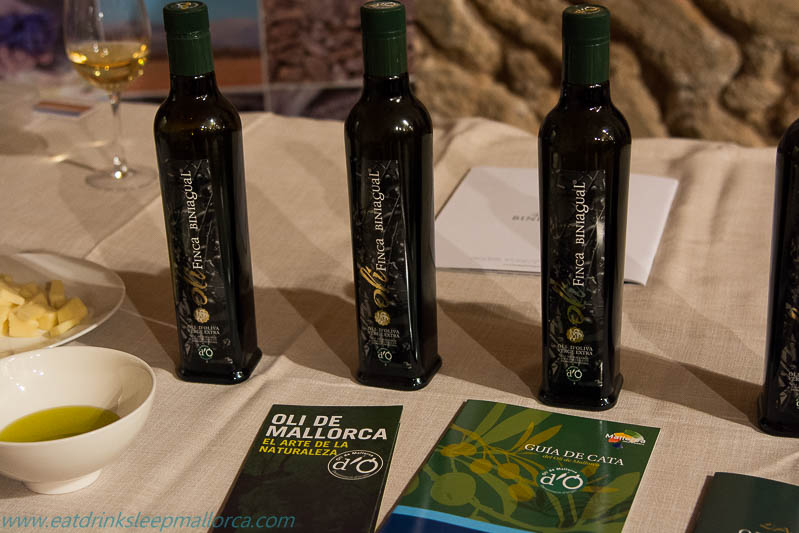
Biniagual is one of several wineries also producing olive oil and, like their wines, it’s very good.
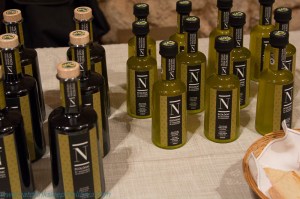
Ecological Oli Novembre, used with the llonguets served at Lorien ale house in Palma.
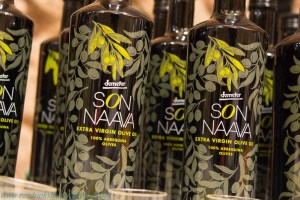
The only Demeter olive oil produced on Mallorca.
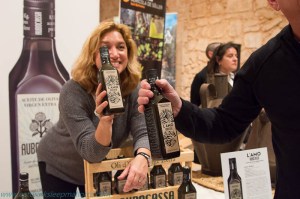
Tiffany Blackman with Aubocassa’s new L’Amo olive oil – presented for the first time, in Madrid this week.
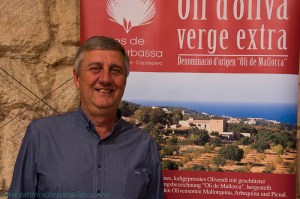
Finca hotel Cases de Son Barbassa also has its own oil.
Olive oil – for health and great taste
With so many luscious and varied oils on offer on Mallorca, it’s hard to believe that when I was a little girl living in the UK, olive oil was usually sold at chemist’s shops, in small bottles for medicinal purposes. My father used to have a measure of olive oil stirred into his daily breakfast porridge for the health benefits…and he’s certainly in great shape as a result.
On this island, and throughout the Mediterranean, the benefits of olive oil have been known for much longer. And having such a great choice of Mallorcan olive oils has been one of the many benefits we enjoy about living here. A peep in my kitchen would usually reveal three or four bottles of different oils on the go. Several friends who have visited for lunch have brought us a bottle of interesting Mallorcan olive oil, instead of a bottle of wine – and what a great gift to bring.
Keep drizzling Mallorca’s liquid gold…you know it’s good for you.
©Jan Edwards 2016
7 Empelts, Aceite Ullaro, Aljub at Es Baluard Palma, Aubocassa olive oil, Biniagual olive oil, Bodega Biniagual, Cases de Son Barbassa, Demeter olive oil Mallorca, Es Verger, L’Amo olive oil, Lorien ale house, Marc Fosh, Michelin-starred Simply Fosh, Oli de Mallorca, Oli Novembre, olive oil from Majorca, Simply Fosh, Son Mir, Son Naava, Spanish olive oils, Ullaro oil