-
Flor de Sal: a Gift from the Mediterranean
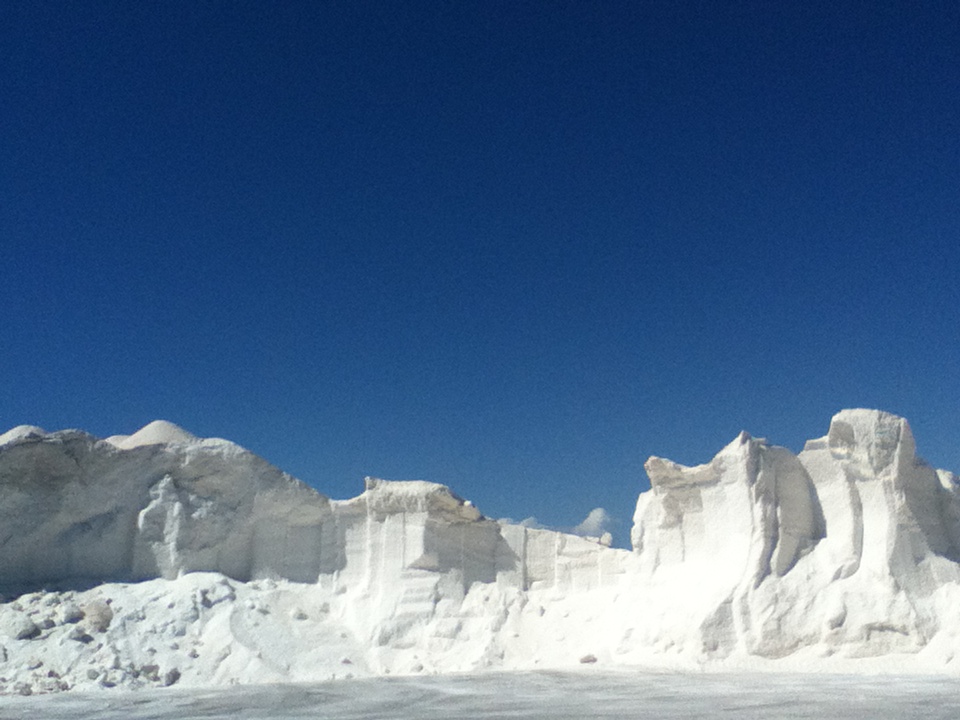
This is an edited version of an article I had published in Food & Wine journal in September 2012 – which included some superb photographs provided by Flor de Sal d’Es Trenc, provided for my one-time use. The photograph below is my own and shows the mountains of sea salt commercially harvested on Mallorca – rather than the hand-harvested flor de sal – to give you an idea of the dazzling stark beauty of this corner of the island. If you visit Mallorca, a visit to this area and to Flor de Sal d’Es Trenc is highly recommended. Sunnies are essential on a bright day!
Not an Alpine scene, but salt mountains in the Ses Salines area of Mallorca.
Type ‘gourmet salt’ into Google and it will find you more than 32 million results. There’s never been such a wide choice of the oldest and most used seasoning – even though we’re constantly being advised to reduce our daily salt intake. One type is particularly prized for its artisanal production and purity, and has been referred to as the caviar of salts. Delicate in flavour and texture, it’s a finishing salt, added by the chef or cook, or at the table.
Flor de Sal
The salt marshes of Guérande in the Loire-Atlantique, south of Brittany, are probably the best-known source of this fleur de sel, which has been harvested by hand from the waters of the Atlantic since the 9th century. Flor de sal (as it’s known locally) is also harvested in Portugal and Spain. On the Spanish mainland, the major source is the Ebro Delta (Tarragona) – home to 970 hectares of salt pans. The Balearic Islands are also important Mediterranean sources: Ibiza was once better known for its salt than for the nightlife with which it’s often associated today. The Romans, Phoenicians, and other ancient cultures harvested sea salt in the southernmost part of sister island Mallorca.
Small Beginnings
Mallorca’s gastronomic reputation owes something to an enterprising Swiss-German woman, who moved to the island in 2002. The previous year, Katja Wöhr had been fascinated by the harvesting of fleur de sel during a visit to France. She came to Mallorca to be the first person to harvest and commercialize flor de sal from the salt marshes behind Es Trenc, the 3.5-kilometre-long white sand beach within an officially protected area that’s home to some 180 species of birds. In 2003, after obtaining the necessary licence, Katja and a friend began to harvest flor de sal manually, using the traditional French rake known as a lousse. Initially, they bagged the crystals and sold them, alongside an honesty box, at the entrance to the salt marshes. Visitors to Es Trenc beach would buy the salt as a souvenir.
Flor de Sal d’es Trenc had the early involvement of Marc Fosh – the first British chef in Spain to have his cuisine recognised with a Michelin star, and owner of the Michelin-starred restaurant Marc Fosh in Palma – was key to the product’s early success.
Flavoured Flor de Sal
“When Katja told me about her intention to produce flor de sal in Mallorca, I thought it was an inspired idea. I’d already been using my own home-made flavoured salts in my kitchen, and suggested producing flavoured flor de sal too,” Marc explains. “We had several different tastings over the following weeks and finally decided on black olive, Mediterranean herbs, and hibiscus, as the first flavours.” Today’s range includes the limited editions produced each year, using local organic ingredients. “There are lots of flavoured salts from all over the world on the market these days,” Mark continues, “but Katja was a real trailblazer and I was extremely happy to play a small part in the success of Flor de Sal d’es Trenc.”
The formation and harvesting of flor de sal
The climatic conditions in this part of Mallorca are perfect for the creation of flor de sal. This part of the island receives only a third of the island’s average rainfall. Summers are long and harvesting can be done from May until October. The delicate salt crystals are formed when there’s an optimal combination of sunshine, wind and low air humidity, allowing a fine layer of crystals to form on the surface of the pools – like a layer of intensely white ice.
Gathering the crystals with a lousse is an artisanal task, requiring sensitivity and patience, because only the upper layer contains all the beneficial minerals that make this product a healthier salt choice. Harvesting is done just before dusk, and the arrival of damper evening air which would destroy the crystals. Today, some 15 people are involved in the process. The flor de sal is put into baskets, made from natural materials, and dried under the sun the next day. Next stop is the workshop, where some is enriched with herbs or spices, and the product is packaged by hand. The plain variety has nothing added or removed, making it a 100 per cent natural product.
A natural product packed with minerals
Flor de sal contains more than 80 minerals and trace elements. Compared to common sea salt, it has double the amount of potassium and calcium, and 16-20 times the quantity of magnesium – the first element to rise to the surface in the crystallization process. Magnesium is also a natural flavour enhancer and, as a result, only a small amount of flor de sal is needed – reducing the intake of sodium chloride. I have several varieties of Flor de Sal d’Es Trenc in my own kitchen and because it’s only necessary to use it sparingly, a 150g pot can last for up to 12 months.
Gourmet essential gone global
Today, Flor de Sal d’Es Trenc is also found in the kitchens of some of the best chefs, and sold around the world in specialist stores. You can also buy it online on the Flor de Sal d’Es Trenc website and at the company’s four shops on Mallorca, including one at the salt marshes.
If you’ve never tried flor de sal or fleur de sel, it’s worth reducing your intake of ordinary salt to make room for this gastronomic gift from the sea.
©Jan Edwards 2013
-
ME Mallorca Hotel Opened in 2014
If you’ve been to London recently you might have seen ME London – Meliá’s smart new hotel (designed by Foster and Partners) on The Strand – on the site of what was once the Gaiety Theatre. It’s on my wish list to visit – if only for the amazing views of London while having a drink at the Roof Bar.
The new ME brand stands for contemporary hotels that are designed (in some style, it must be said) to meet the needs of guests for whom a hotel isn’t just somewhere to eat and spend the night, but a lifestyle choice. As a guest in one of these hotels, you even enjoy the services of what’s called an ‘aura manager’. I would really like to write a ‘day in the working life’ article about one of these aura managers; I’m sure it would be fascinating to know what’s involved . . .
The luxury brand can currently be found in London, Madrid, Dubai, Cancún and Los Cabos in Mexico, and Meliá intends to open more ME hotels in the world’s most important cities and ‘leading tourism destinations’.
From Beach House to ME Mallorca
Mallorca has had its own ME hotel since 2014. It was the result of the redevelopment of the former Beach House (also a Meliá property) in Calvià Beach Resort into the new upmarket brand. The hotel has 206 rooms, 78 ME+ suites (with extras including private check-in, Nintendo Wii, ironing service, and pre-dinner cocktail), exclusive Suite ME, two swimming pools, and Skinc spa.
If you can’t find Calvià Beach Resort on your map of Mallorca it’s probably because it’s the new name for the southern end of Magaluf. With the infamous reputation of the party-hard resort – and its negative impact on Mallorca’s image as a tourism destination – it’s no surprise that this end of the large sandy beach is being reinvented for a different, more affluent type of visitor. Or that Meliá Hotels International – a company which began here on Mallorca in 1956 – is involved.
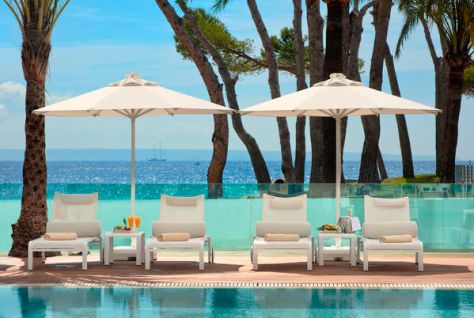
Poolside at the ME Mallorca, from 2014
©Jan Edwards 2013
-
Learning to Make Sushi on Mallorca
I lost my sushi virginity right here on Mallorca, when I went to review Coast by east restaurant for abcMallorca magazine (August 2012). I’d always been slightly nervous about eating raw fish but, sushi being an important part of the food offering at this waterside place in Port Adriano, it had to be tried. Thomas Baar, who was taking the photos, gave me a useful intro to the world of sushi. I tried. I liked. A lot.
Mallorca offers plenty of opportunities to enjoy sushi; even Manacor, our nearest town, now has a couple of sushi places – as yet untried. They’re on the list. So many places; so little time (and money!).
When The Boss and I visit Palma we often go for sushi in one of the two main markets. Our favourite in Mercat Olivar is Yosushi, owned by German chef Thomas Wilden; in Santa Catalina market you’ll find us perched on the high stools (once I can get up onto one!) at the counter of Arume – where we enjoy watching our order being made for us.
Turning Japanese
A day after our last sushi lunch excursion I heard about an imminent sushi-making workshop being offered by Delicioso – a catering and provisioning business in Santa Ponsa, in the southwest of Mallorca – and signed up immediately to take part. I’d already been planning to have a go at making sushi at home and, over the course of several weeks, had been buying the Japanese store cupboard ingredients I’d need.
The four-hour workshop was held last Wednesday and, because there were only three of us participating, was held at the home of Sofia Warsaeus – the Swedish yacht chef who was going to teach us the art of making sushi – rather than in the large pro kitchen at Delicioso. Emily – a yacht chef – and Jade – a budding yacht stewardess – were my fellow ‘students’.
Getting sticky with it
As we sipped Japanese green tea, Sofia briefly talked through the notes that she’d prepared for us to take home, which included recipes for sauces, instructions for making perfect sushi rice, and other useful information. Then it was off to the kitchen to prepare some rice, cut some fish (on this occasion we tackled loin of tuna and a superb piece of salmon), and prepare some vegetables. Sofia knows a lot about sushi preparation and had learnt some useful skills and tips from a master sushi maker, during a month-long stay in Japan. I felt we were getting some good insider information.
Preparation of all the ingredients completed, we learnt how to use a bamboo mat to roll the sushi, and each prepared maki, nigiri, sashimi, inside-out rolls, and rainbow rolls. The workshop was very hands-on and all three of us had plenty of practice at rolling, under the watchful eye of our tutor. On the occasion I forgot to wet my hands in the bowl of water we’d each been given, I ended up with more rice on me than on the nori sheet. I’m sure Sofia will have found bits of sushi rice all over her kitchen after we’d left . . .
What’s Japanese for bon profit?
Once we’d prepared everything, it was time to cut the rolls and present them on platters, with the benefit of some of Sofia’s shared professional presentation tips. With our combined handiwork artistically displayed and decorated, we took our platters to the dining table, where we had a sushi supper together, accompanied by a cup of hot sake.
Last night I put my sushi-making skills to the test at home and I’m pleased to report I got a thumbs-up from The Boss. My rolling skills require some refinement, but I’m sure this will come with more practice. Saturday nights at home could become regular sushi nights at our finca . . .
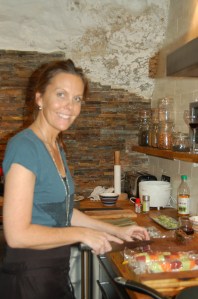
Sofia demonstrates her knife skills
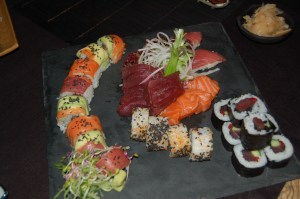
Ready for the table
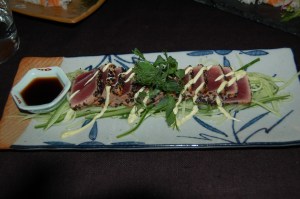
Seared tuna – makes a good starter
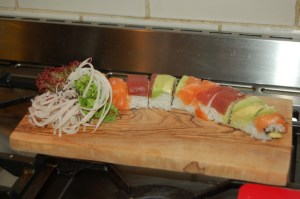
Rainbow rolls
You can also learn the art of sushi-making with other chefs on Mallorca:
If you’re based on Mallorca, offer professional sushi instruction and haven’t been mentioned here, please feel free to add your details to the comments section.
©Jan Edwards 2013
Arume, Asian Inspiration Cooking, bamboo mat, Coast by east, Delicioso, inside-out roll, Japan, Japanese, maki, Manacor, mercat olivar, Nathalie Lapping, nigiri, nori, Palma de Mallorca, Port Adriano, Private Chef Mallorca, rainbow roll, Ross Hutchison, salmon, sashimi, sushi, sushi rice, Thomas Baar, Thomas Wilden, Tuna, yosushi -
Time for Tapas
It was a short break in Seville in 2011 that got me hooked on tapas, although I’d enjoyed these small morsels of deliciousness before then. We spent several nights in the city and didn’t have one sit-down dinner; we enjoyed the relaxed feel of eating our tapas at the bar, ordering more when we felt like it, then heading somewhere else for something different. I like the concept of going from place to place (I kid myself that the little bit of exercise involved in walking between bars helps counter the fact that some tapas are fried and therefore a little heavy on calories).
A tapas route in Manacor
Here on Mallorca, it seems to me that tapas have become more important over the past few years. Our local town, Manacor – like several towns on the island – offers an autumn season tapas trail. Manacor’s is known as ‘Ruta 44’ (there were 44 bars taking part in the first one in 2011) and happens on a Thursday evening.
We tried two bars that we hadn’t visited before and will certainly return to the first. Our four montaditos and two glasses – or more accurately, plastic cups – of tinto cost us just six euros. Not surprisingly, the place was packed. We’ll be back to try some of the others bars’ tapas on a future Thursday. Perhaps we’ll find something that isn’t a montadito!
Gourmet tapas in Inca
This Sunday we’re guaranteed to enjoy some creative tapas: seven of the best chefs from the Inca area are offering something called ‘Peccata Minuta’ – a gourmet tapas event organized by Chefsins, taking place in the Santo Domingo cloister in Inca, from 12:00-16:00hrs. Joan Marc, Tomeu Torrens, Marga Coll, Maria Solivellas, Santi Taura, Cati Pieras and Andreu Genestra will be offering savoury and sweet tapas, created for the occasion. I’m a big fan of Cati Pieras (who, with her partner David, runsDaiCa in Llubí) and am looking forward to her brocheta de pulpo pequeño balear con tocino y vinagreta de piñones con aceite de trufa. I also hope that she’ll bring some of the delicious sourdough bread they serve in the restaurant. Tapas and drinks (artisan beers from Beer Lovers Mallorca and wines from Son Bordils) will cost 2,50 euros each. I’ll be breaking open the piggy bank . . .
Palma’s annual tapas trail
And Palma’s biggest tapas event takes place next week. TaPalma 2013 will have 25 participating bars and restaurants, all offering special tapas for the occasion. You can find out who’s taking part and what they’re offering on www.tapalma.es. This year all venues are offering two special tapas – and an additional one based on Mallorca’s famous Quely biscuit; you’ll be able to vote for your favourite and go into a draw to win some nice prizes: free weekend away in a hotel on Mallorca, anyone?
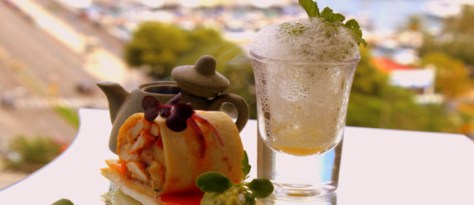
Essencia Art is offering ‘Ali Baba y los 40 sabores’ for TaPalma 2013. Photo courtesy of Associació Restauració de Mallorca
©Jan Edwards
-
Where Does Chef Marc Fosh Eat Out on Mallorca?
If you don’t know the name Marc Fosh, you probably don’t live on Mallorca. He’s still the only British chef in Spain to have been awarded a Michelin star for his cuisine (when he was employed at a country house hotel on the island). He left several years ago to start his own business in Palma.
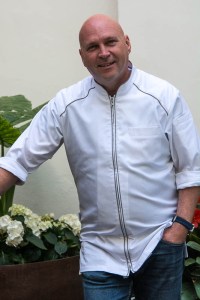
Marc Fosh on the terrace of his restaurant in Palma, Mallorca.
In our early days of living on Mallorca, we stayed several times at Reads Hotel & Spa, where Marc used to create the delicious innovative cuisine that clearly impressed the Michelin Guide inspectors. Being quite a foodie, it’s probably fair to say that Marc’s food, served in what was then called Bacchus restaurant, was the prime reason I liked to stay there.
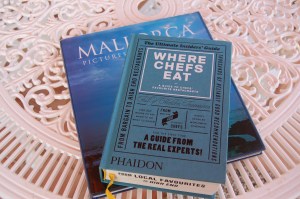
The ultimate restaurant guide
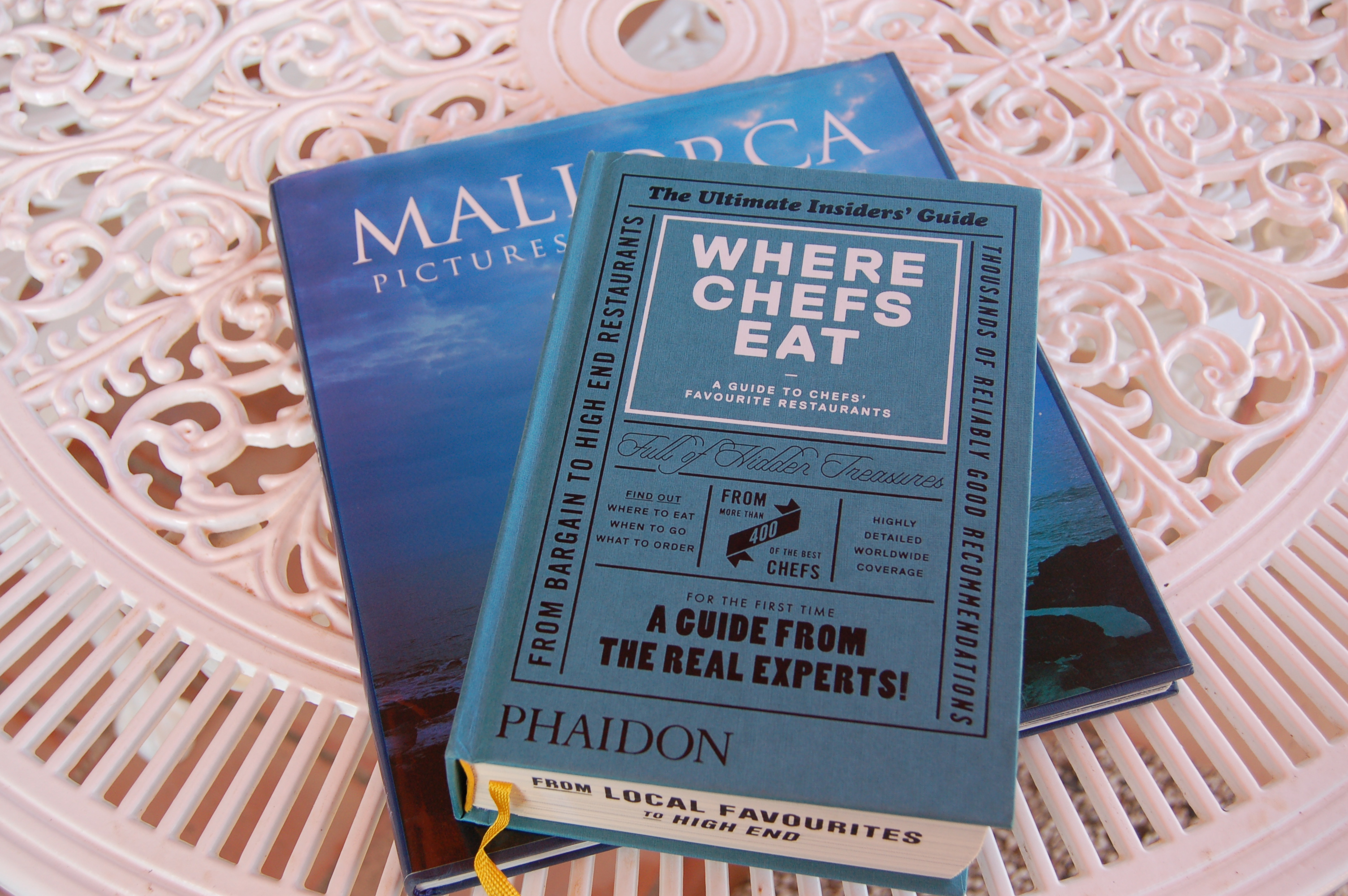
Earlier this year I was delighted to learn that Marc had been chosen as one of more than 400 chefs around the world to be included in a book called Where Chefs Eat, published by Phaidon. I’d ordered the book (directly from the publisher) because it sounded like a very interesting concept and I’d liked their description of it as ‘the ultimate restaurant guide chosen by the real experts: more than 400 of the world’s best chefs from Heston Blumenthal to René Redzepi and David Chang.’ The book was compiled (and what a lot of work it must have been) by Joe Warwick, food writer and co-founder of The World’s Best 50 Restaurants awards.
This wasn’t going to be a particularly useful book for us as we rarely travel off Mallorca: we have an old finca to maintain which gobbles up the money we would probably otherwise spend on travelling.
In fact, the book I ordered did more travelling to reach me than I’ve done for years. It arrived several times in Palma, only to be sent back to the publishers as undeliverable. It also made a couple of visits to Birmingham in England (a city not featured in the guide) on its circuitous journey to me. Long story short, it finally arrived after a series of emails and phone calls – and several months.
So where does Marc Fosh like to eat on Mallorca? According to Where Chefs Eat:
- Ca Na Toneta
- El Bungalow
- Fibonacci (NOW CLOSED 2021 UPDATE)
- Zaranda (with one Michelin star). Note: For 2016 and 2017, Zaranda has had 2 Michelin stars. (NEW LOCATION IN PALMA 2021 UPDATE)
©Jan Edwards 2013