-
The Best Way to Discover Mallorca’s Many Wines
If you want to discover Mallorcan wines, a visit to the Fira del Vi, held in the Cloisters of Santo Domingo in Pollensa, is a must. This annual spring event usually takes place two weeks after Easter, and brings together around half of the island’s 70-or-so bodegas, whose wines are available for tasting by the fair’s visitors – who include wine professionals as well as those who just love drinking the stuff.
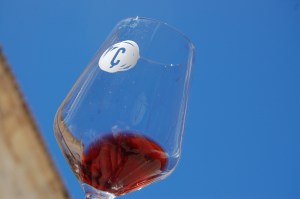
Fine wine and fine weather – what more could we ask?
The Fira del Vi was first held in 2004. We’ve been every year since 2005, always discovering new wines to add to our favourites. This year’s Fira was the weekend of May 3rd/4th. We paid 10 euros each to enter, and could taste as many of the wines as we wanted (using the tasting glass included in the price). This year’s fair attracted 34 bodegas, with some 185 wines available for tasting. Needless to say, we did not taste them all!
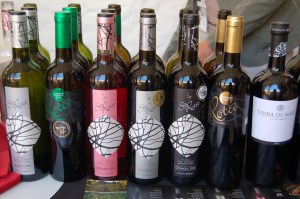
Wines from Sa Rota
It’s a wonderfully sociable event where you’re likely to find yourself chatting to a stranger about a particular wine or bodega, or bumping into friends. Everyone has a love of wine in common. Over the years we’ve got to know quite a few of the people who run the wineries and it’s always good to catch up with their latest news and activities.
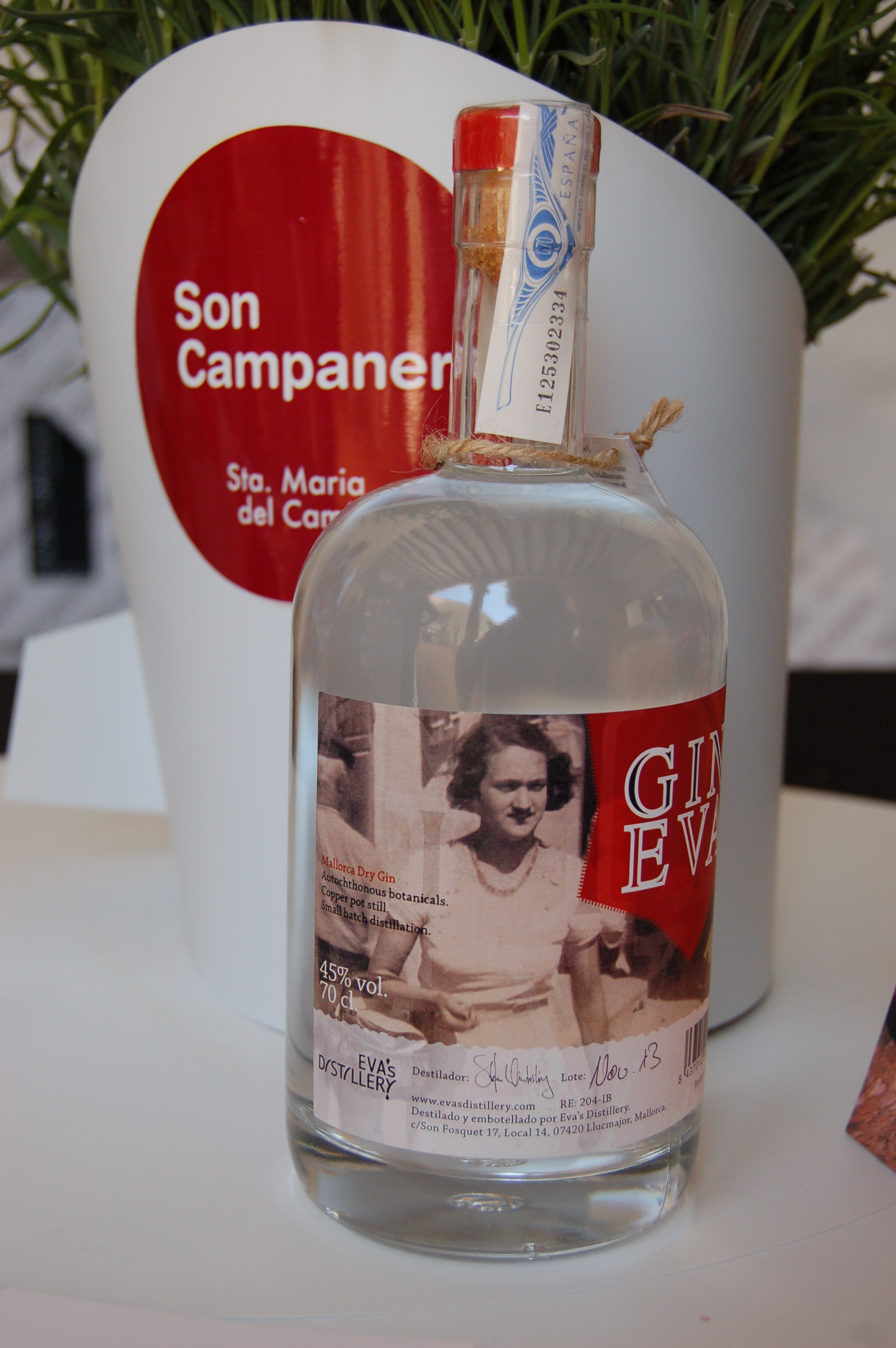
At a previous Fira we discovered Can Vidalet’s Onze – the first gin to be made on Mallorca. We bought a bottle then and it’s been my favourite gin since then. But there’s a new kid on the block: this year, we bought a bottle of Gin Eva (great name) – a new gin produced at a distillery in Llucmajor – made by the two winemakers from Son Campaner, http://www.soncampaner.es, a relatively new German-owned bodega in Binissalem. It’s an artisan London Dry Gin made on Mallorca, with juniper berries from the Es Trenc dunes and more than 20 different botanicals. We haven’t tried it yet, but look forward to doing so, after our livers have had their usual few days to recover after the wine fair!
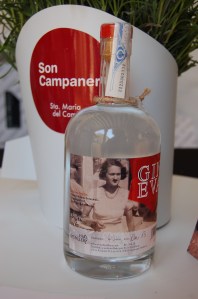
G&T anyone?
Some other news from the Fira:
Fabrice de Suyrot from Bodega Conde de Suyrot (French winemakers based in Colònia de Sant Pere) told us they were going to be opening a new bodega building in the village. Currently, they make wine in the cellar of their home. http://www.condedesuyrot.com
Bodegas Ca’n Vidalet, Pollensa, which produces the Onze gin I enjoy, have added two new products to their range: Cor de Cecili brandy and Marc de Cecili. http://www.canvidalet.com
Son Sureda Ric, near Manacor, is the closest bodega to our home; we’re great fans of their wines. Javier produces only red wines of a high quality (and organic). Finca Son Sureda Ric now opens to visitors every Thursday (from 10:00-14:00h) and it’s well worth going to have a look around. Not only is the winery interesting (and the wines superb), the estate itself has quite a history and there’s a beautifully restored chapel you can visit. www.sonsuredaric.net
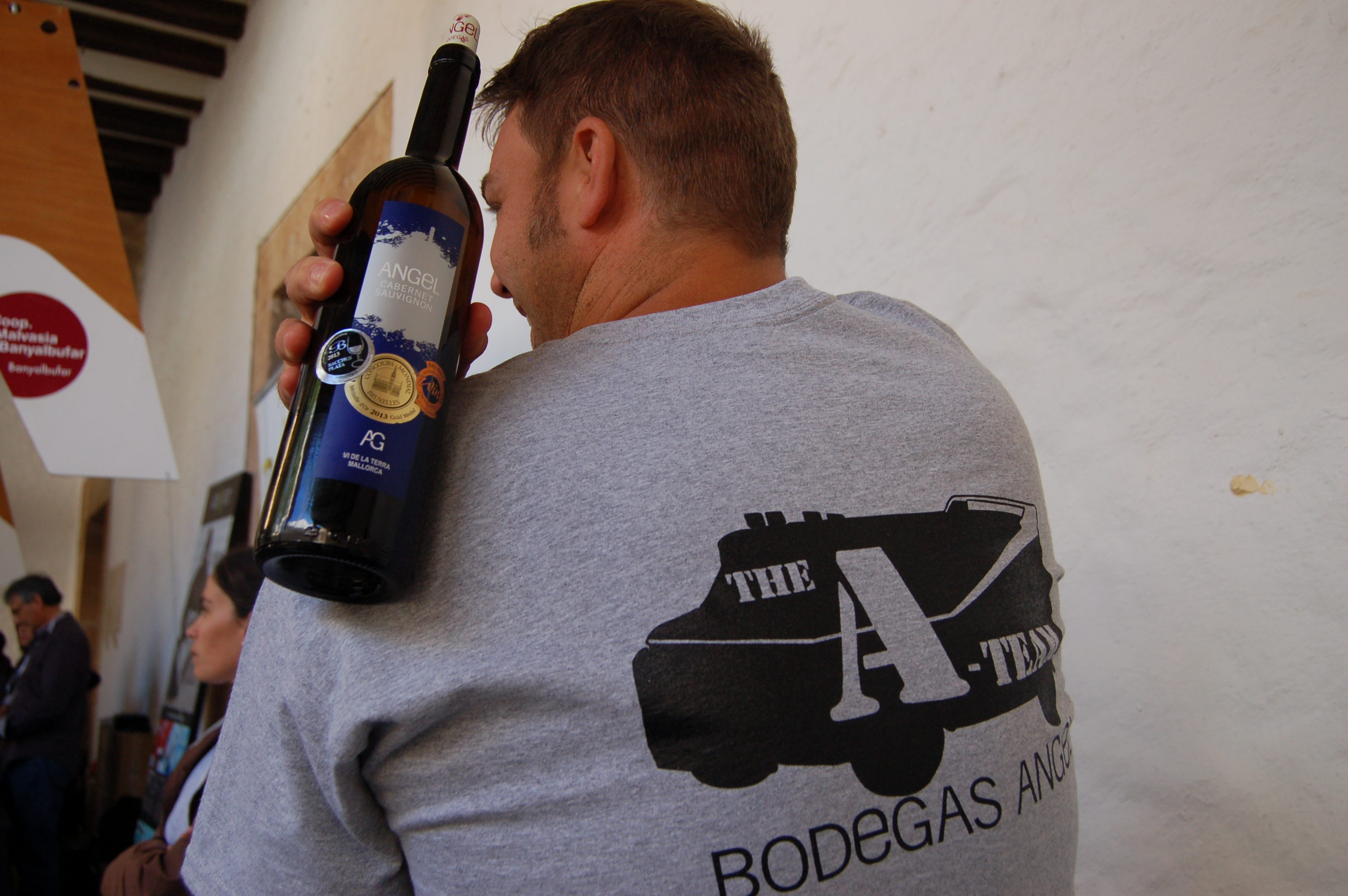
Bodegas Angel, Santa Maria del Camí, is a relatively young bodega offering wines that are deservedly garnering plenty of prizes in wine competitions. Andres is Mallorcan but grew up in California and is a really interesting person to talk to. He is launching a new website in about a month’s time, including an online shop (for certain European countries). http://www.bodegasangel.com
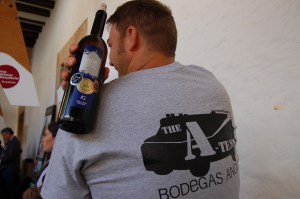
Sporty winemaker Andres from Bodegas Angel
Barbara Mesquida Mora made wine at her family’s bodega, before starting her own eco-winery Celler Mesquida Mora, with her husband, in Porreres. The winery uses biodynamic practices in the production of the vines and Barbara told us that some of the wines are now sulfite-free. She’s passionate about her healthy and more authentic vineyard – and it shows in the quality of her wines. http://www.mesquidamora.com
Once again, the well-organized Fira del Vi was an opportunity to discover more about Mallorca’s fantastic wines. Our fuller-than-usual wine rack is proof of that . . .
©Jan Edwards 2014
Bodega Conde de Suyrot, bodegas, Bodegas Angel, Ca’n Vidalet, Cloisters of Santo Domingo, Colonia de Sant Pere, Cor de Cecili, Fira del Vi, Gin Eva, Llucmajor distillery, Mallorca Voltors American football team, Mallorcan wines, Manacor, Marc de Cecili, Mesquida Mora, Murcia Cobras, Onze gin, Palma de Mallorca, Pati de la Misericordia, Pollensa, Sa Rota, Santa Maria del Cami, Son Campaner, Son Sureda Ric, wineries -
Asian Food Par Excellence in Palma
I don’t make a point of writing general restaurant reviews on this site. If you’re looking for a restaurant on Mallorca you’ll find that the best are featured in Mallorca’s 101 Top Restaurants 2014-2015, just published by abcMallorca.
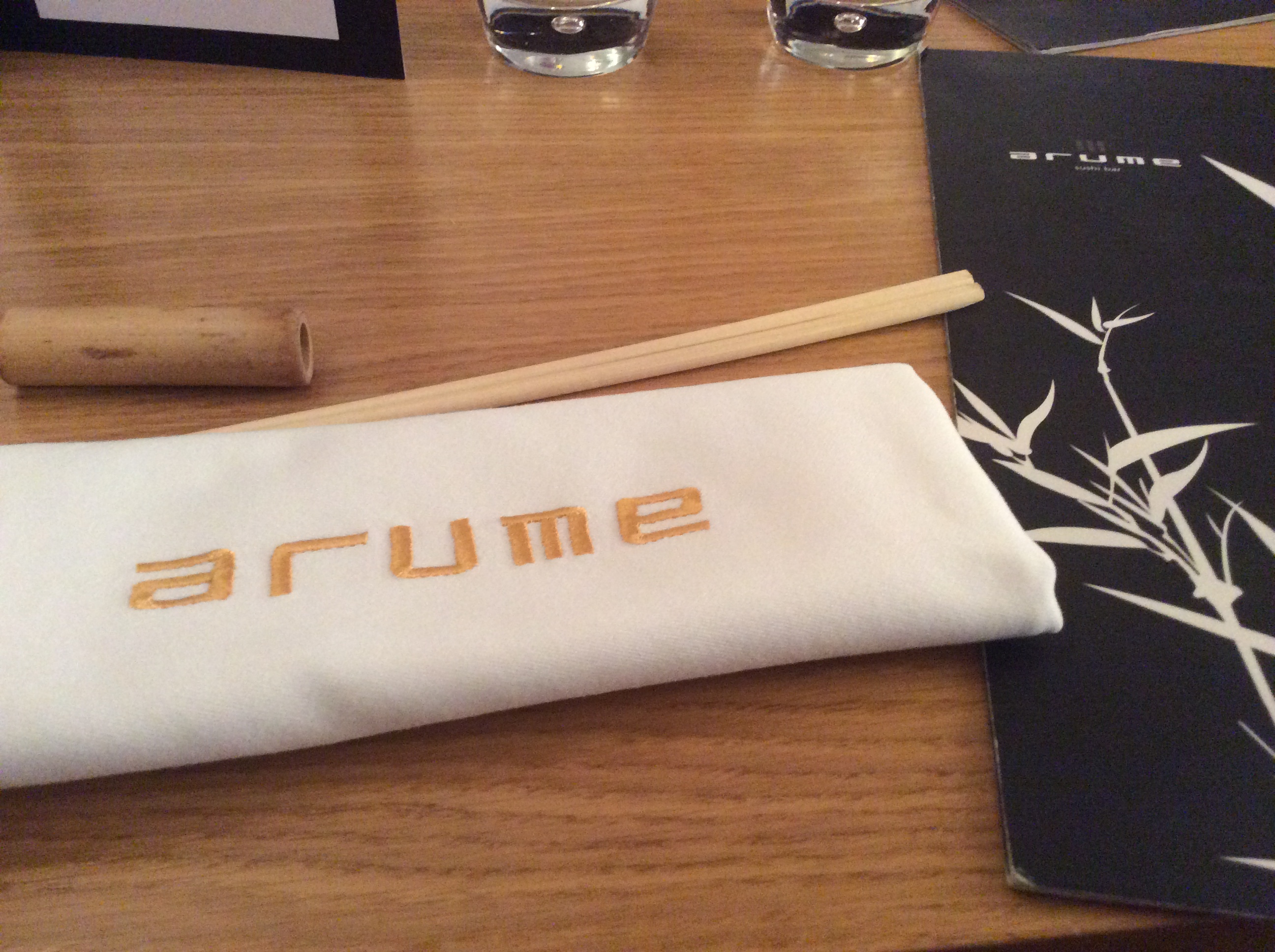
Having said that, we had such a great experience on Friday evening at Arume – a Japanese/fusion restaurant in Palma de Mallorca – that I thought I’d share details with you. (It’s also in the aforementioned guide).
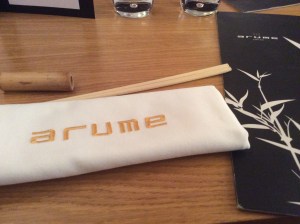
Turning Japanese
After attending an abcGourmet Club wine-tasting and sushi event (wines from Jaume Llabres’s excellent small bodega Son Prim and sushi from Urban Sushi in Palma), we were in the mood for more Asian flavours. We headed to Arume, at Palma’s inner ring-road end of C/San Miguel.
It’s located slightly off the typical tourist route, but if you visit Palma I’d recommend you seek it out if you love Japanese/fusion food.
Arume opens for lunch – serving an executive set menu in the week for 14,50 euros, of three courses, coffee, plus glass of wine or water. It opens for dinner at 8.30pm, which is late by British standards, at least, but it’s worth the wait (and besides, there are plenty of local bars and cafes in the area for a glass of something before dinner).
Two Tasting Menus
We didn’t study the à la carte menu because we saw the magic words: tasting menus. I’m a huge fan of these, as they give you a good introduction to a chef’s repertoire and reward you with lots of different flavours and textures. They’re also useful if, like me, you sometimes find it hard to choose from a menu that offers too many tempting dishes. Arume has two, of which we opted for the smaller Menu Arume, at 30 euros (including VAT). The dishes on both menus change at the start of each month.
Strangely – considering Spain is known for its late nightlife – the last train from Palma to Manacor (our nearest town) leaves at 10.15pm. This presented us – but, more accurately Arume’s kitchen – with a challenge. Could we dine here on this tasting menu and be out within one hour, to catch the last train home? I’m guessing they normally serve their tasting menus at a more relaxed pace, but it’s useful to know that they could speed things up for time-challenged diners like us. We caught our train.
We Ate . . .
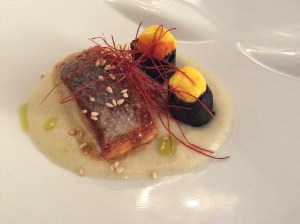
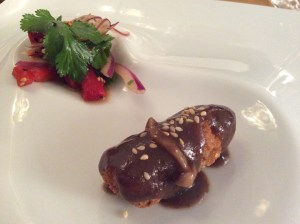
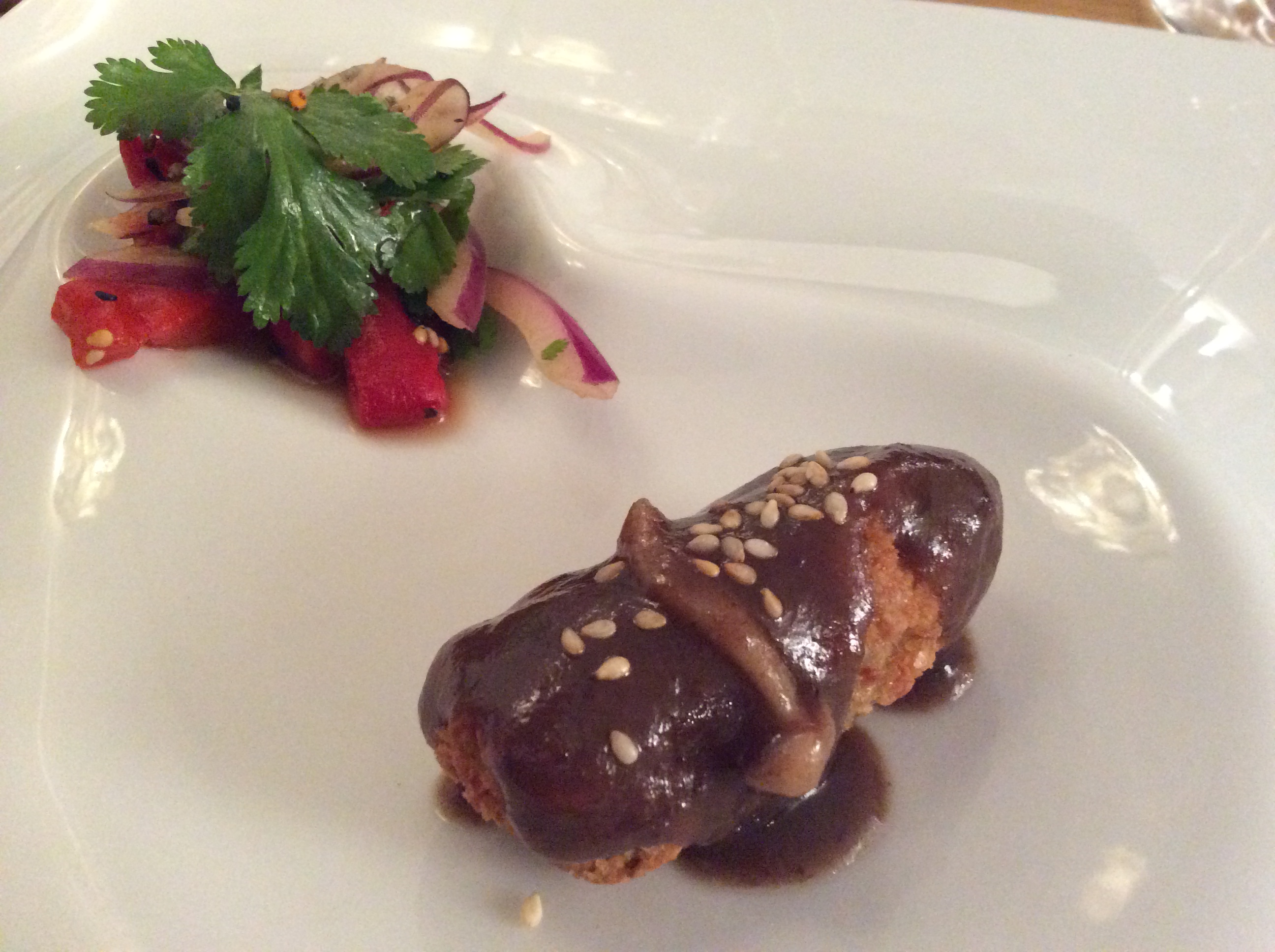
. . . seven delicious and beautifully presented courses, starting with an appetizer of smoked salmon wontons, followed by: a delicious soup based on Mallorcan prawns; Arume’s ‘kebab’ of duck with orange; nigiris of smoked cod and roast tuna; salmon teriyaki, fennel, pears and wasabi; crunchy lamb, and a super-scrummy chocolate dessert incorporating popping candy.
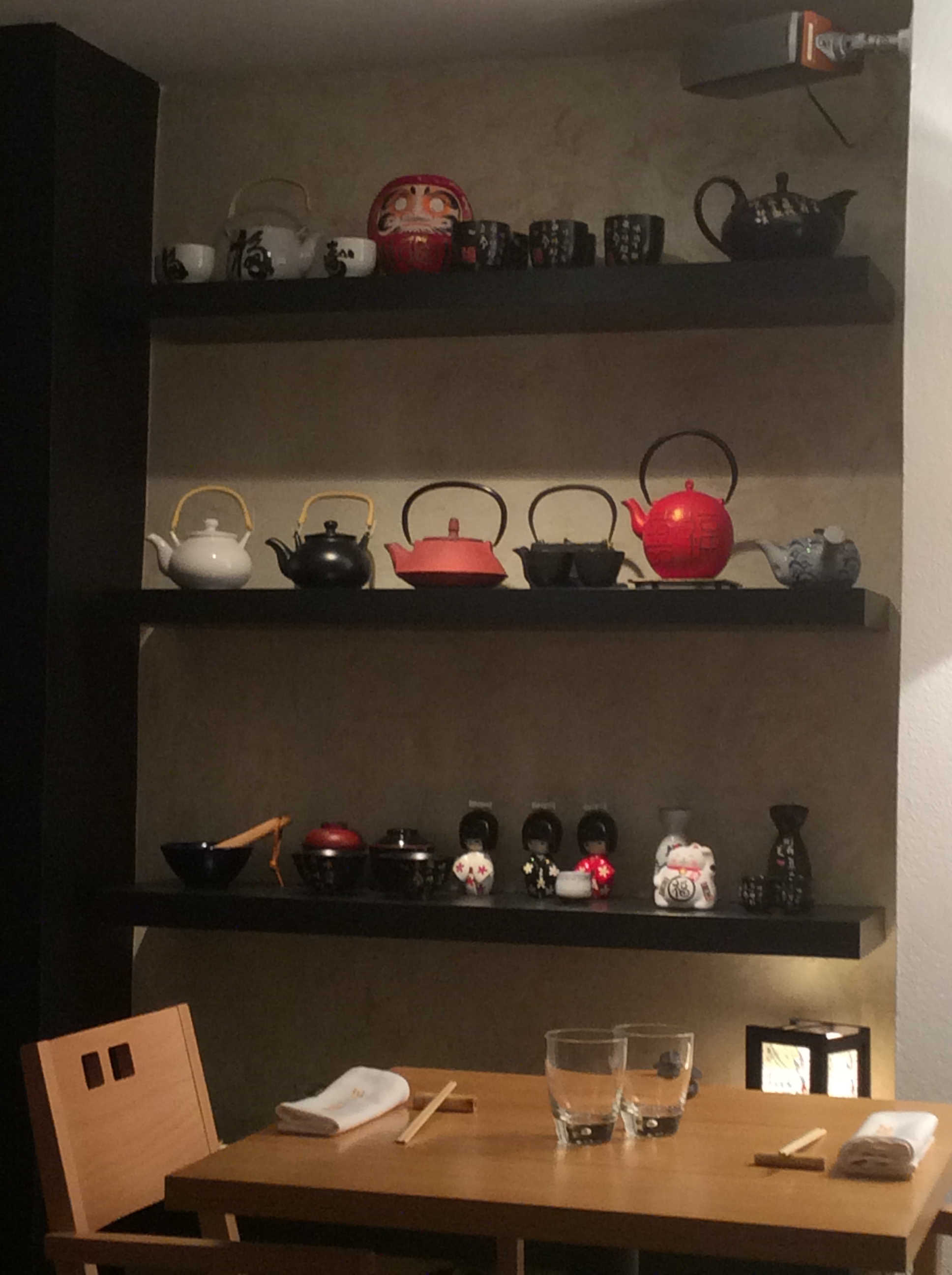
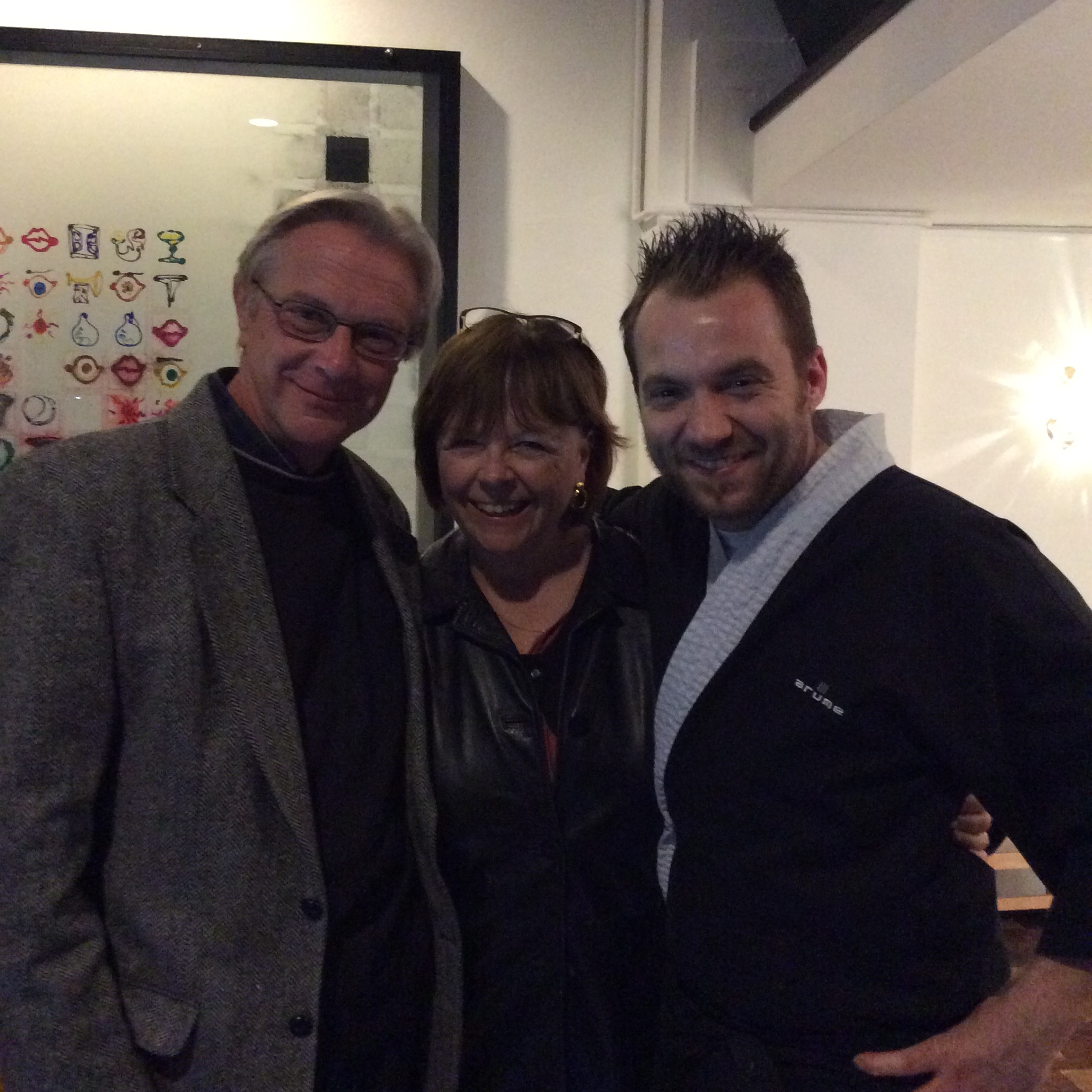
The Mallorcan chef Tomeu Martí learnt his Asian culinary craft in Tokyo and incorporates these techniques with local Mediterranean ingredients. We loved his sushi chef coat too, which complements the attractive décor of this contemporary restaurant and, although I’m not one for publishing selfies, I thought you’d like to see the chef dressed for action. We’ll certainly visit again.
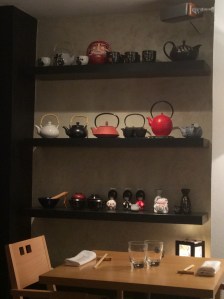
Part of Arume’s décor
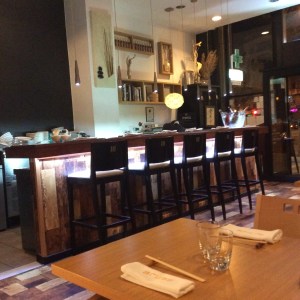
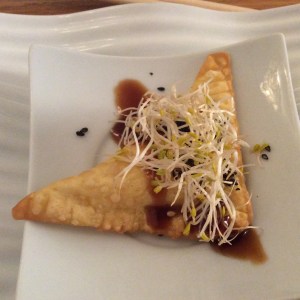

The Boss, yours truly and Tomeu at Arume
If you love this place, you’ll also like Arume Sushi, in Mercat Santa Catalina. Perch on a high stool at the counter, watch your sushi being made to order, and enjoy the buzz of this great little indoor market.
©Jan Edwards 2014
-
Hotel Review: Sheraton Mallorca Arabella Golf
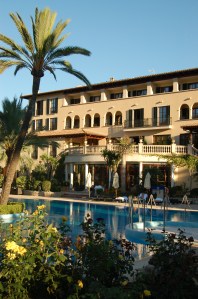
The outdoor pool at the rear of the hotel.
Strictly speaking, this hotel is called the Sheraton Mallorca Arabella Golf Hotel – but taxi drivers will know where you mean if you ask for “the Sheraton”. If you get a newbie, it’s on the Son Vida estate, just outside Palma.
The longer-than-convenient hotel name reminds me of my former days of doing PR for Holiday Inn Worldwide (EMEA). When they acquired the famous Midland Hotel in Manchester (where Rolls and Royce met in 1904 and formed their legendary car company), head office dictated that the landmark property should, in future, always be referred to in media communications as Holiday Inn Crowne Plaza Midland-Manchester. Perhaps not surprisingly, local editors resisted all attempts to persuade them to use the new name and continued to call it The Midland.
A First Sheraton Experience
I’ve always loved seeing and staying in hotels and look forward to the times when we throw a few essentials into a suitcase and head off for a night away in another part of Mallorca. We’d not stayed at the Sheraton before, so why not? It was closed for nine months last year for a refurbishment that cost 13 million euros. I was curious.
We stayed for one night in a double room (with private balcony and views of the Son Vida hills and lush greens of the golf courses).
Here are some of the room highlights:
- Huge bed, which lived up to its name of the Sheraton Sweet Sleeper;
- Dallmayr coffee capsule machine in the room – no kettle and nasty instant coffee sachets here!
- Spacious bathroom with walk-in shower and good assortment of amenities;
- In-room safe that was big enough for my handbag and tablet;
- Iron and ironing board in wardrobe. I loathe ironing, but it’s always good to be able to get the creases out of clothes if, like me, you’re not a great packer;
- Clothes hangers that can be removed from the wardrobe, rather than the fiddly theft-proof ones;
- Low-level small light at the side of the bed – just enough to let you see your way to the bathroom in the middle of the night, but not enough to disturb your sleep.
Another good point to note: there is carpet in the corridors, so no clattering heels on marble floors to rouse you from your Sweet Sleeper slumbers.
Spa & Food
The hotel has a new Shine Spa – apparently Europe’s first in a Sheraton Resort. We didn’t use it, but the indoor pool and treatment rooms look good. Outdoors there’s a huge pool (only for looking at during chillier months), two tennis courts and a fitness pavilion.
We ate in Es Carbó, which serves cuisine from several Mediterranean countries. As tapas fans we’d hoped to eat in Bodega del Green but it was closed that evening. If you decide to stay here and fancy tapas, best check that it’ll be open. In fine weather, you can eat alfresco in both restaurants.
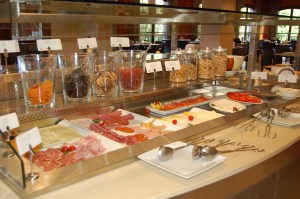
Just part of the breakfast buffet.
Breakfast is buffet style and with masses of choice – including a wickedly indulgent chocolate fountain with fresh fruit kebabs, as well as eggs cooked to order by a very friendly lady who’s been doing the same thing for years yet still seems to love what she does.
This is first and foremost a golf hotel and the room prices include green fees for the three courses owned by Arabella on the Son Vida estate. Unfortunately golf isn’t my game (more of a Scrabble girl, myself), but golfers are in their element here, I’ve no doubt. Golf widows (or widowers) can indulge themselves in the spa or head to nearby Palma for some shopping and sightseeing. I was happy just to admire all those greens (it’s been a long while since I’ve had a lawn of my own).
There’s a great team of people working here and we were impressed by all the smiles and greetings we had during our short stay. I wasn’t surprised to learn this week that they’ve been nominated for the chain’s Exceptional Achievement Award 2014.
Little Things Count . . .
The investment of thirteen million euros has brought a lot of improvements – in facilities and interior design – and resulted in a lovely hotel where we’d happily stay again. But one of the things that impressed me most about the Sheraton Mallorca Arabella Golf Hotel had nothing to do with corporate standards or mega-money investment.

The one-eyed cat, rolling in the sunshine at the foot of a stone wall.
Walking around the gardens we came across a friendly one-eyed ginger cat, that seemed very much at home. Mentioning it later to a member of staff, we learnt that it had been ‘rescued’ as a feral kitten by the hotel and now lives happily in the grounds. Everyone there seems to care about the creature, which had a rough start to life but now enjoys the attentions of hotel staff and guests alike. And while the hotel was closed for refurbishment, the builders took over the task of making sure the cat was fed. Now that’s my kind of hotel!
©Jan Edwards 2014
-
Gold in the Soller Valley (Part 2)
This is the second – and slightly edited – part of an article I had published in Food & Wine Journal in September 2013. Please see previous post to read the story from the beginning.
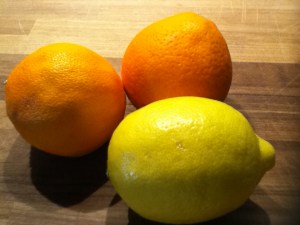
Nature’s bounty
In the late 20th century, Sóller’s fortunes began to improve – thanks to Franz Kraus, who had moved to Sóller from his native Germany.
In 1994 Kraus founded Sa Fàbrica de Gelats – which produces high-quality artisan ice creams and sorbets, using local milk, cream and fruit (and no artificial colours or flavours). Over the course of a year, they make around 120 varieties, of which some 20-35 (depending on the season) are citric-flavoured and made with freshly squeezed juice from the Sóller Valley’s own bounty. The company employs 22 people and, in season, they produce up to 6,000 litres of ice cream/sorbets a day. Come to Sóller and you have to put your ice cream head on and try as many flavours as you can manage. Their natural orange ice cream – something not often found – is particularly good.
“I used to work for a chocolate company in Germany,” Kraus tells me. “I wanted to change my life, and moved to Mallorca. I love Sóller but when I came here there wasn’t any good ice cream on the island – only industrially produced types. I decided to use my experience of the confectionery business to change this.”
A fantastic initiative
Kraus has more than 300 citrus trees on his own property and, understanding the challenges faced by a farmer trying to sell his harvest and calculate his potential earnings, decided to take action. In 1996 – his ice cream business established – Kraus started Fet a Sóller (Mallorcan for Made in Sóller), as a means of marketing and selling the organic citrus fruit harvested in the valley. Fet a Sóller www.fetasoller.com now directly employs 25 local people, with more than a hundred farmers and producers indirectly ‘employed’. The citrus farmer benefits from year-round fixed prices, so he knows what he can earn: “And that’s important,” says Kraus. “His speciality is growing, not selling. When a farmer earns money from his citrus trees he’ll grow more.” The harvest is around 500,000 kilos of fruit a year.
Fet a Sóller launched its online store in 2003 and you can buy their products in some 17 European countries, including England, Germany, Holland and France. The range includes more than just unwaxed organic oranges, lemons, grapefruit and tangerines. The fruit is used by local artisan manufacturers of gourmet products such as marmalades, chutneys and flavoured vinegars – some of them Fet a Sóller-branded. Other products include high-quality olive oils, charcuterie, flavoured flor de sal, and the orange liqueur Angel d’Or, invented by local orange farmer Miquel Capó.
Fet a Sóller works closely with local producers, such as Estel Nou – a not-for-profit organisation employing people with disabilities, which manufactures jams and preserves under the Fet a Sóller brand. “It provides disabled people here with work and an income – they are treated like able-bodied people,” Kraus explains.
There are some 15 different types of oranges grown in the Sóller valley, each with its own characteristics. They include Navelina, Navel, Valencia and Canoneta (the latter only found in this area). “Another is Peret, harvested in summer,” says Kraus. “You can put it in your house and if there’s no humidity you may be able to keep it for 3-4 months.” Because of the different types, there are oranges to be harvested from November through to July.
Sending vitamin C to your doorstep
The oranges are organic and unwaxed; because they’re not treated with fungicide they have a shorter shelf-life (3-6 weeks) than a supermarket orange which, Kraus suggests, “could already be up to three months old.” Fet a Sóller has become the supplier of natural vitamin C to northern Europe: you can order a 10kg box of Sóller oranges (choosing from the types available at the time) and have them delivered to your home – whether it’s in Paris or Peterborough, Copenhagen or Cologne – within five days.
The Sóller Valley is again thriving, with tourism also playing its part. Since 1997, motorists have been able to reach the town through the three-kilometre toll tunnel, as an alternative to the somewhat unnerving now-asphalted snaking mountain pass. The lovingly maintained old wooden train that once carried oranges from Sóller to Palma now carries camera-toting day-trippers. ‘Red Lightning’ may not live up to its name in colour or speed (the 27km journey takes an hour), but it offers a taste of nostalgia and some spectacular mountain scenery on its journey to the heart of the ‘Valley of Oranges’.
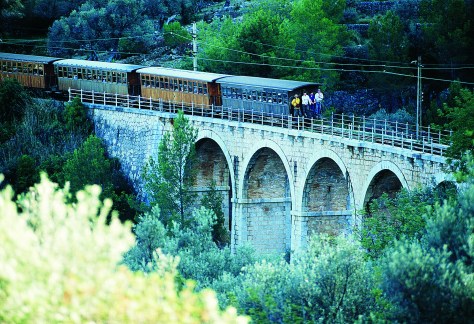
‘Red Lightning’ is now one of Mallorca’s best loved tourist attractions. Copyright FOMENTO DEL TURISMO DE MALLORCA. Photo by Eduard Miralles.
Jan Edwards ©2013
-
Gold in the Soller Valley (Part 1)
This is an edited version of my article published in Food & Wine Journal (quarterly), September 2013.

Port de Soller. Photo courtesy of FOMENTO DEL TURISMO DE MALLORCA and taken by Eduard Miralles
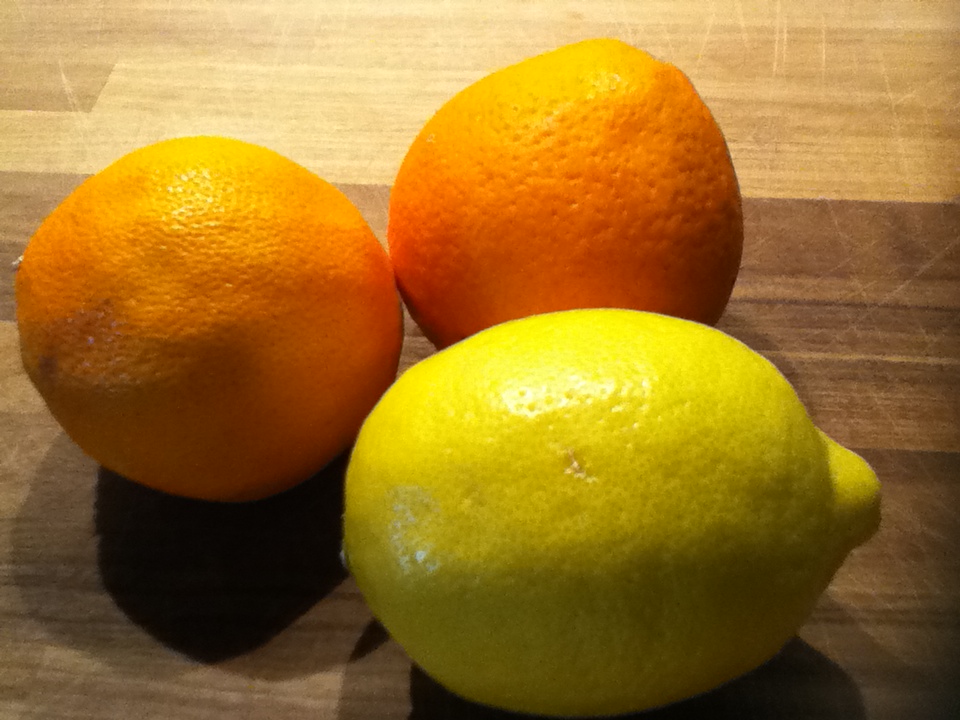
Blinking in the bright sunlight, having emerged from the long dimly lit Sóller road tunnel, motorists see a roadside sign announcing their arrival in the ‘Valley of Oranges’. The sign is hardly necessary: for a large part of the year it’s impossible to miss the profusion of citrus fruit trees – laden with oranges or lemons – growing in Mallorca’s Sóller Valley. Given the importance of citrus fruit to the local economy, it’s not surprising that this area is also known as the ‘Valley of Gold’.
In the handsome town of Sóller and nearby Port de Sóller, every bar, café and restaurant takes advantage of the delicious oranges grown on more than 120,000 trees in the vicinity. Visit in the first two weeks of June and you’ll even find a fiesta dedicated to oranges – the Fira de La Taronja – when the fruit takes the starring role in the festivities, and local restaurants create special dishes using oranges. Oranges (and lemons) have brought fame and fortune to Sóller.
Exports to France
The history of citrus cultivation here goes back to the 11th century, when it was introduced by the Arabs, who were in occupation. They recognised that this sheltered valley in the west of Mallorca – protected by the UNESCO World Heritage Site mountains – offered the perfect growing conditions for citrus trees, with water in abundance.
The French Revolution prompted many people to flee France, and Mallorca became a refuge. The exiles sailed into Port de Sóller and it wasn’t long before they were sending shipments of the delicious oranges they discovered here back to France – which became an important market for Sóller’s citrus fruit. But in 1860 serious pest damage decimated the orange plantations and many local people were forced to leave the island to find work, travelling to France or Latin America. Others stayed to re-stock their plantations.
A touch of the French on Mallorca
When the islanders eventually returned to Sóller, their new wealth enabled them to build impressive properties, which reflected the architecture of the countries where they’d been working. There are Colonial influences in some of the grand urban mansions but, most evident, is the legacy of time spent in France: Sóller has more Art Nouveau (Modernismo, in Spanish) architectural style than anywhere else on Mallorca. To this day, the town still has something of a French feel about it.
The reason that Sóller’s oranges were shipped from the nearby port was the mountain range, which effectively isolated the valley from the rest of the island: the only overland route was a twisting dirt track over the vertiginous Coll de Sóller mountain. This changed in April 1912, when a narrow-gauge railway service started between Sóller’s new Art Nouveau railway station and Palma – funded by the citizens of the valley town. It had taken five years to construct the 27-kilometre track, which involved excavating 13 tunnels through the mountains.
Competition from Israel and southern Spain eventually reduced the export market for Sóller’s oranges, causing a downturn in the area’s economy.
But fortunes began to change again in the late 20th century . . . as you’ll read next time.
©Jan Edwards 2014
-
Who Needs Pizza When Mallorca has Coca?
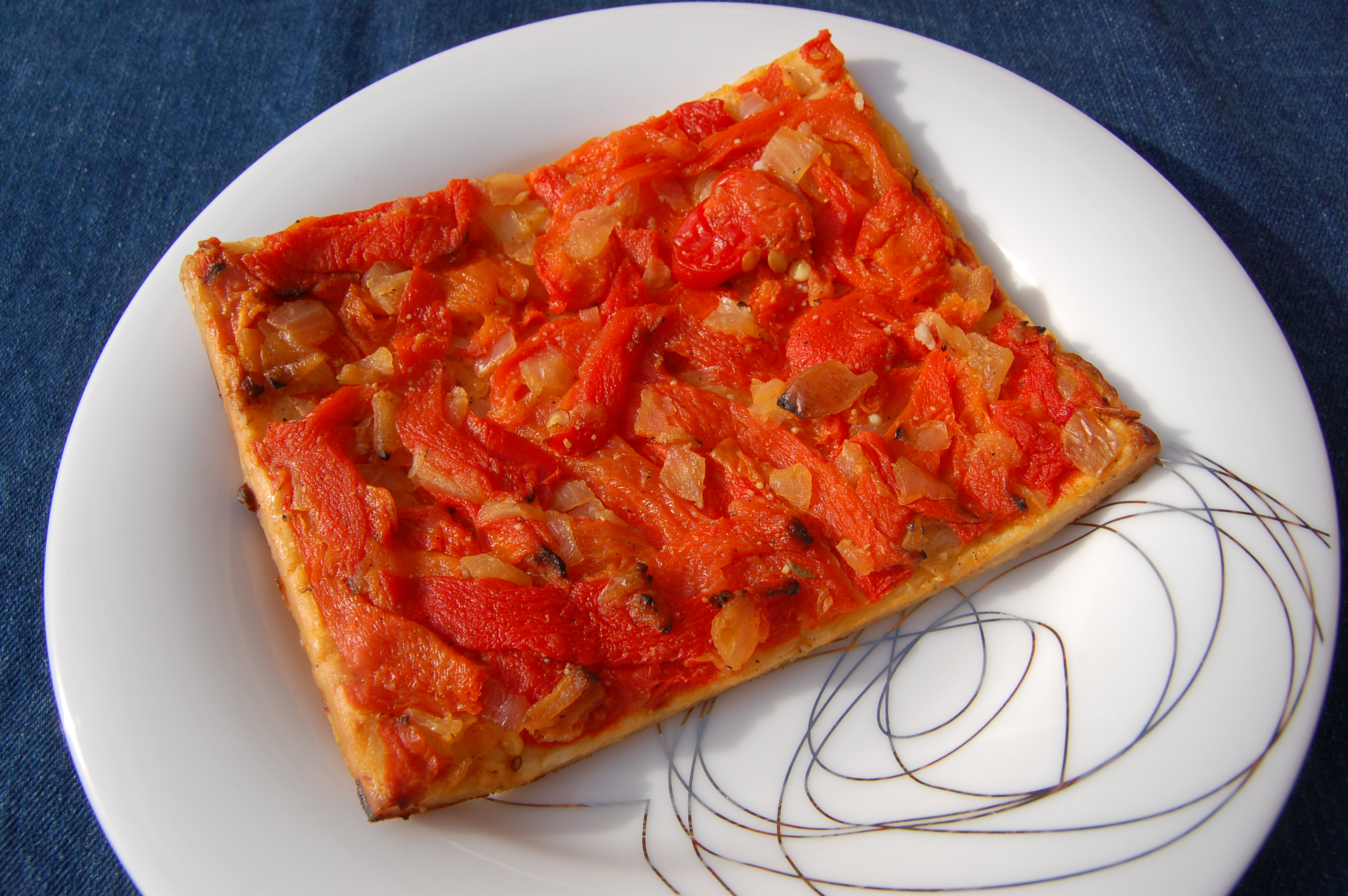
Coca is the Catalan equivalent of a pizza, differing from its Italian culinary cousin in that cheese doesn’t feature – so it must be healthier (I tell myself). Eaten as part of a meal or as a snack, coca is usually served at room temperature.
Most bakeries on Mallorca bake large rectangular coques and sell portions. A transportable snack, it makes a tasty alternative to a bocadillo (or filled roll). Individual coques may be oval or round and toppings may comprise only a few ingredients. Coca de trempó is probably the most common: a combination of peppers, tomatoes and onions – one of my personal favourites.
You can expect to find coca on the menu (or buffet) in some traditional Mallorcan restaurants but, like all dishes, some versions are better than others. If the base is too thick, it turns claggy in the mouth and needs a good gulp of something (preferably one of Mallorca’s excellent wines) to wash it down. And, as with all dishes, everything depends on the quality of the ingredients.
The proof is in the eating
Last September, I took my father on a winery tour organised by Mallorca Wine Express. Mid-tour we stopped in the heart of a vineyard to taste a wine and excellent coca de trempó, made by the owner of the business. Sadly, my coeliac father had to miss the latter. I’ve never seen gluten-free coca for sale, so will trying making one for his next visit.
Excellent coca at Miceli and Ca Na Toneta
Last week I ate a superb one, as part of lunch at Miceli restaurant in the village of Selva (just a couple of kilometres towards the mountains from Inca). Chef/proprietor Marga Coll’s version had a crisp thin base and was topped with salt cod (bacalao) and vegetables. It was probably one of the best cocas I’ve eaten. For information, Miceli changes its menu daily, serving dishes based on what Marga has bought at the market that morning. . .
I can also vouch for the delicious coca I’ve eaten at Ca Na Toneta in Caimari, and I’d love to hear if you have eaten any particularly good versions elsewhere on the island.
Lunch today is coca de trempó – couldn’t let the photographic ‘model’ go to waste!
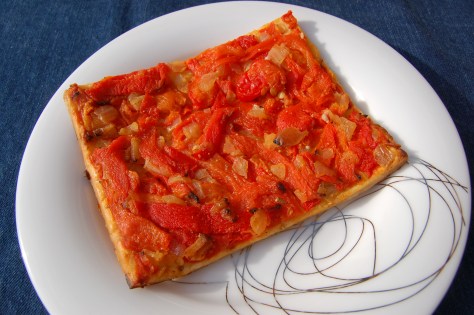
Anyone for coca?
©Jan Edwards 2014
-
Spain’s New Year Grapes Tradition
Tonight, as we say goodbye to 2013 and welcome in the New Year, we’ll be taking part in a Spanish tradition that’s more than a century old. All over Mallorca, the Spanish mainland and other islands, Latin America and Hispanic communities around the world, as midnight is striking, we’ll be gulping down one grape for each of the dozen chimes. These are the lucky grapes – las uvas de la suerte – and by methodically swallowing these twelve grapes we are supposedly ensuring that the New Year will be a prosperous one.
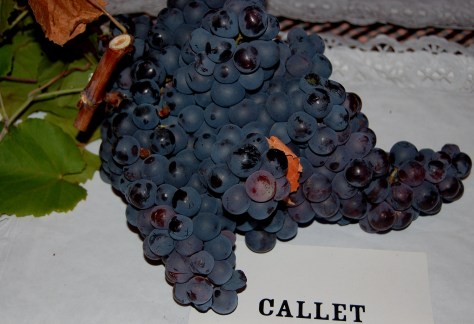
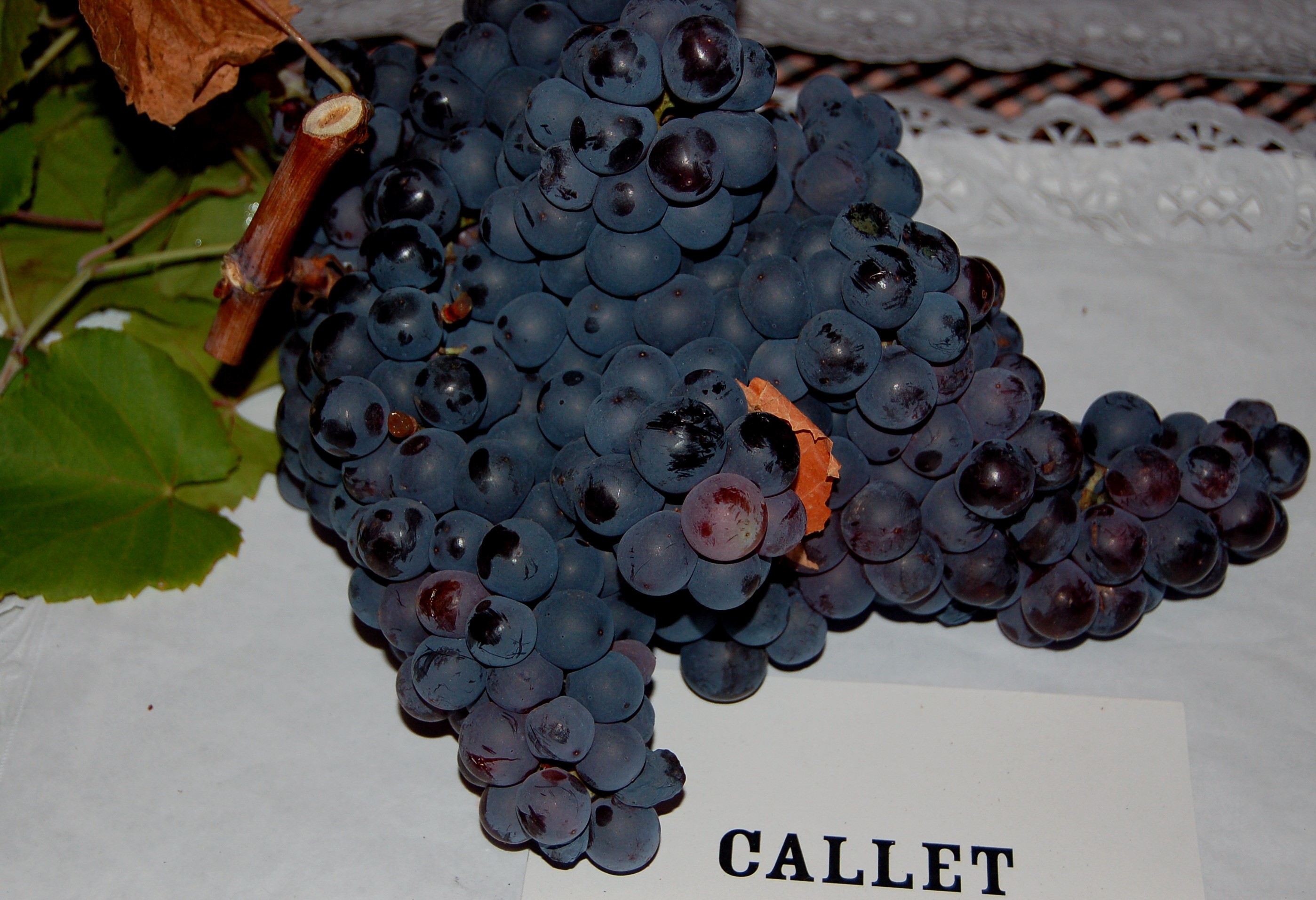
One of Mallorca’s native grape varieties: great for wine, but not for New Year’s Eve tradition
It certainly will be for the companies that package small seedless grapes each year specifically for this tradition, for these carefully selected and conveniently portioned dozen grapes come at a higher price than the bunches of local fruit we buy on the market. As New Year’s Eve approaches, shops, supermarket and even some market stalls offer these fit-for-purpose grapes packed in plastic containers, inside a disposable cava glass or a small tin with ring-pull for easy access. Tomorrow morning, the pavements of squares like Plaza Cort in Palma and the famous Puerta del Sol in Madrid will be littered with discarded containers. Hopefully someone will recycle all this waste plastic . . .
Small grapes are no choke
For our first New Year’s Eve here, we bought a bunch of grapes (after counting to ensure it contained at least 24 grapes) – not then appreciating why people pay extra for small seedless ones in a fancy package. But as we spluttered our way from 2004 into 2005, we realised that size matters when it comes to this tradition. It’s not as easy as you’d think to swallow one grape with each chime of the clock – and it’s certainly not advisable to try and get ahead of yourself so that you have some gulping leeway as the final chimes loom.
©Jan Edwards 2013
-
Winter in Puerto Pollensa
Puerto Pollensa in the north of Mallorca has been a magnet for British visitors for decades. It was where I had my first ever holiday on the island, as a teenager. The hotel I stayed in is still there and looks unchanged from the outside. I’ve not ventured in – not that anyone would remember the embarrassing incident in the hotel dining room, when the piece of melon I was trying to spear with my fork shot off the plate and onto the rather-too-close neighbouring table. It put me off eating melon for ages, but didn’t put me off Puerto Pollensa: here my love affair with the island began.
A hotel for a writer’s holiday
Agatha Christie holidayed in Puerto Pollensa too. It inspired her short story Problem at Pollensa Bay, featuring the detective Parker Pyne. Some say that Christie stayed at the Hotel Illa d’Or in the resort; others, that the Sis Pins Hotel was where she lodged during her visit. Wherever she was, she would have enjoyed the sweeping views of this expansive bay, which takes on a special beauty during the winter months. On a calm, sunny day like today, the Mediterranean laps gently at the shore but otherwise looks almost like a lake. Boats are still anchored in the bay, and this morning we even saw a water-skier in action. But it’s the clarity of the light that most impresses on a winter’s day when the sun shines from a clear blue sky.
Open for business
We love to visit Puerto Pollensa in the winter to enjoy its natural beauty and to stride out along the Pine Walk, passing waterfront houses and apartment buildings and daydreaming about living so close to the sea. Every long walk should end with a good coffee or, in winter, perhaps a gloopy hot chocolate, although many cafés and bars here are closed over the winter months.
Restaurante Stay on the waterfront stays open all year and is open through the day for snacks, lunch, tapas, and dinner. The terrace is a sunny spot on a fine winter’s day.
Cappuccino Grand Café – a Mallorcan chain of smart cafés – has had a seafront place in Puerto Pollensa since 2011. The café adjoins the Sis Pins Hotel, a charming British-owned place that first opened in 1952 and is packed with traditional Mallorcan character. Although Sis Pins remains open in the winter – and offers some very reasonable room rates – Cappuccino has been closing for the winter months for the past few years. It must be said that Cappuccino’s prices are more geared towards visitors to Mallorca than to locals…
 Interior of Cappuccino Grand Café in Pto Pollensa
 Another view of Cappuccino.
 Entrance to the hotel’s waterfront terrace.
 No problems relaxing here . . .
Go where the locals go
Many restaurants and bars in the holiday resort are closed outside the holiday season, but locals live here year-round, so venture away from the seafront and you’re sure to find somewhere to get a drink or something to eat.
©Jan Edwards 2013
-
Mallorca’s Emblematic Pastry – Not for Vegetarians!
This is an edited version of my article originally published (under my other name, Jan Dunn) in the Writers Abroad 2011 anthology Foreign Flavours (with foreword by Alexander McCall Smith). The anthology is still available for purchase from Amazon and contains a mix of fiction and non-fiction, all related to food in the countries of the contributors. Proceeds from the sale of Foreign Flavours go to The Book Bus – a charity which helps develop literacy and the joy of reading to children in the developing world.
Note: Can Miquel bakery closed in 2013, when the owner retired. Sadly, Miquel Pujol, featured in the photos in this article, passed away February 2013, at the age of 66.
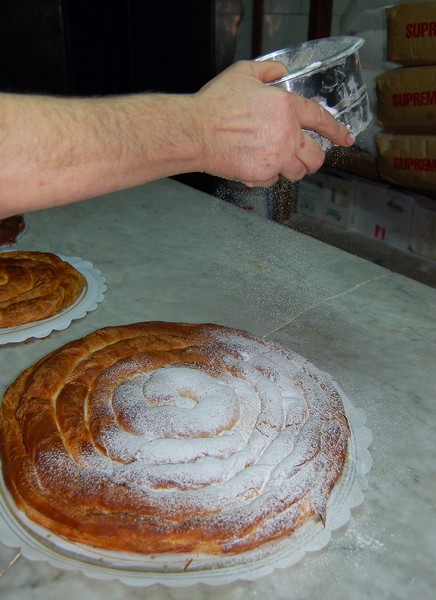
Putting the finishing touches to an ensaimada. Photo J Edwards
You can’t miss the Spanish mainlanders passing through Palma’s airport departures terminal: they’re often clutching at least one large shallow octagonal box (and sometimes a small pile of them) containing Mallorca’s highly prized ensaïmada – described by 20th century Catalan writer Josep Pla as “the lightest, airiest and most delicate thing in this country’s confectionery”.
Written references to the Mediterranean island’s ubiquitous yeasty pastry date back to the 17th century, but a couple of clues point to an even longer history: The root of the name is the Arabic word for pork lard – saïm – and the pastry’s spiral shape is believed to have been inspired by the turbans worn by the Moors, who occupied Mallorca from the 10th century until its recapture by King Jaume I in 1232.
A classic confection
In the second half of the 19th century, the ensaïmada warranted inclusion in one of the most important published works about Mallorca. Archduke Ludwig Salvador of Austria had fallen in love with the island and bought three important estates (one now owned by Hollywood actor Michael Douglas). Adopting the island as his home, Salvador studied every aspect of local life and documented his findings in his magnum opus, Die Balearen (The Balearics). In his social commentary on the islanders, he cites the ensaïmada as the favourite confection of the middle and upper classes.
Today, this pastry crosses all social boundaries and many of the sweet-toothed islanders eat them with a regularity that would make a British dietician or cardiologist blanch. With such a rich historical and cultural heritage, it rightly deserved the Denomination of Origin status, awarded back in 1996. Only an ensaïmada produced by certain bakeries can be sold as an authentic Ensaïmada de Mallorca – the Rolls Royce of these pastries. There are two official varieties: one, plain; the other, filled with a seam of pumpkin jam, known as cabello de angel (angel hair).
A labour of love
As a handmade product, no two ensaïmadas look exactly the same, but certain consistencies are required: a minimum of two spirals – always clockwise; a round but slightly irregular shape, and an undulating golden top. The base must glisten and be smooth. When pulled apart, good flaky layers should be visible. The aroma and flavour should be pleasantly sweet, but with discernible evidence of good lard.
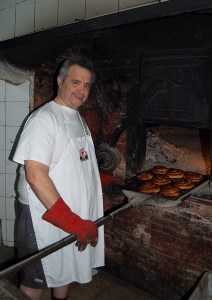
Hot work for Ca’n Miquel’s baker. Photo J Edwards
Apart from lard, ensaïmadas contain strong wheat flour, water, sugar, eggs, and a “mother” (or starter) dough. Production is a lengthy process: After a considerable amount of kneading, the baker rolls the dough out thinly, spreads a film of lard over the entire surface and shapes the dough into a triangle. It’s then rolled into a long “sausage”, finally curling it into the required spiral shape and leaving it to prove for 12 hours. Given the heritage of the ensaïmada – and the labour of love involved in its production – any non-vegetarian visitor to Mallorca should at least sample one. They are surprisingly light and flaky.
Any excuse . . .
When to eat ensaïmada? It makes a satisfying snack or can be part of a meal – perhaps breakfast or the dessert in a traditional Mallorcan lunchtime menú del día. A large one is usually shared during a family celebration – be it first communion, birthday or saint’s day. Community-sized ensaïmadas often take centre stage at village fiestas: one baked for a fiesta in the village of Porreres weighed in at a hefty 50 kilos!
If you’re visiting Mallorca and want to try this emblematic pastry, there’s no more authentic way than to order one with a coffee or hot chocolate (in winter) in one of Palma’s venerable temples of local social life: classic old cafés such as the Lírico, Moderno, Progreso or Bar Bosch. Better still, if you’re a very early riser, call at a bakery and buy your ensaïmada still warm from the oven and lightly dusted with icing sugar.
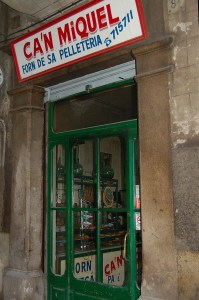
In Palma’s old town, this bakery has been run by the Pujol family since 1914. The oven has been in use since the 16th century. Photo J Edwards
Although versions of the ensaïmada can be found in other parts of Spain, they’re not authentic or as highly prized as Mallorca’s. Little wonder that so many of these pastries are bought by island visitors to take home. Beware though if you fly Ryanair: they’ll charge you eight euros if you want to carry one in addition to your hand luggage…
©Jan Edwards 2013
-
New Flavour for Mallorca’s Gourmet Salt
Cold weather has come early to Mallorca this year, and our finca‘s Jotul woodburning stove has been in service for at least a week already. One of our favourite lunch dishes at this time of year is a baked potato cooked inside the stove, resting on firebricks alongside the burning logs. After washing and drying the skin of the potatoes, I rub them with olive oil, sprinkle them with sea salt and wrap them in a double layer of foil, before leaving them to cook for about an hour. Deliciously warming and satisfying, whether served with some kind of topping or simply dressed with butter or olive oil and seasoning.
A Seasoning for the Season
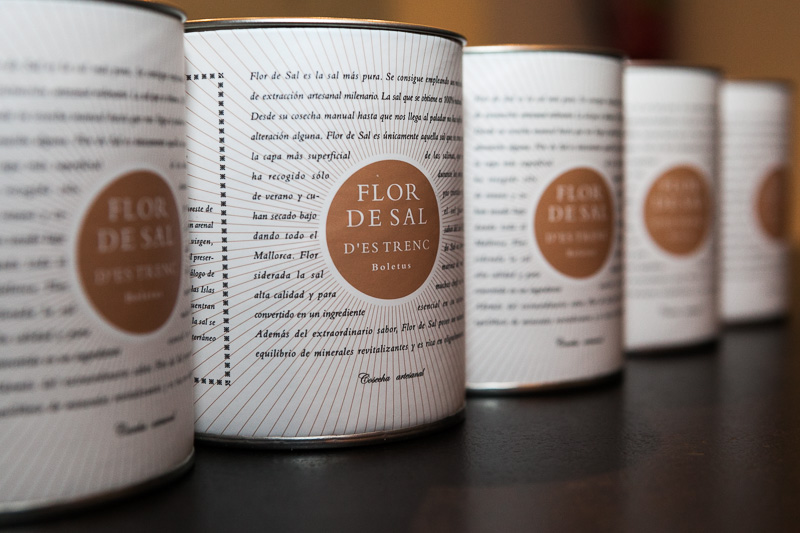
Today, we added a touch of Mallorcan magic to our jacket potatoes, in the form of Flor de Sal d’Es Trenc Boletus. This is the newest addition to the flavoured salts under the Flor de Sal d’Es Trenc* brand; so new that it was only launched to the press on Friday, at an event I attended in the Private Wing of the stylish boutique Puro Hotel in Palma.
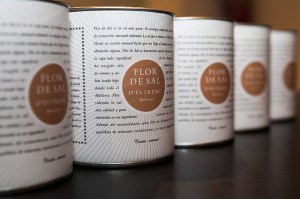
The new flavour in the Flor de Sal d’Es Trenc range of gourmet salts. Photo courtesy of Flor de Sal d’Es Trenc/Gusto Mundial Balearides, SL
The recipe for the latest salt in Flor de Sal d’Es Trenc’s range blends hand-harvested salt ‘flowers’ from the Salinas of es Trenc with Trompeta Negra, Seta Calabaza and Shitake mushrooms. This is, after all, the season for fungus. The recipe was created in collaboration with renowned local chef Tomeu Caldentey. In 2004 Tomeu became the first Mallorcan on the island to have his cuisine recognized with a Michelin star (at Es Molí d’en Bou restaurant, later renamed Bou); the star was awarded every year since until Tomeu renounced the star to change his restaurant concept.
At the press launch, Tomeu said the new flavour salt works well with pasta, rice, white fish, and meat dishes. But there’s something particularly special about the new Boletus variety: for each pot of it sold over the next two years, Gusto Mundial Balearides SL – the company behind Flor de Sal d’Es Trenc – will donate 50 cents to the Mallorca-based Asociación ASNIMO (the Down Syndrome Association of the Balearics). This was Spain’s first association specializing in Down Syndrome, when it launched in 1976.
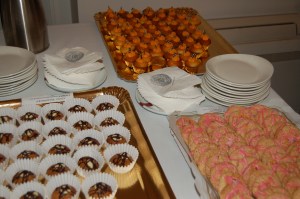
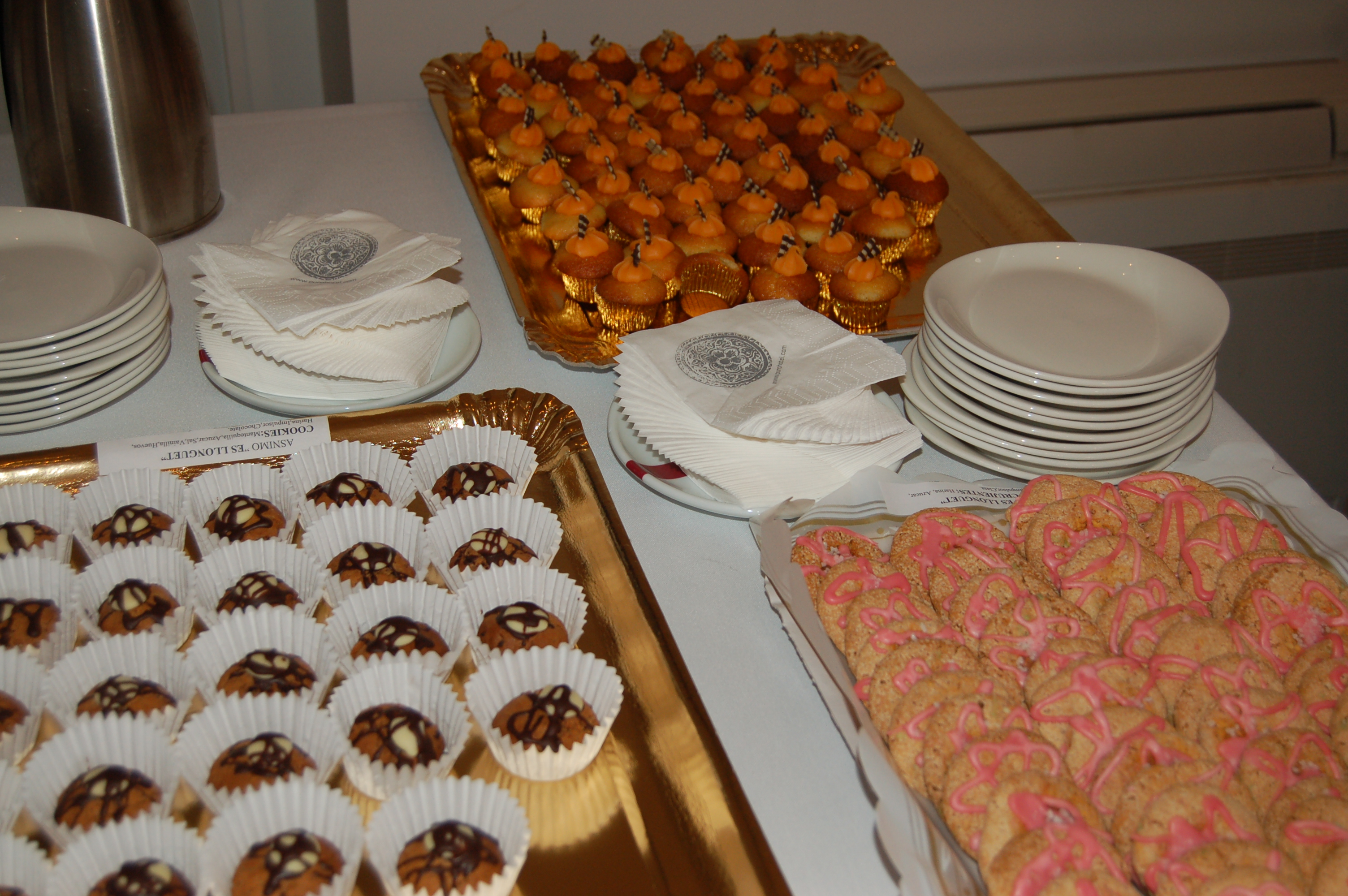
Cookies at the press launch, made in the ASNIMO bakery. Photo: J Edwards
A Gourmet Gift
Many of ASNIMO’S services – which include a special education centre, occupational centres, day centres etc – receive public funds, but other projects, such as their Programa de Vida Independiente (independent living programme) receive only private funding.
If you’re looking for something different to put into the Christmas stocking of a gourmet or keen cook, a pot of Flor de Sal d’Es Trenc Boletus is sure to please – and you’ll be helping an excellent cause. And I can vouch for the fact that the new flavoured salt works a treat with jacket potatoes . . .
*Read more about Flor de Sal d’Es Trenc here.
Find out more about the work of ASNIMO here.
Read about Tomeu Caldentey here.
©Jan Edwards 2013










 Eat Drink Sleep Mallorca