-
Seven Michelin stars for Mallorca for 2015
Within the past hour, the news that every decent chef in Spain and Portugal has been waiting for was announced: the Michelin stars for 2015.
Last year on Mallorca there were five restaurants with Michelin-starred cuisine. For 2015 there are two new additions; the restaurants with stars in 2014 have retained them for 2015, making a total of seven restaurants each with one star. I’m pleased to say I’ve eaten in them all and can confirm that the stars are well deserved. In fact I’m thrilled skinny (if only that were possible) for them all.
Here then are the restaurants on Mallorca with Michelin-star recognition in 2015:
- Andreu Genestra, Capdepera NEW
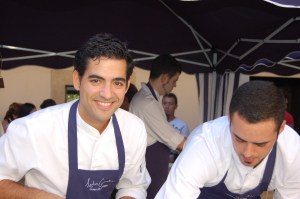
Andreu Genestra (left) – his eponymous restaurant now recognized with a Michelin star.
- Es Fum,Costa d’en Blanes
- Es Moli d’en Bou, Sa Coma – now renamed Bou
- Es Racó d’es Teix, Deià
- Jardín, Puerto Alcúdia
- Simply Fosh NEW – now renamed Marc Fosh
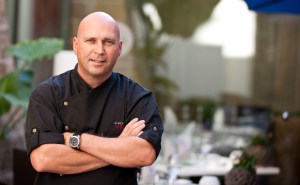
British chef Marc Fosh
- Zaranda
Congratulations to everyone at these superb restaurants. Mallorca is truly a great gastronomic destination.
©Jan Edwards 2014
-
Another ‘Peccata Minuta’ Success for Chefs(in)
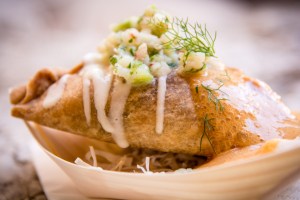
Andreu Genestra’s ‘cocarroi’ of fried prawns with spiced apricot
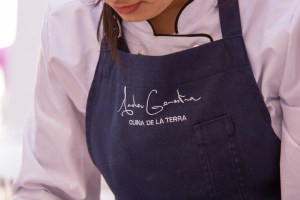
Concentrating on the detail
Warm sunny weather added to the enjoyment of ‘Peccata Minuta’ – the gourmet tapas event organized by Chefs(in) in Inca on Sunday. Eight chefs produced some delicious tapas, which were available at a cost of three euros a portion. Money well spent, we thought, after we’d indulged ourselves in a few of them.
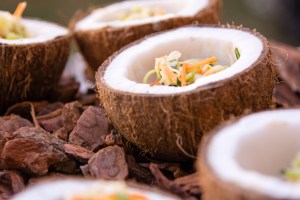
Coconut with chicken and sweet and sour sauce – Andres Benitez
We bought our ‘tickets’ for the number of tapas we wanted at 11am promptly, an hour before the event started, then headed off for a coffee in town. At midday we were there as the doors opened. The event seemed very well supported and it was good to overhear people’s enthusiastic comments when they tasted food from a chef whose cuisine or restaurant they hadn’t experienced before. This is what Chefs(in) is doing successfully: promoting the Balearic Islands’ excellent gastronomy – both here and abroad. A great day out and a very tasty experience too.

Andres Benitez
If you missed it, you can watch coverage of ‘Peccata Minuta’ that was shown on local IB3TV below:
©Jan Edwards 2014
-
Where to Go for a Great Paella Experience on Mallorca: Sa Foradada
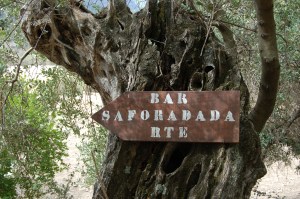
Every year we set ourselves some Mallorca missions. One of this year’s was to have paella at Sa Foradada, a unique restaurant located opposite the eponymous rock, on the north coast of Mallorca. Sa Foradada (the restaurant) came to fame in the UK when it featured in one of the episodes of Yotam Ottolenghi’s series ‘Ottolenghi’s Mediterranean Island Feast’. Seeing this enchanting restaurant on the episode about Mallorca strengthened our determination to go.
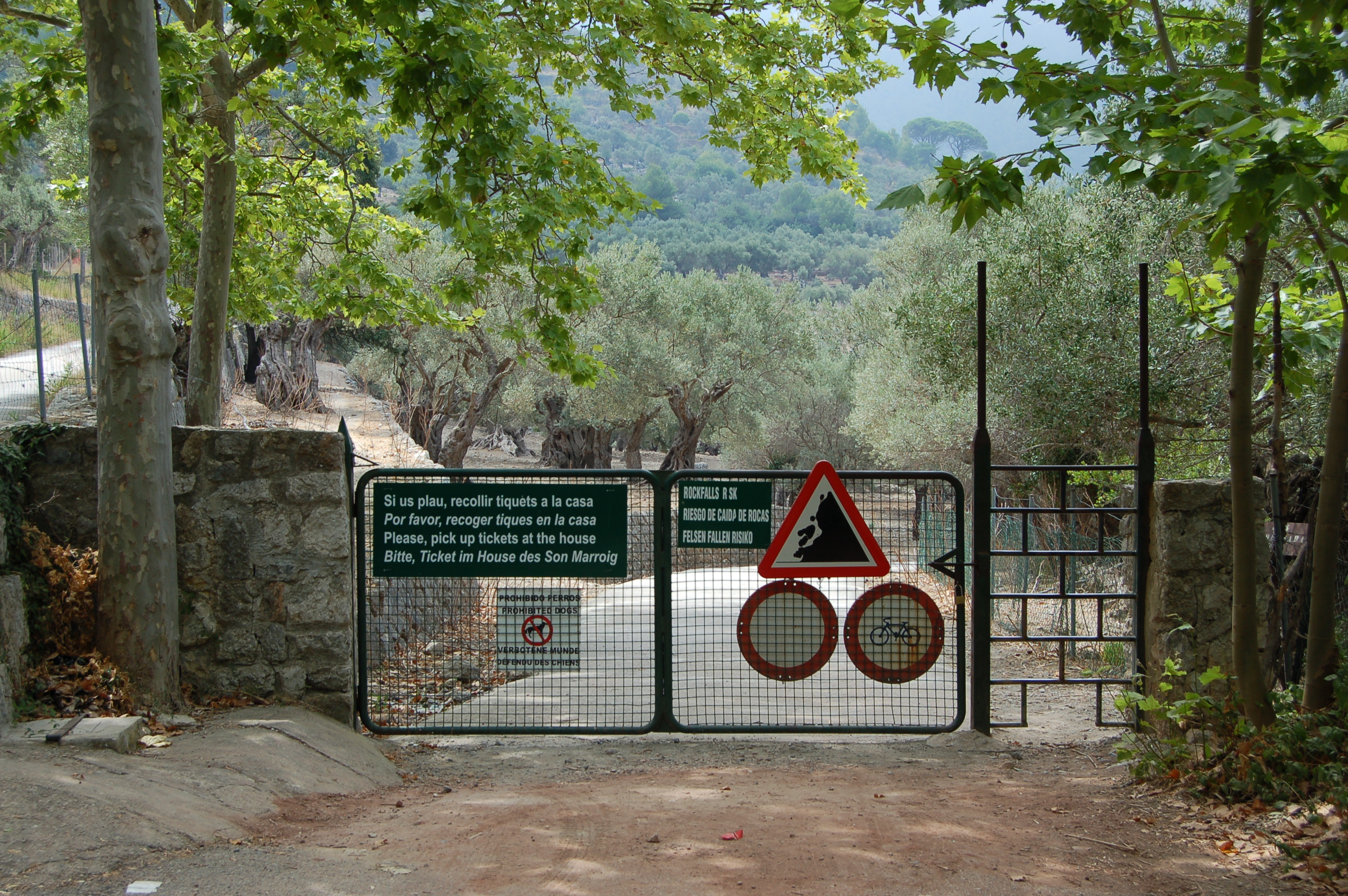
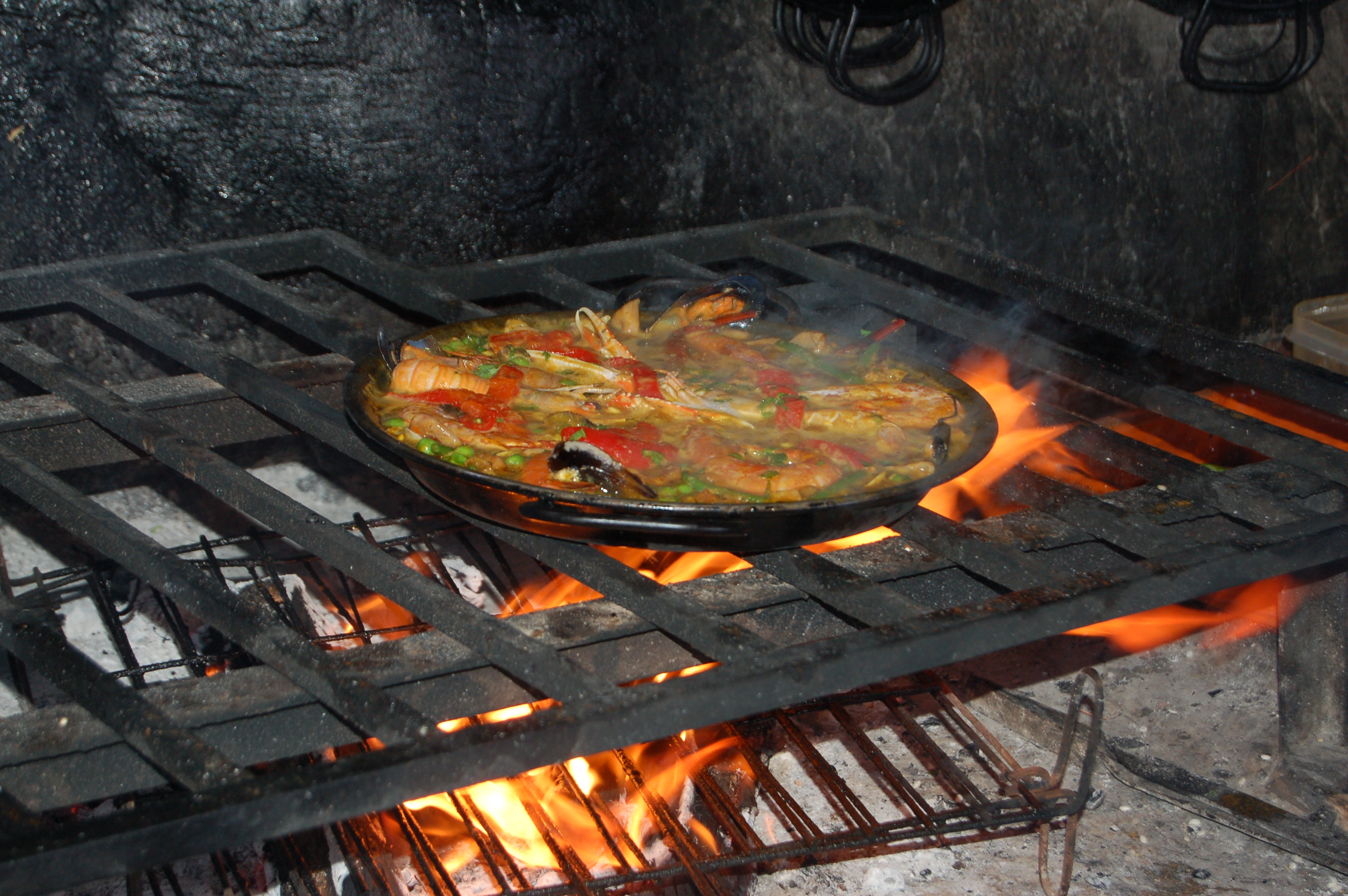
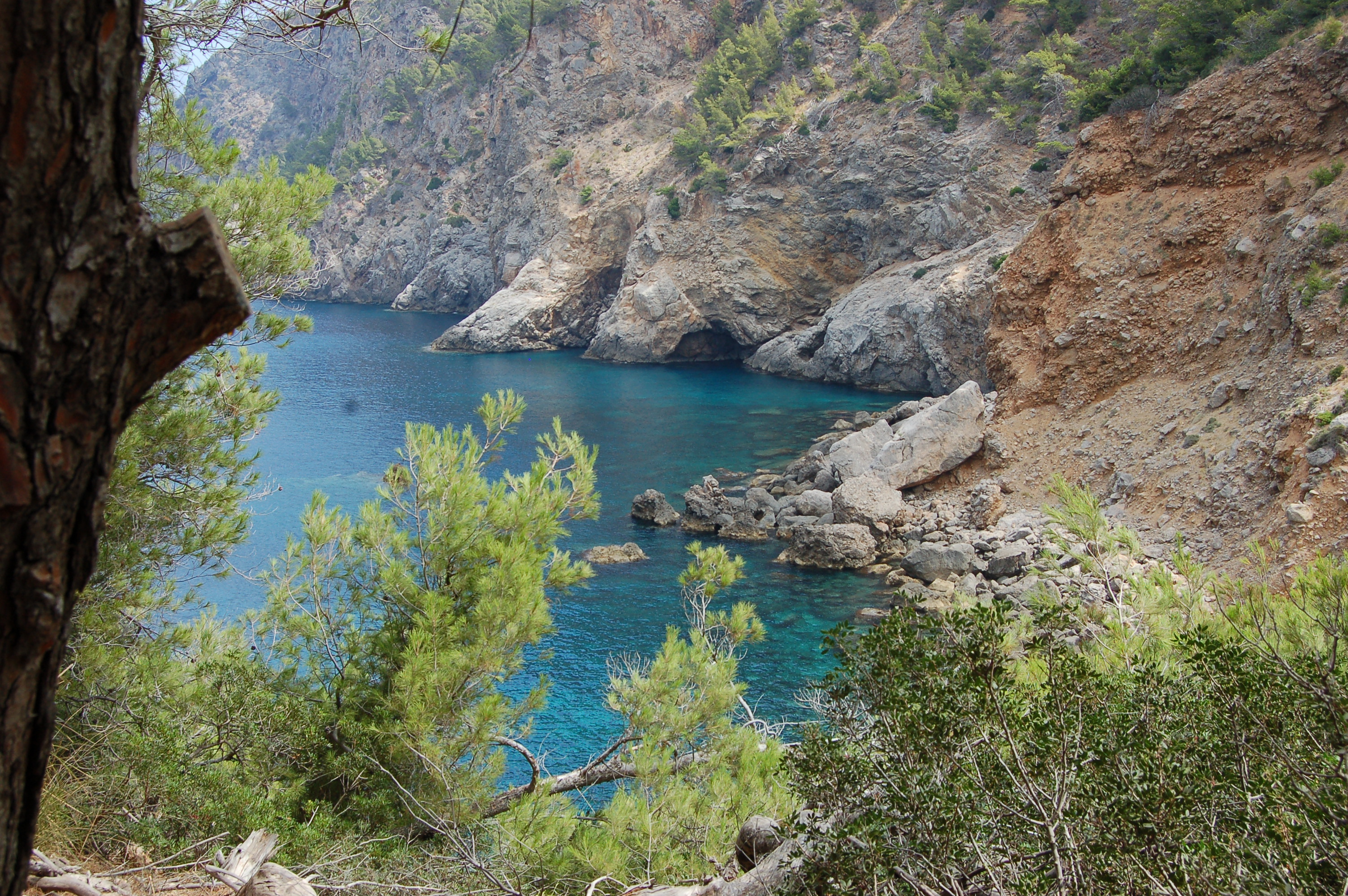
Sa Foradada is famous for its paellas, cooked over a wood fire, although they serve other dishes too. Many people travel here by boat, anchoring close to the imposing rock with a large hole in it. There are steps up the cliff to the restaurant, which is open to the elements, but for a rustic roof. The simple website for the restaurant gives instructions for access: “by boat directly from the sea or down from the viewpoint of Sa Foradada, through Son Marroig, and jumping the gate, down the mountain to the little beach, with a pleasant half-hour walking tour in the countryside.”
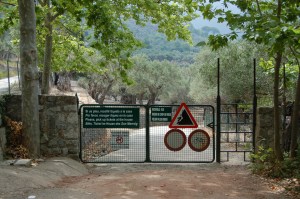
Not so much a ‘jump’ as a clamber.
Not being very tall, I was a little daunted by the prospect of ‘jumping the gate’, but needn’t have worried. There’s a built-in stile and my less-than-lengthy pins had no problem getting over. Our walk down took about 40 minutes, as we stopped numerous times to take photos. There was plenty of evidence of donkeys on the ground but, sadly, I didn’t see a single one of these beautiful creatures.
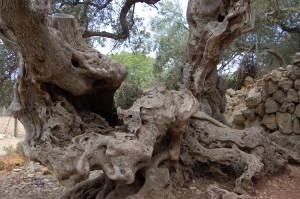
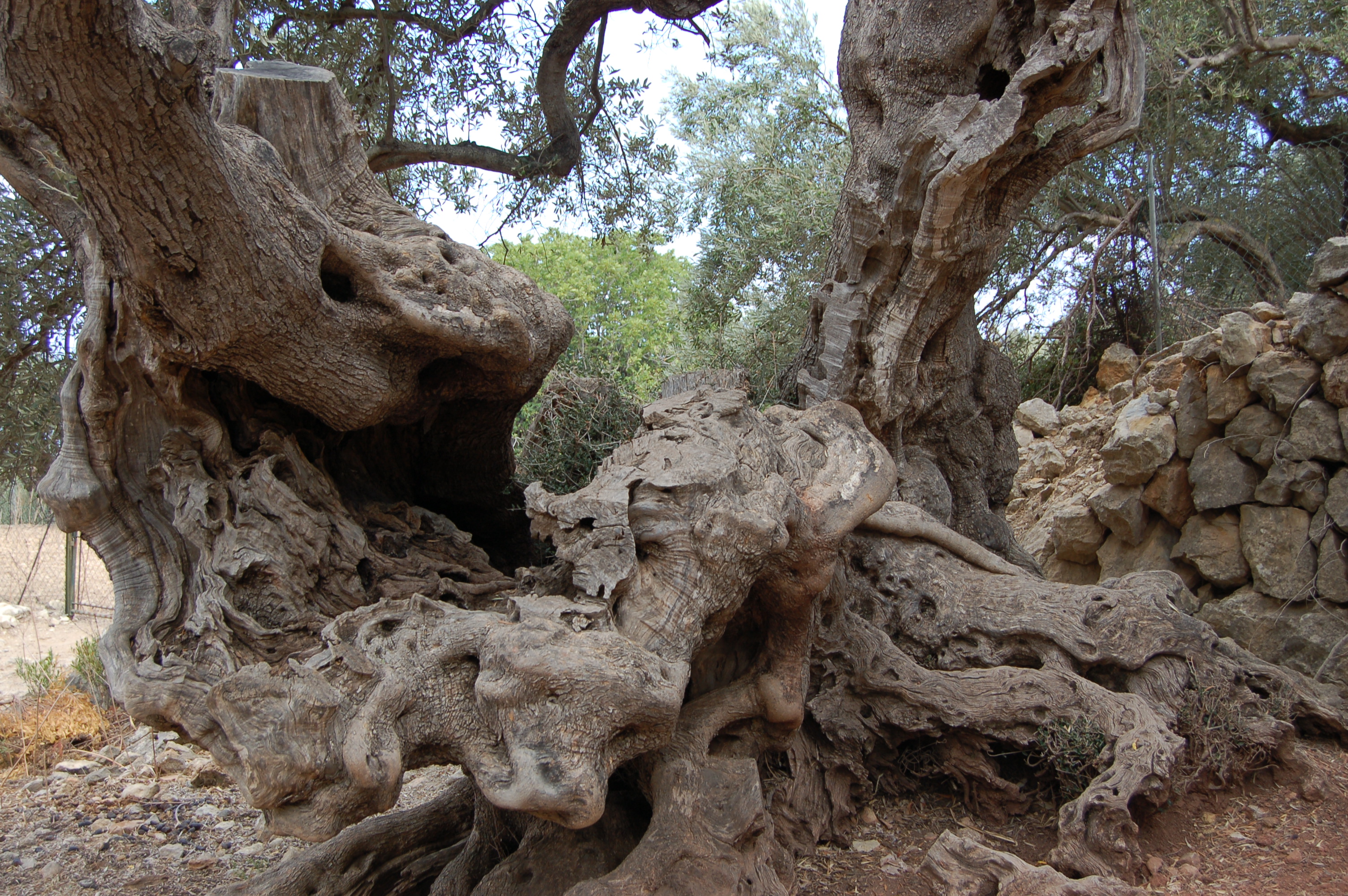
Passing ancient olive trees along the walk
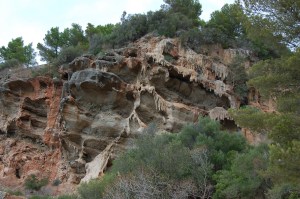
Dramatic rock formations alongside the path
Sa Foradada – a Family Affair
The property that is home to the restaurant was once owned by Archduke Luis Salvador of Austria, who fell in love with Mallorca when he visited in the 19th century and bought several estates in the Tramuntana mountains – including Son Marroig. In 1972, Emilio Fernandez leased the small rustic property that became the informal restaurant up on the cliff. Today, his daughter Lidia runs the place, which is open for lunch only (March to October, from 12 noon until 6pm). Chef Paula told us she’d been working there for five years.
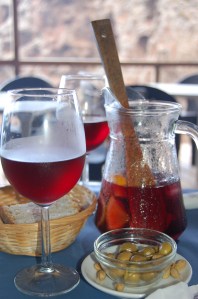
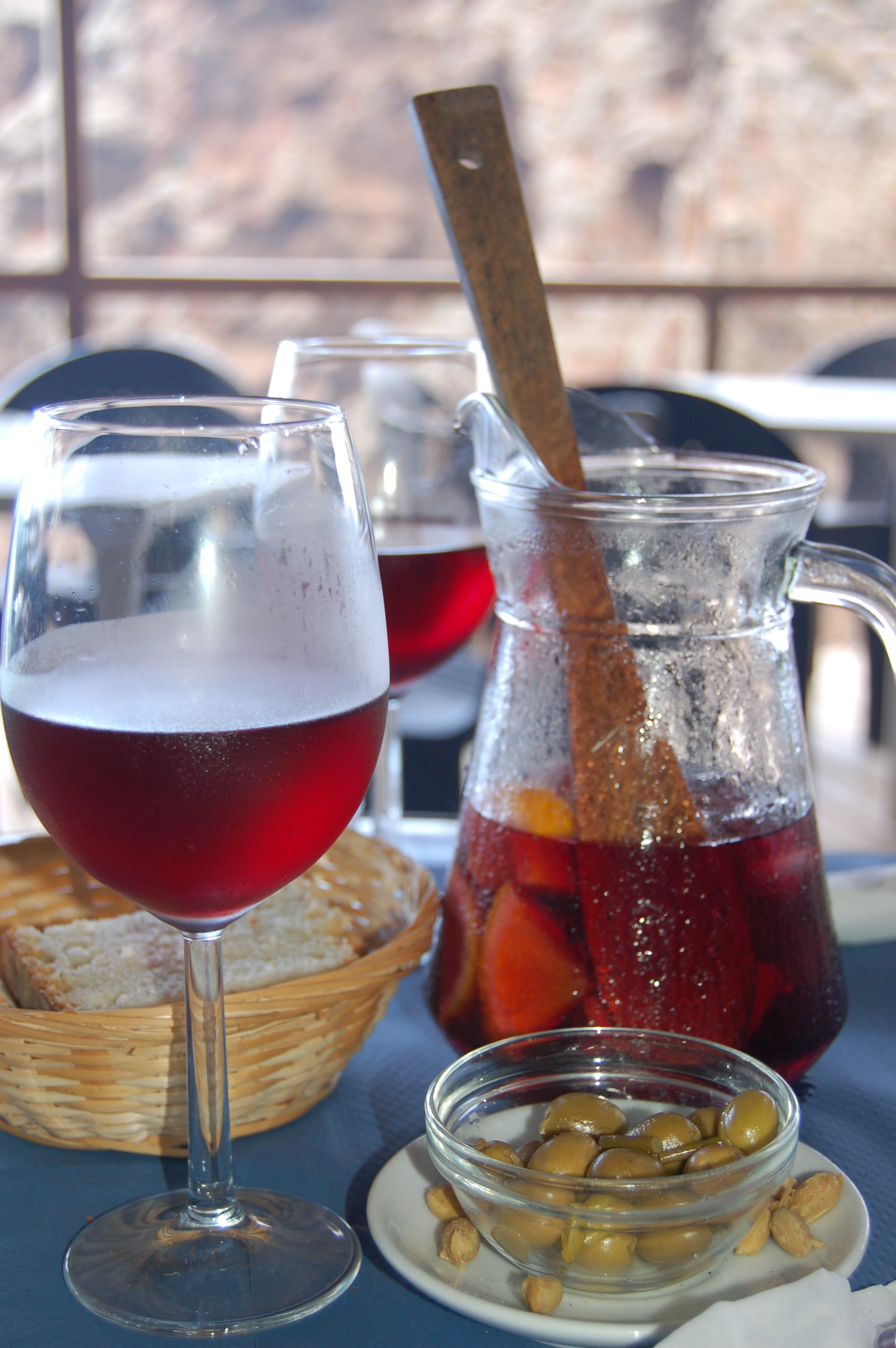
Sangria. What else?
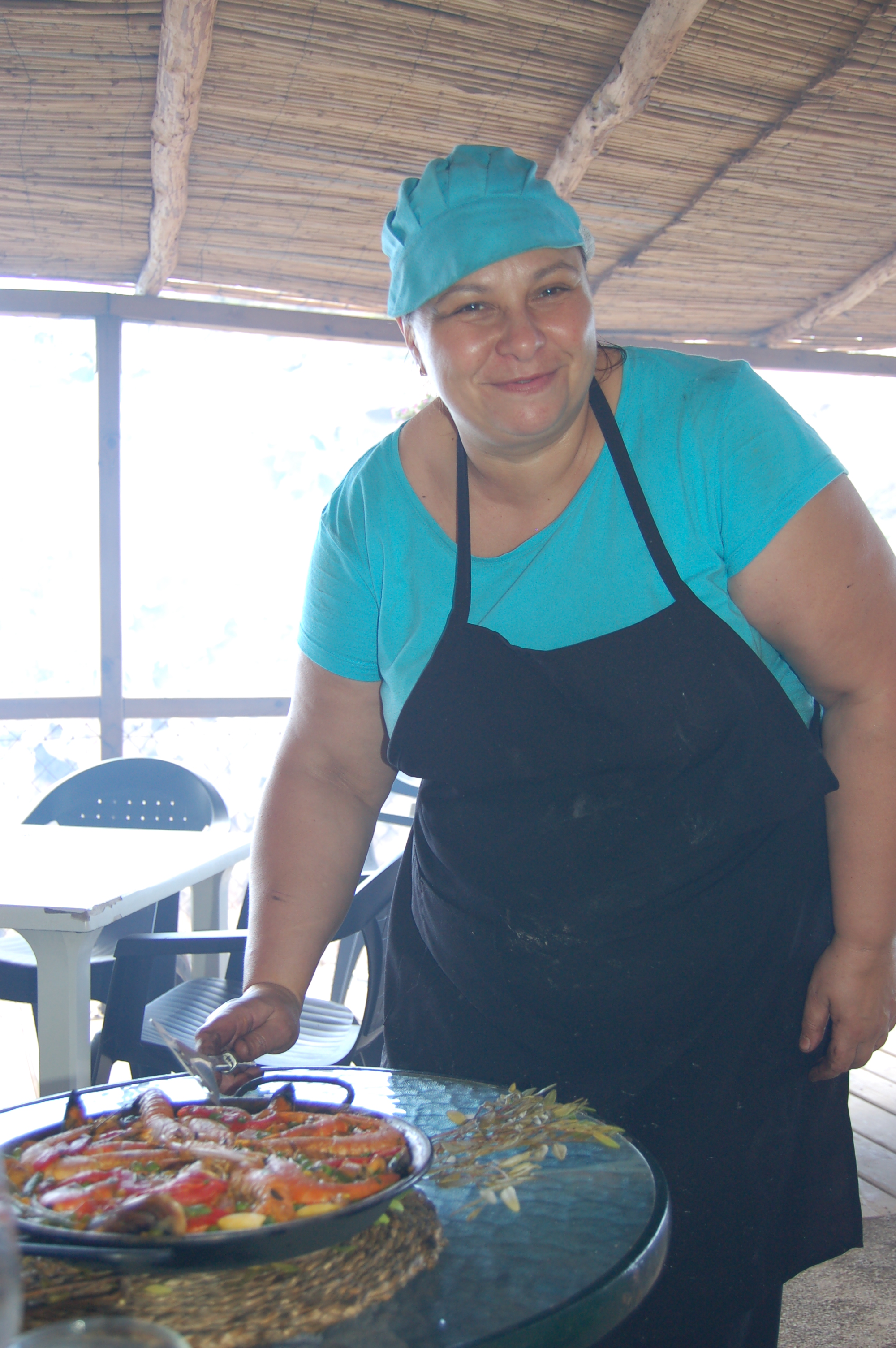
Our lunch was a jug of sangria and their seafood paella. Seated near the cooking area, we watched as Paula cooked – and battled the wood smoke which was blowing into her cooking space, rather than up the ‘flue’ between wall and ceiling. It wasn’t just windy that day: the wind was also blowing in an unusual direction, but the accomplished cook had obviously encountered such conditions before . . .
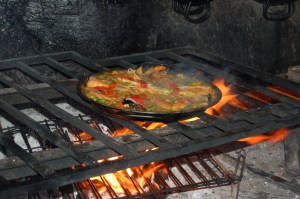
Delicious aromas of seafood paella and wood smoke
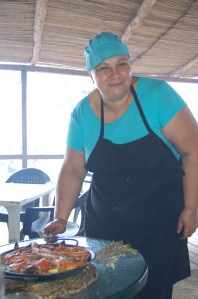
Paula delivers our paella
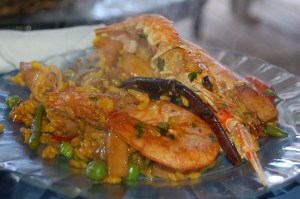
The first helping of seafood paella
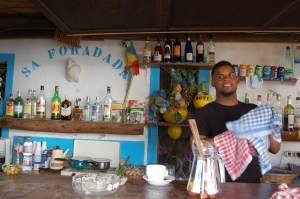
Friendly staff await you
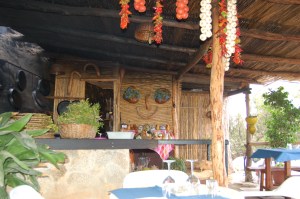
Rustic charm
Gin: a Tonic for Cutlery
As we left – at the end of a memorable and delicious lunch – Lidia was sitting at a table, with a large tray of just-washed cutlery in front of her. We watched as she poured gin over it, then removed each item from the spirit and gave it a polish. We’d never seen that before, but Lidia told us it helps to sterilize the cutlery and give it a shine. Now that’s what I call attention to detail . . .
It took us just over an hour to walk back up to the car park and we spent all that time talking about the experience we’d had. Sa Foradada is open for a few more weeks yet and if time and weather conditions permit, we’ll be going back this year.
NOTE: We did this in walking sandals, which proved adequate for the purpose, given that conditions were dry. The path is well defined but can be a little slippery with loose stones. Take a bottle of water and wear a hat if it’s sunny.
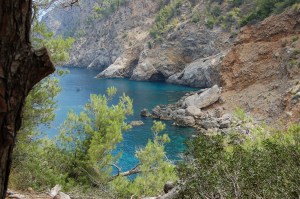
One of the many gorgeous views on this walk
 Sa Foradada: Tel 0034 616 087 499©Jan Edwards 2014
 -
Review of Dinner and Overnight Stay in Banyalbufar

Malvasia grapes in a Banyalbufar vineyard
Its name apparently means ‘vineyard by the sea’ and this couldn’t be more appropriate for the beautiful coastal village of Banyalbufar, on the northwest of Mallorca. Wine was made from grapes grown here from the time the Moors occupied the island, until the dreaded phylloxera plague devastated the island’s wine industry in the late 19th century. Today wine production on Mallorca and in the village of Banyalbufar is thriving. The wine made at the latter’s bodegas is from the malvasia grape – which thrives in the salty air of such a location.
Tomatoes too . . .
The village is best known for its picturesque terraces, sculpted from the sides of the mountain so that the people could grow crops on the challenging terrain. Ramallet tomatoes – used in the Mallorcan staple dish pa amb oli – are widely grown here. They have excellent keeping qualities and, when ripe, are sewn onto string and hung up until needed.
For The Boss’s birthday (yesterday), we went to stay in the village for a night. We came here because, although we had lunched at 1661 Cuina de Banyalbufar a couple of times, we’d never had dinner here. It’s just too far to drive home after dinner, with some good wine – so an overnight stay was called for.
Tradition and Charm in a 3-star Hotel

Home for a night
We stayed at the 3-star Hotel Mar i Vent in the village. The name means sea and wind. It’s a hotel I first heard of two decades ago, when a work colleague told me he visited with his wife every year for a walking holiday (there are some great walks in the area). Yesterday we finally stayed at the hotel, which has been run by three generations of the same family. All rooms have sea views, there’s a decent outdoor swimming pool and terrace with loungers, an old tennis court (which probably wouldn’t impress Rafa Nadal), parking, and heaps of traditional charm. It certainly seems popular with British clients (I found some Marks & Spencer clothes hangers in the wardrobe and heard quite a bit of English spoken), and I can understand why so many people come back year after year. It’s relaxed, friendly, and has a great location. The hotel has a restaurant – with a terrace for alfresco dining – but we were dining out, so I can’t comment on the food.
A gin-lovers paradise
Eating at 1661 Cuina de Banyalbufar (Tel +34 971 618 245) is worth the drive (and an overnight stay if you want to take full advantage of the wines – and any of the 40+ types of gin in the bar!). I don’t often eat steak, but the Argentinian beef I had here was the best I’ve ever had. The Boss had duck and raved about the sauce it came with.
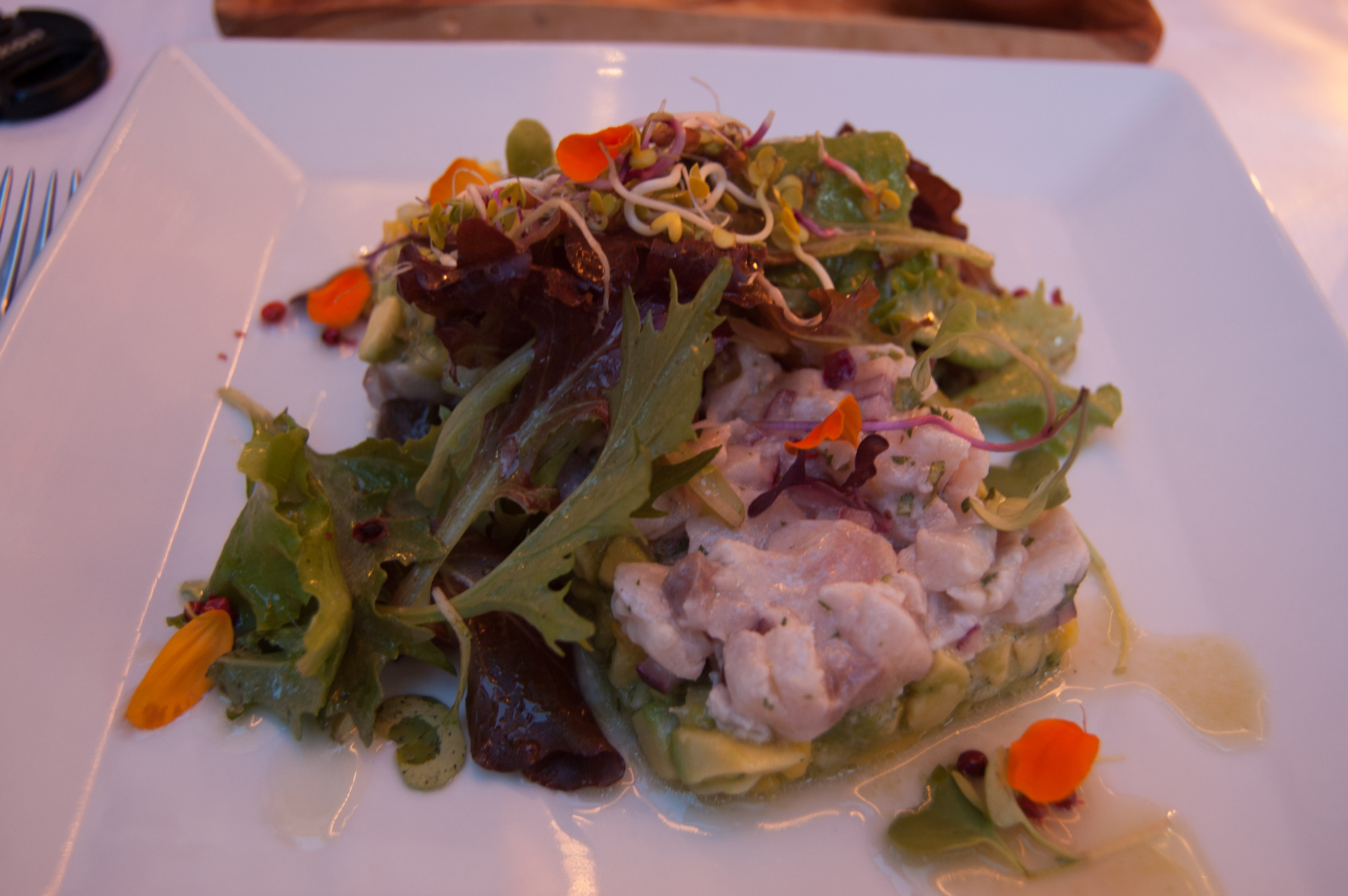
Sea bass ceviche with mango and avocado, at 1661 Cuina de Banyalbufar.
It’s a German-owned restaurant: Julia is front-of-house and her parents cook, using fresh local (and often organic) ingredients. Michael, one of the serving team, made our evening particularly special. He’s one of those restaurant characters you remember for a long time, and was a lot of fun – managing to be funny in English and Spanish (although he’s German).
This morning we walked the winding path down to Cala Banyalbufar, a tiny rocky cove which has only just reopened after a closure resulting from dangerous falling rocks. As you walk down, there are cute little stone properties, with small huertas, or vegetable gardens. You also spot one or two places where properties have fallen away. When you live in this part of Banyalbufar you are living on the edge, in more than one sense of the word.
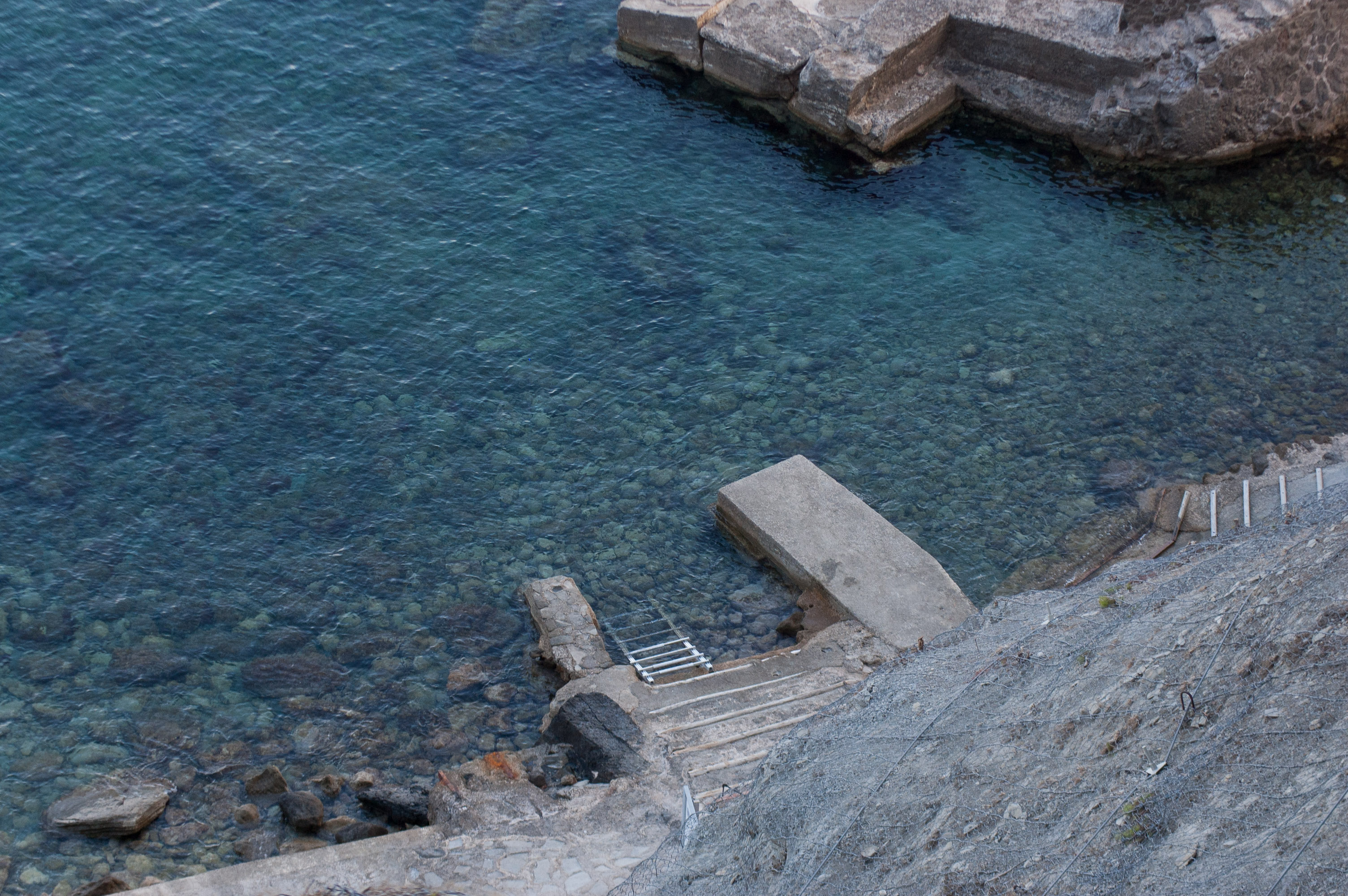
Cala Banyalbufar
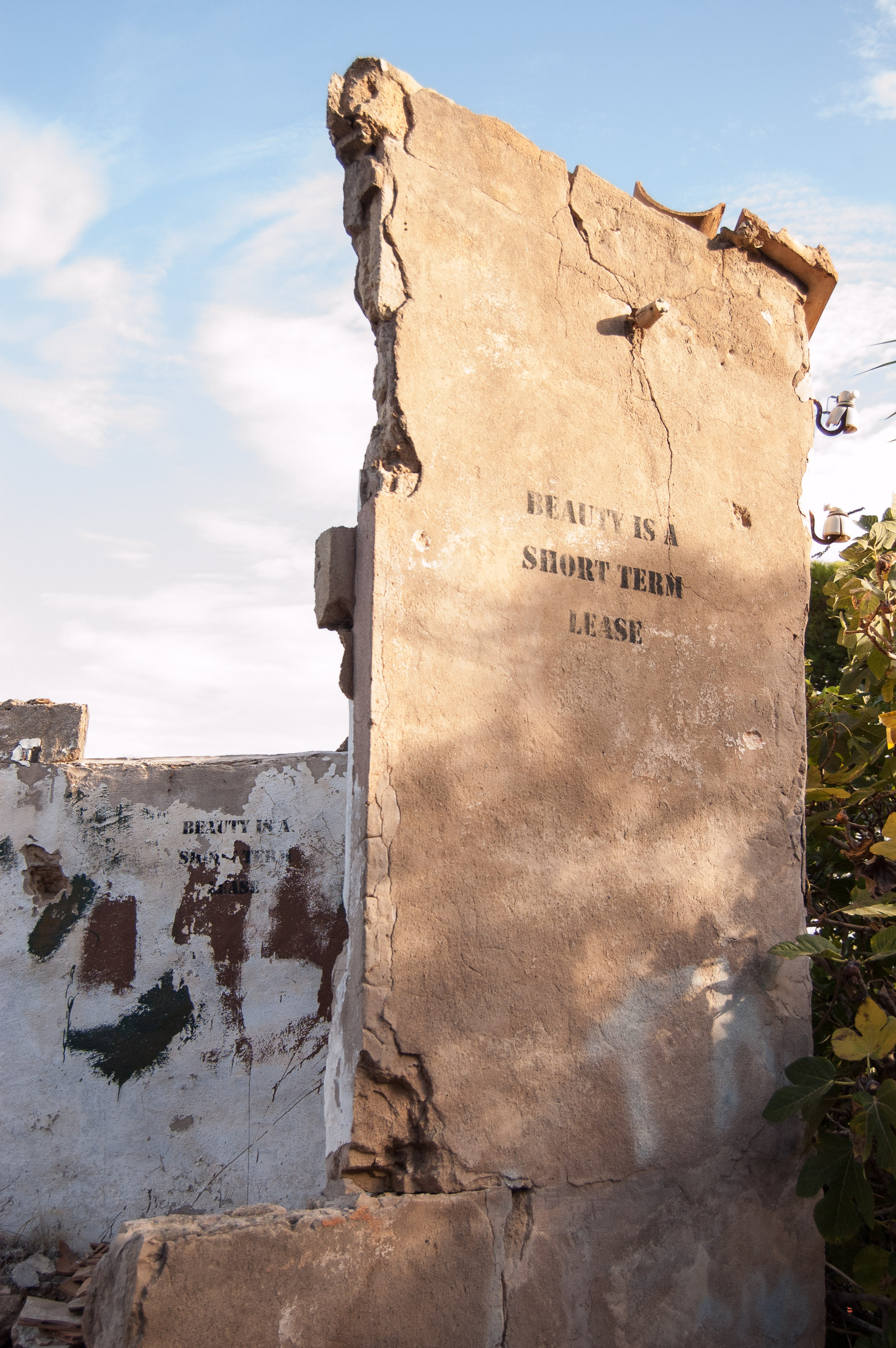
Beauty is a short term lease: words of wisdom on a Banyalbufar ruin.
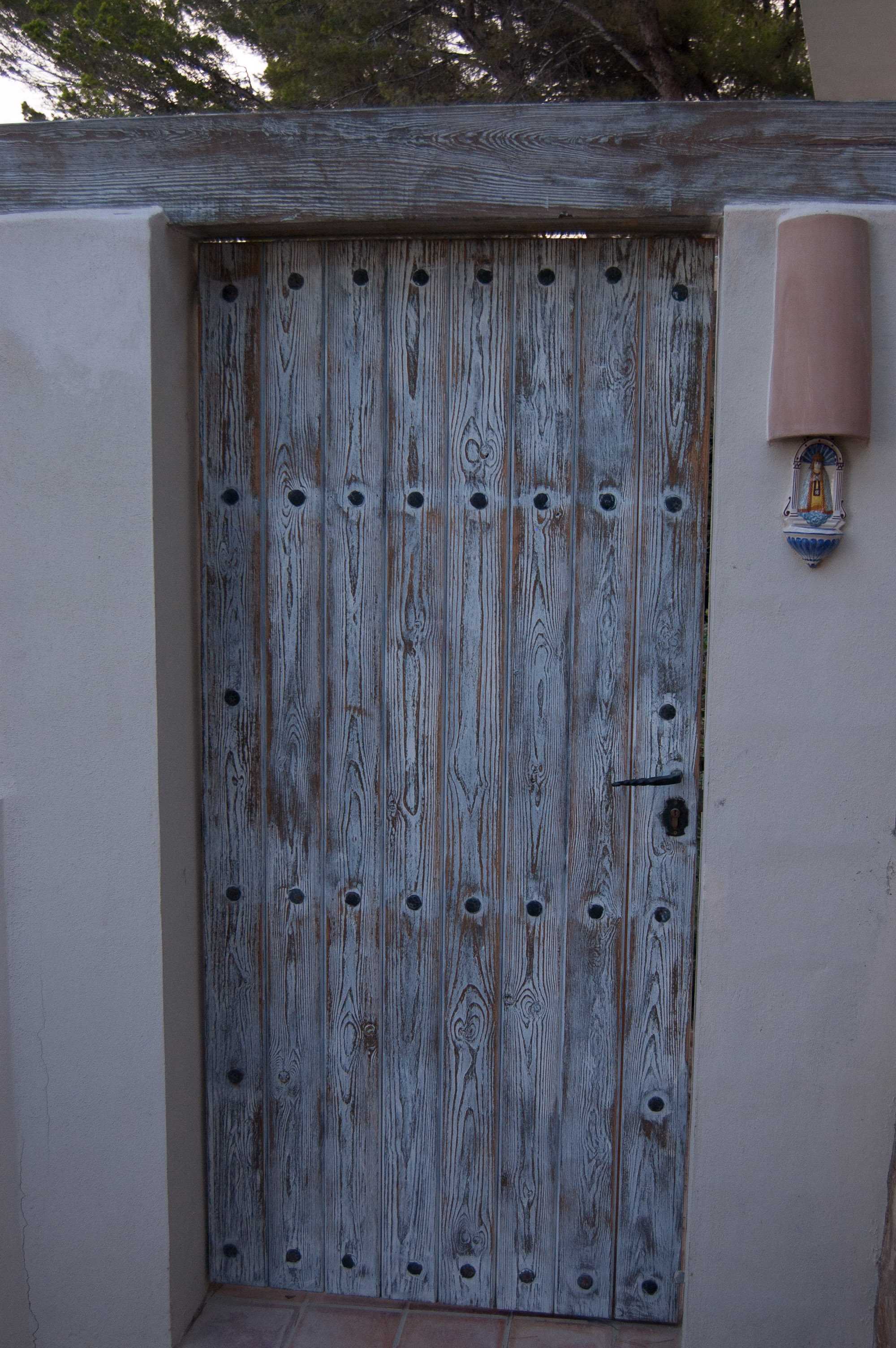
An attractive gate, spotted during our walk.
We’ve already decided that we’ll go back to stay in the village again, because it’s peaceful, and picturesque, and has a very different feel to other places on Mallorca. But it won’t be very peaceful this weekend: the bunting is already flying, as the annual village fiesta starts tomorrow. Let’s hope the guests at the Hotel Mar i Vent will enjoy the party . . .
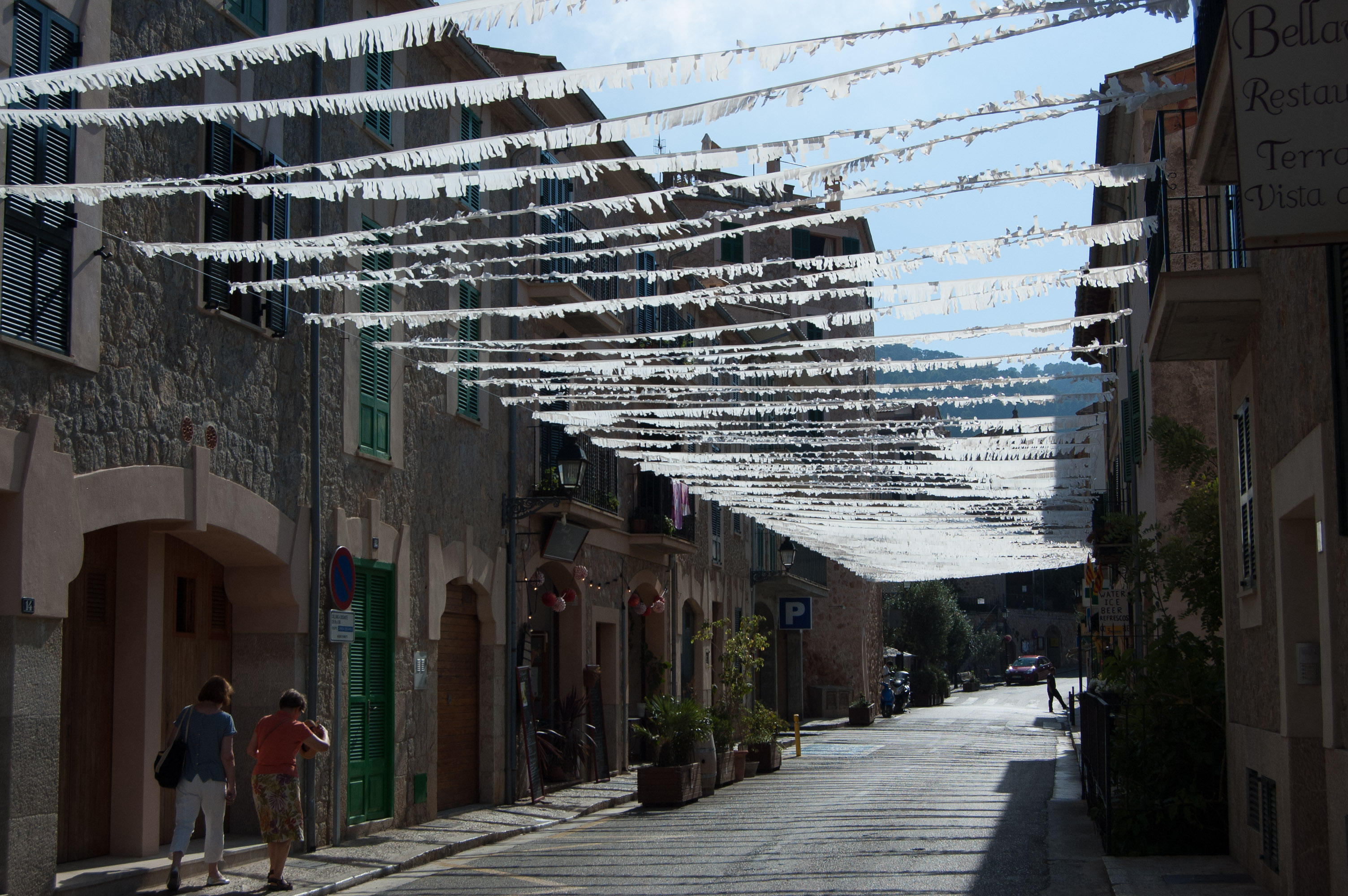
Preparing to party
©Jan Edwards 2014
-
Review of Petit Hotel Son Arnau, Selva
One of the best things about Mallorca is the island’s diversity. Travel from one side to the other and you’ll find completely different scenery. It feels as though you’re visiting another island…but without the travel hassle.
Another great thing about Mallorca is the huge choice of hotels. We usually try and have a handful of nights away across the course of a year, to compensate for the fact that – because rather a lot of cats depend on our ministrations – we don’t go away on holiday.
A Stay in Selva
One of the hotels we tried in 2014 was Petit Hotel Son Arnau in Selva, which opened early that year. It’s run by young British couple Alex and Susan Terry, who left well-paid London careers to run their own boutique hotel in the sun. And, for the quality of the hotel, it is very well priced. Selva is in the foothills of the Tramuntana mountains and ideally located for keen cyclists. The hotel website has a page dedicated to cycling guests.
Two Houses Became One Hotel
Arriving at the hotel, The Boss and I immediately noticed the high quality of the property’s renovation.Two adjoining houses, dating back to the 18th century, have become one building. Original architectural features, such as arches and beams, are abundant, but the hotel décor is contemporary – with comfort. There are just six rooms (including two types of suite), so Son Arnau feels intimate and rather like staying in someone’s beautiful home. Our room for the night was the main suite, where we found the type of amenities you’d expect in a five-star hotel. Perhaps not surprising, given the multilingual Susan’s background . . .
All’s Sweet in the Suite
What’s unusual about the suite is that you enter through the huge bathroom (with his ‘n’ hers sinks, freestanding bath, separate shower and loo – often a traveller’s first port of call on arriving in a hotel room). There’s a rural view from the window and a door onto the suite’s private terrace (which itself has direct access to the infinity swimming pool). The main part of the suite has a huge (and very comfortable) bed, and there’s a sofa if you want to relax with a good book.
Amenities in all rooms include air conditioning/heating, free Wi-Fi, satellite TV and DVD, complimentary in-room hot drink making facilities (with a Nespresso machine as extra in the suite), safe, hairdryer, slippers, robes, and full-length mirror. Oh, and there’s lots of original art around the place.
The hotel has a well-stocked separate library of books in several languages, and there are leaflets galore to help you make the most of the area’s attractions.
Outdoors, the hotel (on the edge of the village) is backed by almond orchards and there’s the pool, with long views across the island (and even a glimpse of the Mediterranean if the weather is better than it was during our stay).
From the Hotel Kitchen . . .
Alex dons his apron to cook dinner for guests four nights a week and we enjoyed a very tasty three-course home-cooked dinner for 25 euros – served by Susan, a charming host (who previously worked in a 5-star London hotel). Nothing seems to be too much trouble for them and they certainly try their best to accommodate their guests’ wishes.
If you’re there when Alex isn’t cooking, I can highly recommend Miceli restaurant in the village, where chef Marga Coll creates her own versions of Mallorcan dishes. They’re different each day and depend on what she has sourced at the market in Inca. Miceli is open for lunch and dinner and any stay in Selva really should include one meal at this lovely townhouse restaurant in the heart of the village (and just a short walk away from the hotel).
A Tasty Start to the Day
Breakfast was served on the terrace, with a view of the village ahead of us. The breakfast menu at Son Arnau offers a good choice and we were both tempted by Alex and Susan’s home-made granola. I had mine with Greek yoghurt; The Boss had his with almond milk – both served with strawberries. Our breakfast juice had been freshly squeezed from a gift of oranges delivered by a neighbour the previous day. Alex and Susan have quickly become accepted in their local community, and that says a lot about them as people.
Having a car is useful here, because there is a lot to explore in the area. But, for a short stay of two or three days, if you just want to relax, you could manage without hiring a car, by catching the train from Palma to Inca (there’s a bus link from the airport into central Palma) and then getting a taxi for the couple of kilometres to Selva. Alex and Susan at Petit Hotel Son Arnau – and the village of Selva – will welcome you warmly.
 Reception desk at Petit Hotel Son Arnau (from the dining room).
 Dining room
 View across pool to suite’s private terrace.
 Plenty to read in the library.
 A view of Selva with breakfast.
 View into the suite’s bedroom/sitting area from the bathroom.
 Alex’s handmade gate onto the suite’s private terrace from the pool area.
 A leisurely soak awaits in the suite’s huge bathroom.
 Alex and Susan Terry offer a warm welcome to Petit Hotel Son Arnau’s guests.
Any prices quoted were correct at time of writing.
©Jan Edwards 2014
-
Rialto Cafe: Style and the City
How do you escape the many visitors that throng to Palma in summer? Some come for a break from the island’s beautiful beaches; some are cruise ship passengers – disgorged from their floating holiday homes to try and ‘discover’ Mallorca’s capital in a few hours. Most want to spend some time relaxing over a drink or something to eat during their visit.
Respite, Relaxation & Rialto Living
Cafés and bars on the main thoroughfares in the heart of Palma are often jammed with visitors, seeking relief from the sun and the pain of footwear inappropriate for pounding pavements. What they rarely find – unless they know where to go – is a brief respite from the bustle of this glorious cosmopolitan city.
Here’s some local knowledge: that elusive respite can be found in Café Rialto in Rialto Living. This Swedish-owned lifestyle store is comfortably close (even in tottery heels) to the Paseo del Borne, home of designer boutiques and handsome architecture. Located in the lane separating the two Massimo Dutti stores, Rialto Living opened in 2007, but has doubled in size, after expansion within the sympathetically renovated palacio known as Can O’Ryan. This splendid building was the 18th-century home of Irish military doctor John O’Ryan who – fleeing the persecution of Catholics in Ireland – came to Mallorca and married Francisca Flor i d’Alemany, daughter of a wealthy local businessman.
Eat, Drink . . . Browse
The expansion enabled the store to relocate and enlarge its café, which now serves home-made food all day until 8pm. Come for a coffee or cool drink and you can also enjoy anything from a cookie or cake to a more substantial savoury dish. My personal recommendation is their breakfast: carefully made coffee (with a chocolate), freshly squeezed orange juice and a small filled bread roll (good home-made bread).
If you come to Café Rialto, take some time to explore the store – in particular, the art gallery on the upper floor. There are new exhibitions every five weeks or so.
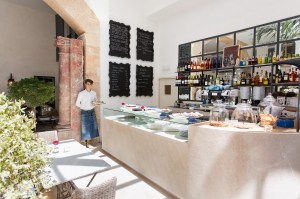
A view of the Rialto Café. Photo courtesy of Rialto Living 
The stylish Rialto Café. Photo courtesy of Rialto Living 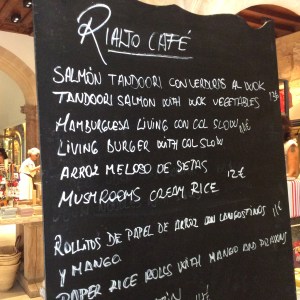
A blackboard lists the day’s special dishes. (My own photo). ©Jan Edwards 2014
-
Mallorca’s Mesquida Mora Winery
Healthy vines lead to healthier wines. That’s not just rhetoric for the Mallorcan winemaker Bàrbara Mesquida Mora – whose wines are the result of vineyards made healthy through biodynamic cultivation. Celler Mesquida Mora is a relatively new winery (started in 2012), but Bàrbara brought a barrelful of experience to her own project – having run her family’s winery with her brother Jaume for some years. It was during that time that the siblings discovered the benefits of biodynamic cultivation.
Bodega Party
Although fairly new compared to other wineries on Mallorca (Can Ribas, for example, dates back to 1711), Mesquida Mora’s wines are already widely appreciated and have been critically acclaimed. There was much to celebrate then when Bàrbara threw last night’s party to thank supporters, clients and friends. The Boss and I were delighted to have been invited, having known and been impressed by Bàrbara for several years. And having drunk quite a lot of bottles of her wines!
The Magical Seven
The winery is just outside the small town of Porreres – a town also known for the apricots produced in the area – and currently produces seven wines:
- Sincronia – red, rosé and white. These are all designated Vi de la Terra Mallorca.
- Acrollam (you may have spotted that this is Mallorca written in reverse) – white and rosé (Vi de la Terra Mallorca)
- Trispol – red – from Cabernet, Shiraz and Callet (DO Pla I Llevant, Mallorca)
- Sòtil – red – from Callet and Mantonegro (Vi de la Terra Mallorca)
Bàrbara chose the wine names and the designs of the bottle labels with great care; the relevance of each reveals how much thought went into every stage of her own project. I found her description of the label for Mesquida Mora Acrollam Blanc particularly applicable to this talented and dedicated young Mallorcan winemaker:
“The woman who wants to recover her identity, the femininity prepared to plunge into the sea, prepared to live new adventures and to lead change without relinquishing her personal way of being . . . The mandala formed by concentric blue and gold figures suggests perfection, the constant search for it, and the urge to surpass oneself. The perimeter of the circle evokes the return to the cycles of nature, like the vine itself.”
Island-wide Support
Bàrbara doesn’t just know how to make great wines: she also throws a good party. Wine flowed, tasty snacks were set out on wooden stalls on the large terrace outside the winery building, and a band played great music. Guests came from all over Mallorca – including the Mallorca-based British author Anna Nicholas and her husband Alan (who live in Sóller), the director of the Aimia Hotel in Puerto Sóller, and one of my favourite chefs (I do have a few), Santi Taura, who came from Lloseta with his wife.
Bàrbara made a speech during the course of the evening and, although she spoke in mallorquin (only some of which I understood), her enthusiasm for her project and her gratitude for all the support she’s had were obvious in the delivery of words clearly spoken from her heart.
No visit to Mallorca is complete without tasting the essence of this beautiful Mediterranean island: a wine from Mesquida Mora.
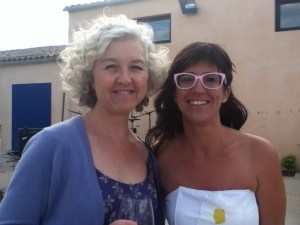
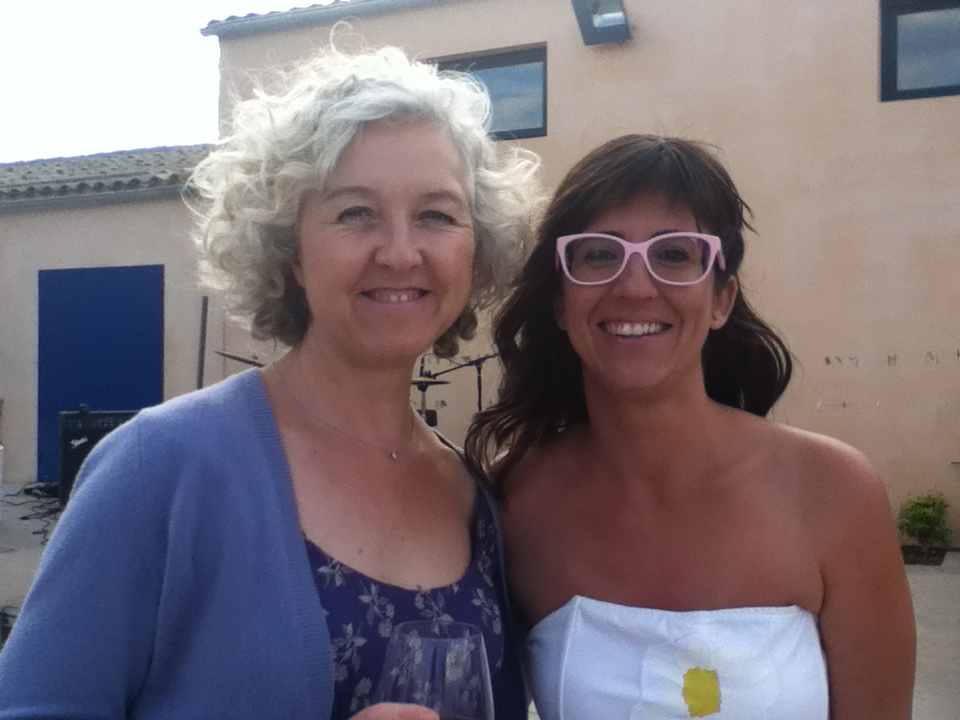
Author Anna Nicholas and Barbara Mesquida Mora
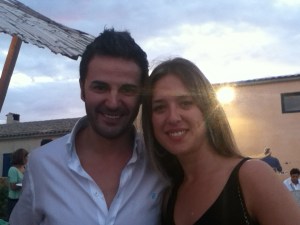
Chef Santi Taura and his wife
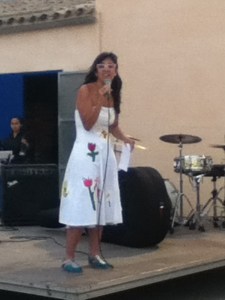
A well-received speech
©Jan Edwards 2014
-
Potatoes from Sa Pobla – a Mallorcan Export
Relatively few tourists visit Sa Pobla, a small agricultural town in the north of Mallorca – but many (particularly British visitors) will have eaten one of the crops grown in the flat fertile fields surrounding the town: potatoes. A large percentage of the new potatoes harvested from this area ends up on dinner plates outside Mallorca; they’re a valuable export crop. I was once told by a Manacor market stallholder that local housewives don’t like the additional work of cleaning small potatoes, preferring to use larger ones, so it’s not that easy to find Sa Pobla’s tasty new potatoes for sale.
The Potato Fair
Sa Pobla isn’t a town we’d go to simply for a day out, but we do visit a couple of times a year to see our gestor – who deals with all the boring (for me!) bits of producing our Spanish tax returns. After our visit on Friday, we went into the main plaza for a coffee, as usual. And it was a hive of activity: preparations were in full swing for the annual Fira Nocturna de la Patata – an evening event (over two nights) that’s a gastronomic celebration of the versatility of the potato. Barrels of beer were being unloaded and set up at a temporary bar in the middle of the plaza and participating restaurants and cafes were setting up their stalls.
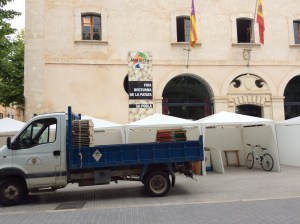
Sa Pobla prepares its potato party
Potatoes, drinks, and music
On Friday and Saturday evenings, more than 30 establishments offered taster plates of their own dishes, with prices ranging from one to three euros each. Each dish – including the sweet ones – featured potatoes. There was wine from a couple of local bodegas and artisan beer produced on Mallorca. Live music and children’s entertainment were also part of the event – as they are at most firas on the island.
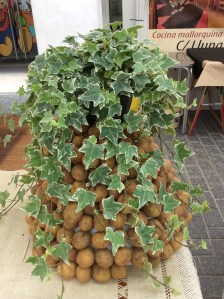
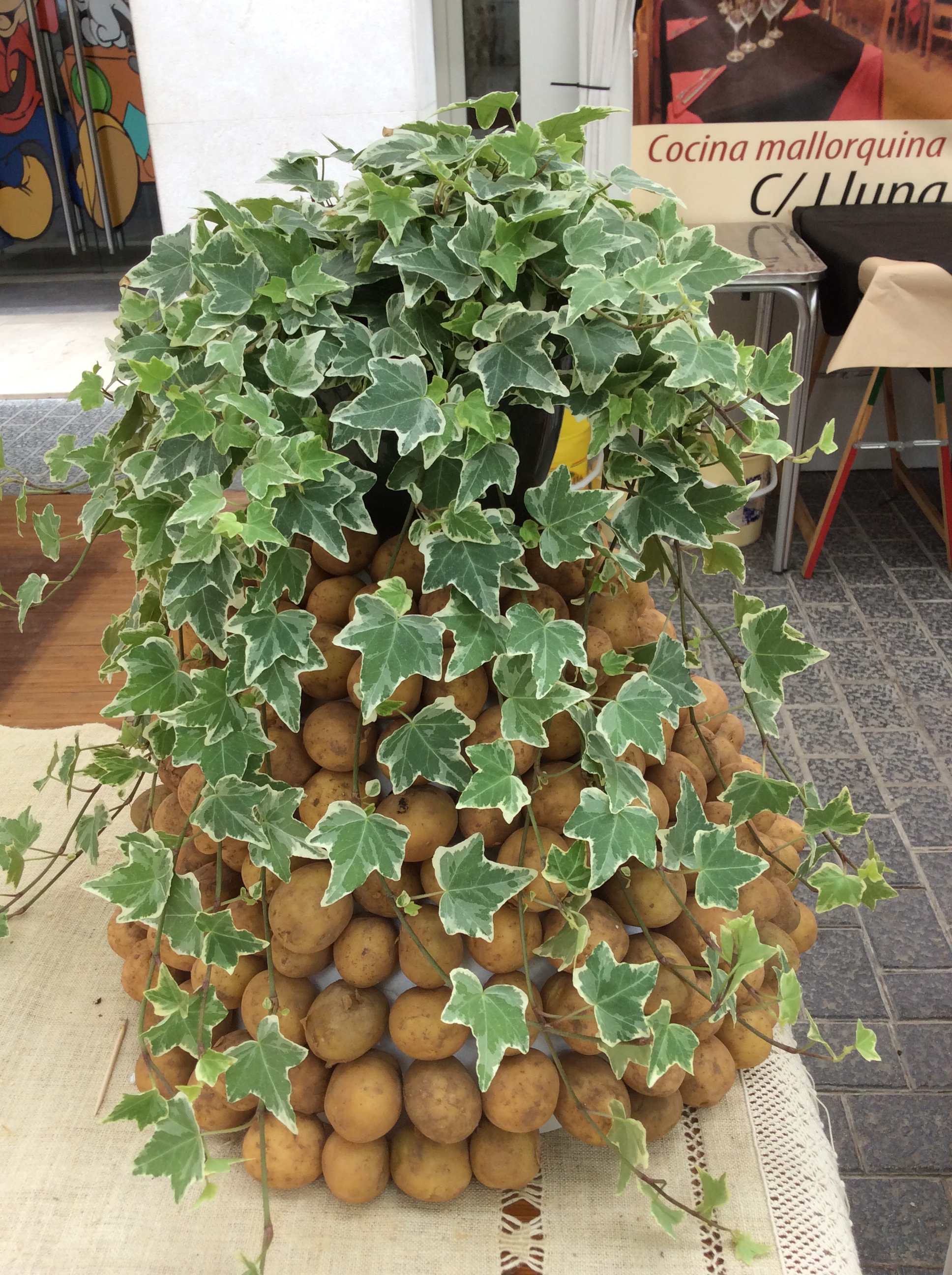
Potatoes even formed part of the décor of the stalls. If you like potatoes, and find yourself on Mallorca in early June next year, check out the Fira Nocturna de la Patata. And next time you buy new potatoes at your local supermarket, you may find they’ve come from Sa Pobla – a town that benefits more from exports than visitors.
©Jan Edwards 2014
-
Mallorcan Olive Oil Named One of the World’s Best
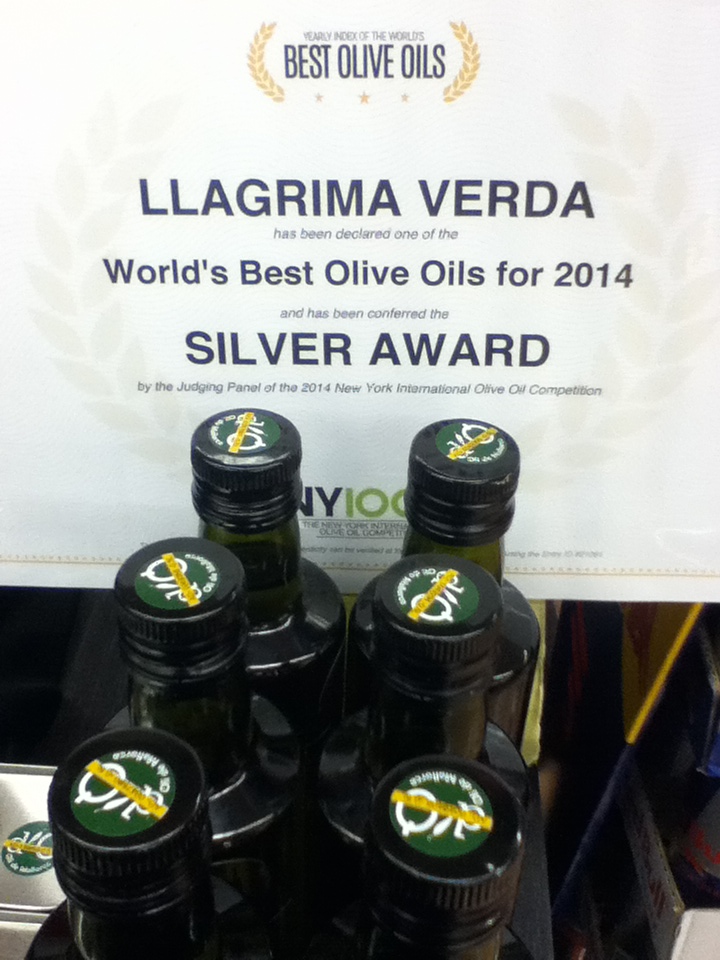
An extra virgin olive oil produced in the Manacor area has been named one of the best in the world. Llàgrima Verda (which means ‘green tear’) won a Silver Award in the New York International Olive Oil Competition 2014 – repeating the success they enjoyed in last year’s competition.
Spain leads the world in quality virgin olive oils
The annual competition brings together a panel of international experts who taste nearly 700 extra virgin olive oils from around the world, to determine the very best. This year Spain won more prizes than any other country in the world.
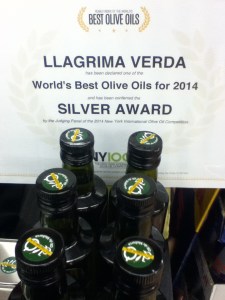
Mallorca on the world’s olive oil stage
Llàgrima Verda is produced by Els Olis Ínsula, from olives grown on some 2,000 olive trees on the Finca de Son Pere Andreu, on the outskirts of Manacor. The Aguiló Veny family decided to dedicate themselves to olive oil production and, as well as the prize-winning Llàgrima Verda, they produce two under the Ínsula name. One of these is made entirely from Koroneiki olives (a Greek variety they successfully planted on Mallorca) and the other a blend of Koroneiki and Arbequina.
The perfect combination
Llàgrima Verda certainly gets my seal of approval (not that I have the influential powers of the prestigious New York International Olive Oil Competition). Delicious with Flor de Sal from Mallorca and some good crusty bread. Who needs anything more?
If you visit the Balearics, be sure to try some Llàgrima Verda. It’s on sale in Hiper Centro supermarkets across the islands.
©Jan Edwards 2014
-
‘Food and Foot’ – Photo Exhibition Organised by Chefs(in)
‘Food and Foot’ is an interesting name for a photographic exhibition, but then it’s a very interesting and original concept, involving eight of Mallorca’s top chefs – members of Chefs(in), eight Mallorcan shoe manufacturers, and Nando Esteva, the award-winning photographer from Palma de Mallorca.
I love food – but I also have a weakness for shoes. The great thing about footwear is that your feet rarely change size once you’re an adult – even if the rest of you gains a little weight from over-indulgence in food – so growing out of favourite shoes isn’t likely to happen. The combination of food and shoes was one I couldn’t resist.
Food + Shoes = Art
Chefs(in) is, as the name suggests, a chef’s organization that brings together top chefs from Mallorca, Menorca and Ibiza. They organize some great foodie events, such as the Peccata Minuta tapas fairs held on Mallorca. This exhibition is their latest initiative and I was amazed to learn from Chefs(in) founder Miguel Angel Payeras that the whole project – from conception to inauguration – took only around a month.
Chefs(in) worked with AFACA – the Mallorcan shoemakers’ association – and the local Inca council to put on the exhibition, which can be seen in the Museu del Calçat i la Pell de Inca until May 25th. From then on, each piece of photographic art will spend a couple of months in the restaurant of its creator. Eventually, all will be used at travel trade fairs to promote Mallorca’s gastronomy.
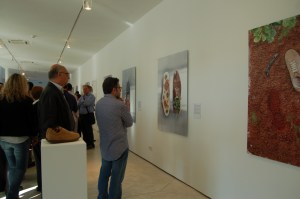
Perusing the exhibits The Concept
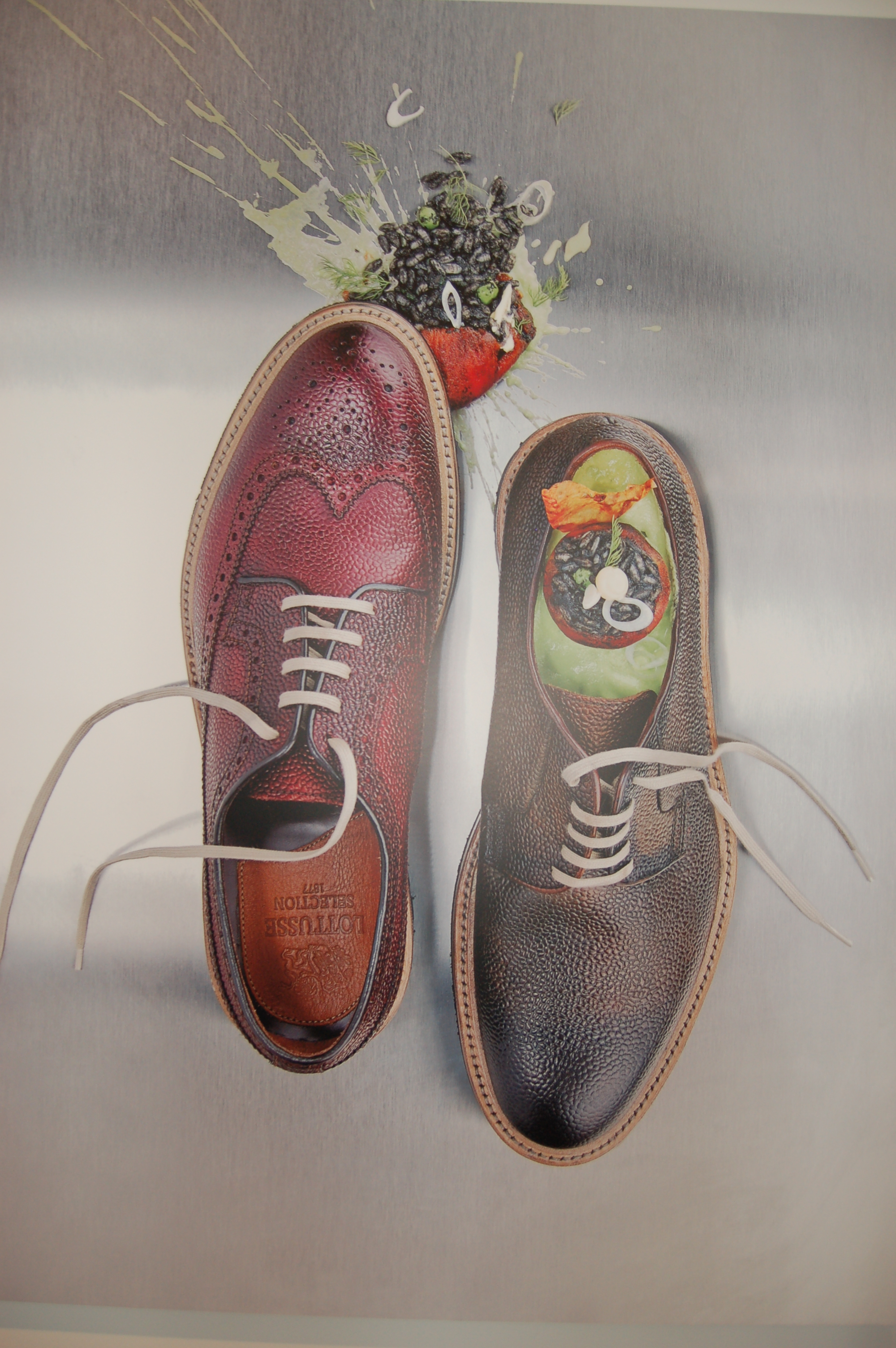
The idea was that each chef would interpret a particular shoe from a culinary point of view, taking their inspiration from the textures, leathers, colours, the philosophy of the manufacturer or a visit to the factory. Under the direction of Chefs(in), Nando Esteva photographed the results, capturing the link between Mallorca’s best gastronomy and the island’s footwear industry.
The participating chefs – and the shoes they interpreted – are as follows:
- Tomeu Caldentey – Camper
- Marta Rosselló – Apache moccasins
- Andreu Genestra – Carmina Shoemaker
- Santi Taura – Lottusse
- Joan Marc – George’s
- Tomeu Torrens – Coclico
- Koldo Royo – Bestard Mountain Boots
- María Salinas – Calzados Miquel
The exhibition inauguration was a great success, with a high attendance, the chance to talk to the participating chefs – and, importantly, to taste some of their delicious creations. Congratulations to Chefs(in) and all involved. I look forward to future events!
Meanwhile, if you’re on Mallorca before May 25th, a visit to the exhibition in Inca is recommended. You’ll be amazed at the amount of equipment involved in making shoes . . .
Read more about the chefs involved on http://www.chefsin.es
More pictures from the inauguration:

Joan Marc (whose eponymous restaurant is in Inca), with his creation. 
Santi Taura’s creation. 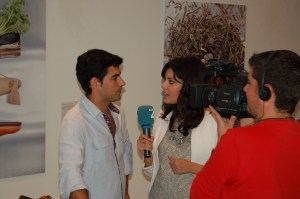
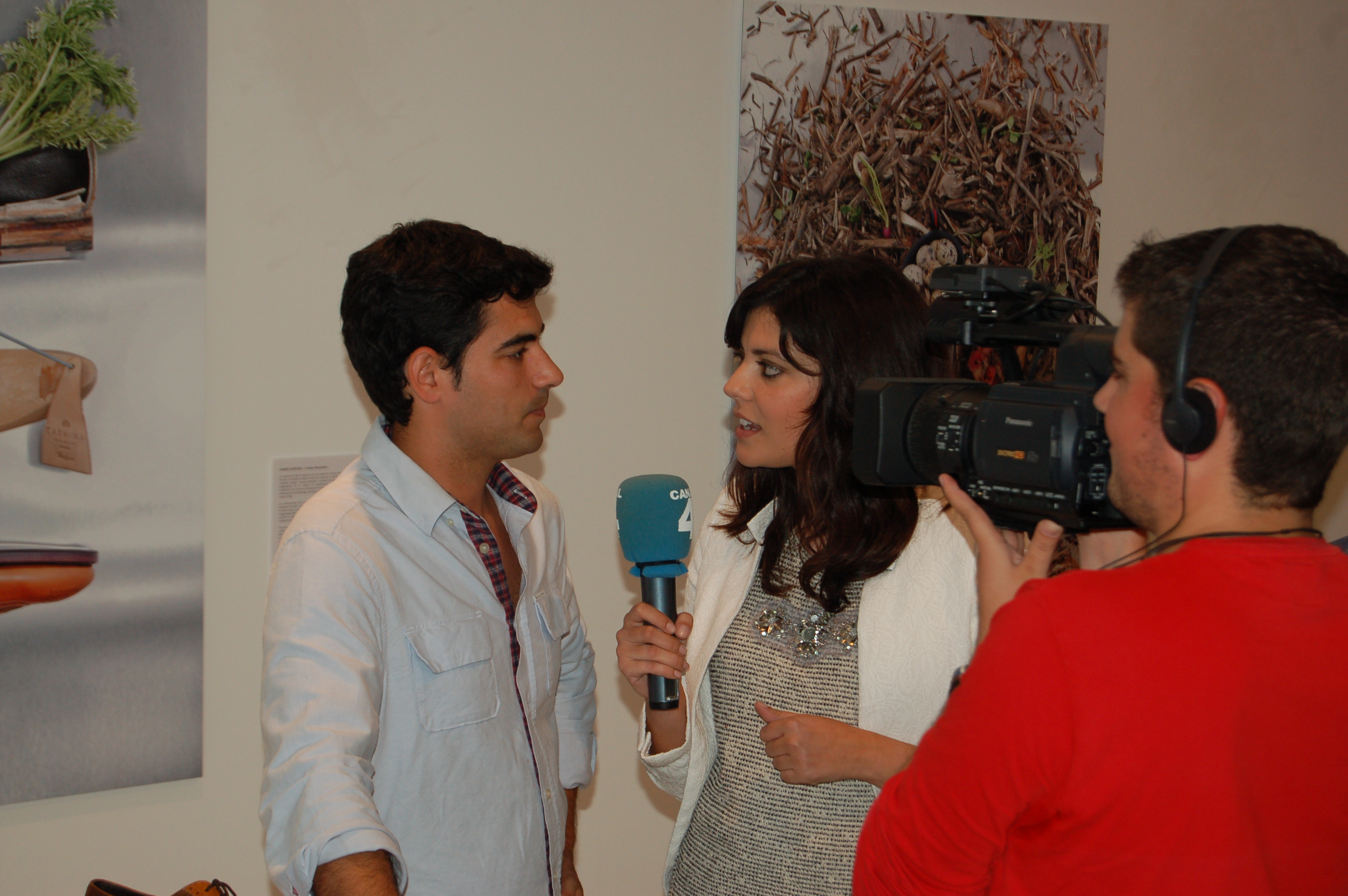
Andreu Genestra being interviewed for TV. His restaurant is on the outskirts of Capdepera ©Jan Edwards 2014
AFACA, Andreu Genestra, Apache moccasins, Bestard, boots, Calzados Miquel, Camper, Carmina Shoemaker, Chefs(in), Coclico, footwear, George’s, Inca, Joan Marc, Koldo Royo, Lottusse, Maria Salinas, Marta Rossello, Miguel Angel Payeras, Museu del Calcat i de la Pell de Inca, Nando Esteva, Peccata Minuta, photographic art, photographs, Santi Taura, shoes, Tomeu Caldentey, Tomeu Torrens


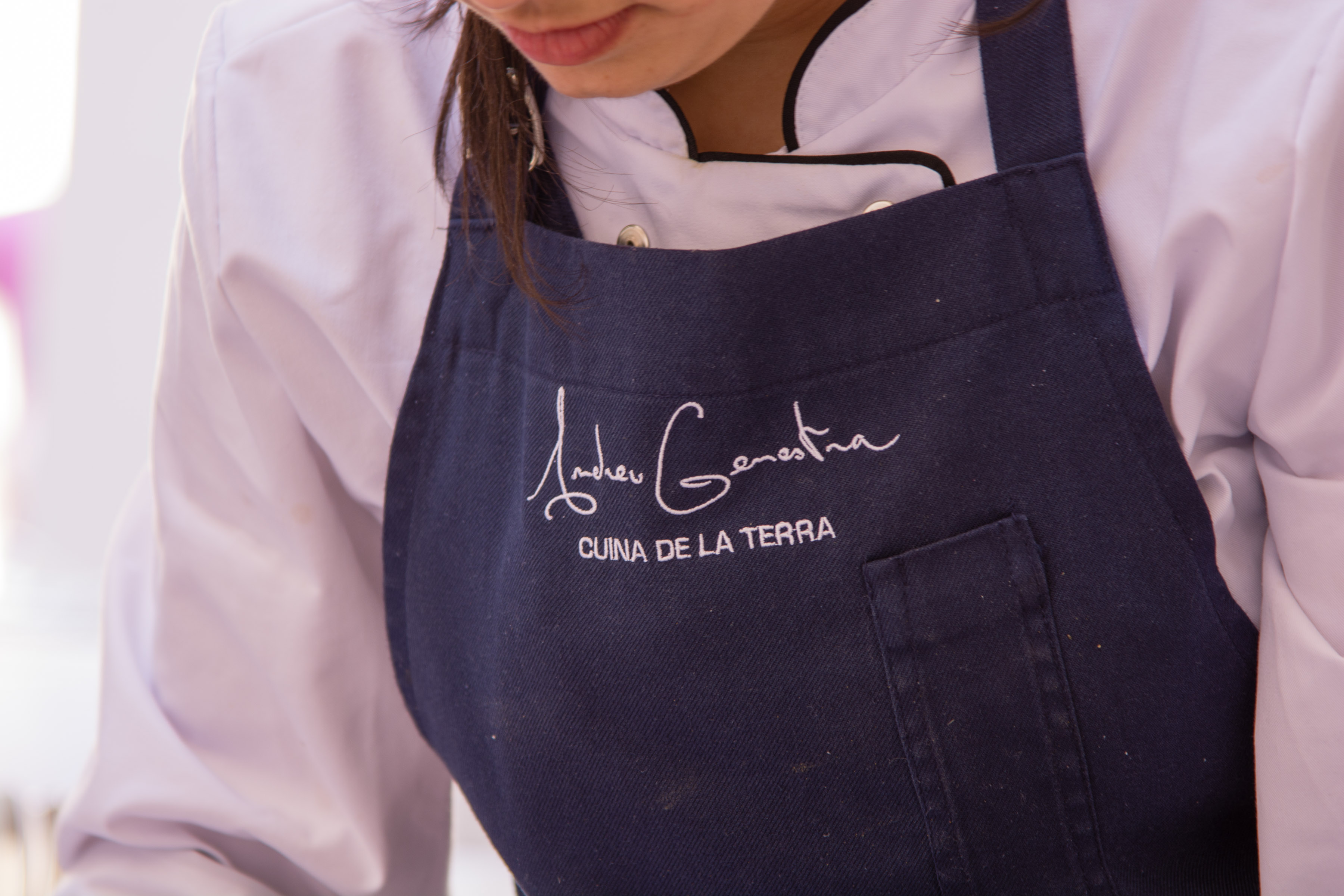








 Eat Drink Sleep Mallorca